Subjects
Grades
 100%
100%
 100%
100% 100%
100% 100%
100%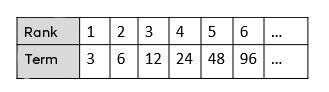
A pattern rule is a mathematical relationship used to find the value of each term in a sequence.
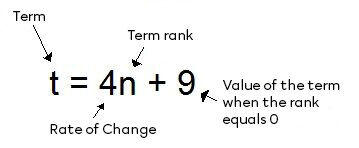
To describe certain sequences, a pattern rule can be established. This is an algebraic equation that enables you to quickly find the value of a term in a sequence using its rank.
The pattern rule of an arithmetic sequence can be written as follows.
|\text{Term = pattern} \times \text{term rank + term when rank is 0}|
In the formula, we can change the word pattern to rate of change.
|\text{Term = rate of change} \times \text{term rank + term when rank is 0}|
You can also write the formula using an abbreviated form.

Use the following procedure to find the pattern rule of an arithmetic sequence.
Determine the rate of change by calculating the difference between two consecutive terms.
Determine the value of the term when the rank is equal to |0| (rank 0).
Write the pattern rule.
Consider the following table of values.
Determine the rate of change
The distance between two consecutive terms represents the pattern of the rule.
|7 - 5 = 2|
|9 - 7 = 2|
|11 - 9 = 2|
Therefore, the rate of change is +2. Thus, write: |t = 2\times n + \text{rank} \,0.|
Determine the value of rank 0
Method 1:
Find the number to add or subtract by replacing the term and the rank by a point (number pair) in the table of values.
Take the point |(3, 9).| Replace |t| by |9| and |n| by |3.|
|9= 2\times 3 + \text{rank }\,0|
|9= 6 + \text{rank }\,0|
Replace the rank 0 with |3| to respect the equality.
|9=6+3|
Method 2:
The value of the term located at rank 0 can be determined. To do so, subtract the rate of change from the term located at rank 1.
|5 - (+2) = 3|
Therefore, rank 0 is |3.|
Write the rule
Therefore, the rule is |t=2n+3.|
Consider the following table of values.
Determine the rate of change
The distance between two consecutive terms represents the pattern of the rule.
|-14 - (-12) = -2|
|-16 - (-14) = -2|
|-18 - (-16) = -2|
Therefore, the rate of change is |-2.| Then, write: |t = -2\times n + \text{rank }\,0.|
Determine the value of rank 0
Find the number to add or subtract by replacing the term and the rank by a point (number pair) in the table of values.
Take the point |(1, -12).| Replace |t| by |-12| and |n| by |1.|
|-12= -2\times 1 + \text{rank }\,0|
|-12= -2 + \text{rank }\,0|
Replace the rank 0 with |-10| to respect the equality.
|-12=-2+ -10|
Write the rule
Therefore, the rule is |t=-2n-10.|
The pattern rule of a geometric sequence can be written in the following form.
|\text{Term} = 1^{st}\,\text{term}\times \text{rate of change}^{(\text{term rank} - 1)}|
The rule can be simplified by using variables.
|t = 1^{st}\,\text{term}\times \text{rate of change}^{(n - 1)}|
Follow these steps to find the pattern rule of a geometric sequence.
Determine the rate of change between two consecutive terms.
Determine the first term of the sequence.
Write the pattern rule.
Consider the table of values below.
Determine the rate of change
To go from one term to the next, we multiply by a factor of |2.| Therefore, the rate of change is |2.|
Determine the first term
The first term in the sequence is |3.|
Write the rule
Therefore, the rule is |t = 3\times 2^{(n - 1)}.|
To find the term that occupies the |12^{\text{th}}| rank using the following rule: |t = 4n + 7,| we replace |n| by its value |(12).| ||\begin{align} t &= 4(12) + 7 \\ t &= 48 + 7 \\ t &= 55 \end{align}|| The |12^{\text{th}}| term in the sequence is |55.|
To find the rank of the term |167| using the following rule: |t = 4n + 7,| we replace |t| by its value |(167).| ||\begin{align} 167 &= 4n + 7 \\ 167 \color{#ec0000}{- 7} &= 4n + 7 \color{#ec0000}{- 7} \\ 160 &= 4n \\ \color{#ec0000}{\dfrac{\color{black}{160}}{4}} &= \color{#ec0000}{\dfrac{\color{black}{4n}}{4}} \\ 40 &= n \end{align}|| Term |167| is located at the |40^{\text{th}}| rank.