Subjects
Grades
Adding vectors using the graphical method makes it possible to find the vector resulting from the combination of two or more vectors.
To add two vectors correctly, it is important to consider their magnitude and direction. If we move a vector accurately without modifying its magnitude or direction, it has the property of remaining unchanged. This is the property that is used in the addition of vectors using the graphical method.
Depending on the textbooks and the teaching method, the technique may be called the triangle method (when there are only two vectors) or the polygon method (when there are three or more vectors). The term graphical method used in this concept sheet includes both methods.
Adding vectors is always done by following a simple procedure:
Adding two vectors
What is the sum of the vectors shown below?
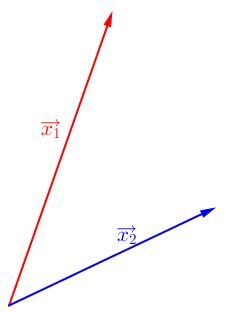
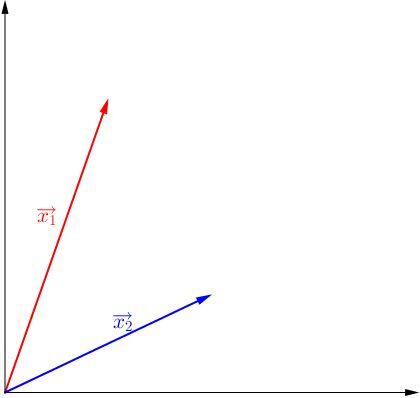
First, it is necessary to create a frame of reference.
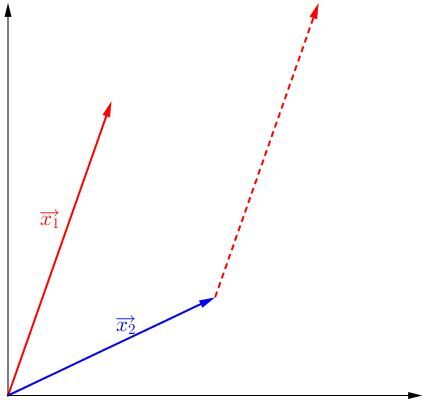
Next, move the two vectors one after the other. Since the addition is commutative, we can move the red vector to the end of the blue vector, or the blue vector to the end of the red vector, and the result will be the same.
Then, plot the resultant vector starting from the frame of reference’s origin until the end of the last vector.
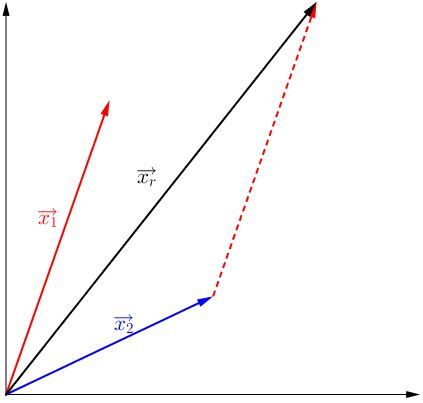
To determine the magnitude of the resultant vector, the vector must be measured with a ruler.
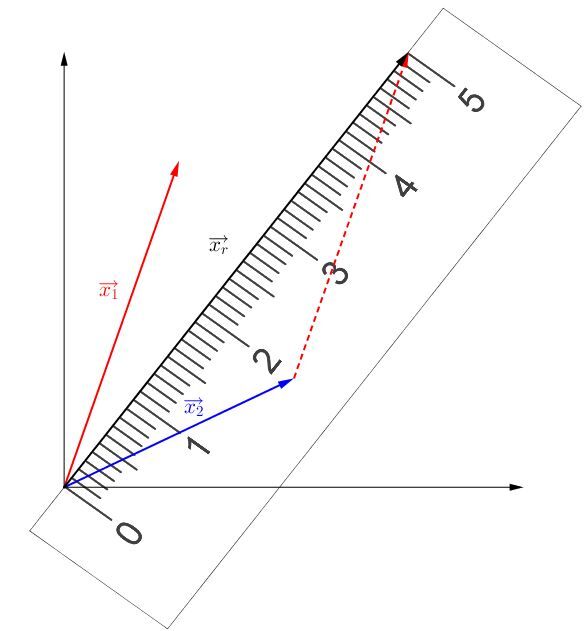
To know its direction, it is necessary to use a protractor.
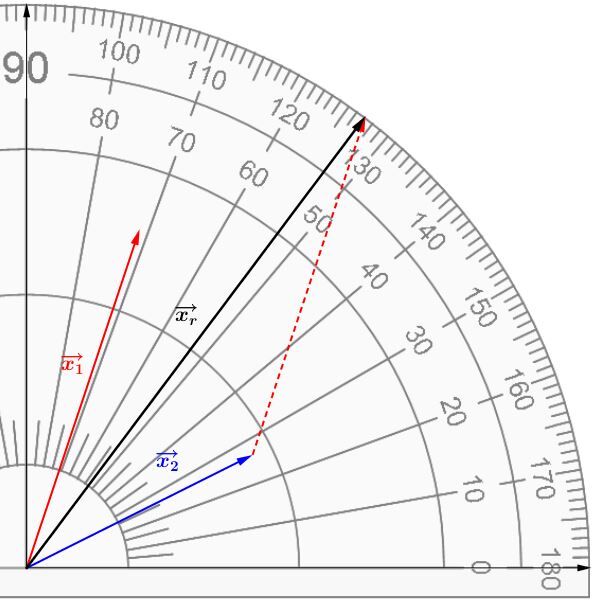
The vector resulting from the addition of the two vectors has a magnitude of |\text {5 u}| and a direction of |53^{\circ}|.
Adding three or more vectors
If several vectors are to be added together, the same technique is used to find the resultant vector.
