Subjects
Grades
 100%
100%
 100%
100%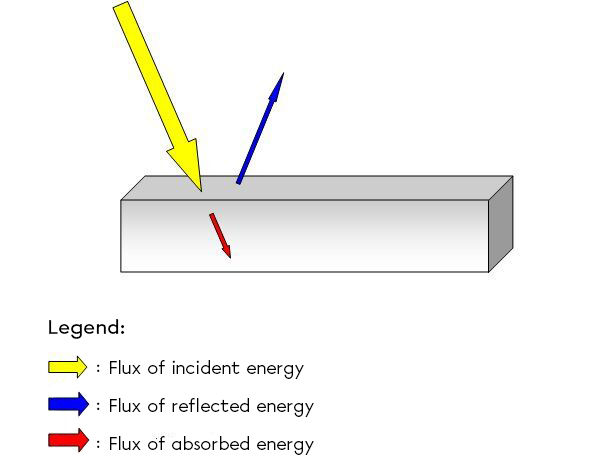 100%
100%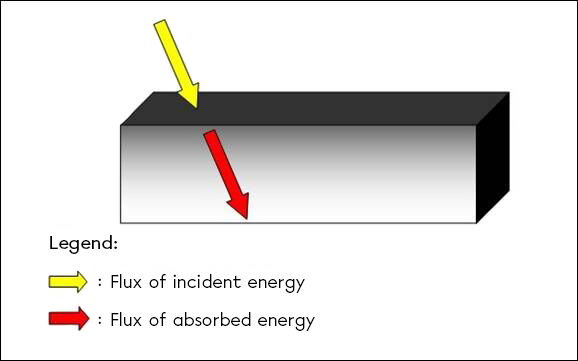 100%
100%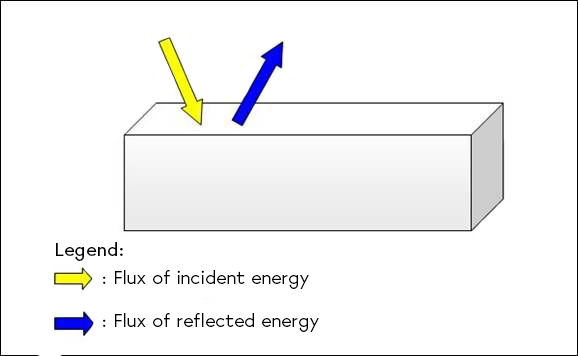 100%
100%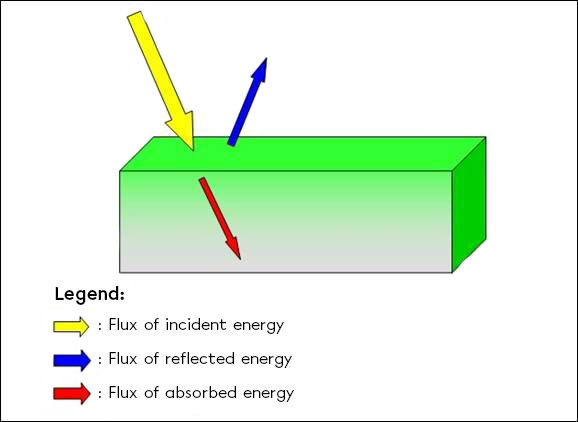
A blackbody is an ideal object that does not reflect any light coming from the outside. Rather, it absorbs all the light it receives.
On a beautiful sunny summer day, the colour of the clothes we wear affects how we feel. Wearing dark colours produces a greater feeling of warmth than wearing light coloured clothes. The colour of a body therefore has an impact on its temperature. This phenomenon is often referred to as the blackbody radiation and describes the effect of colour on a body's temperature.
When the solar rays strike a surface, they can be reflected off that surface or absorbed and transformed into heat. The colour of a body affects its internal temperature, its ability to warm itself and the environment in which it is found. In other words, two surfaces of different colours do not absorb and reflect solar radiation with the same intensity.
It is generally considered that a black object absorbs all the visible light it receives while a white object behaves in the opposite way: it reflects all visible light rather than absorbing it.
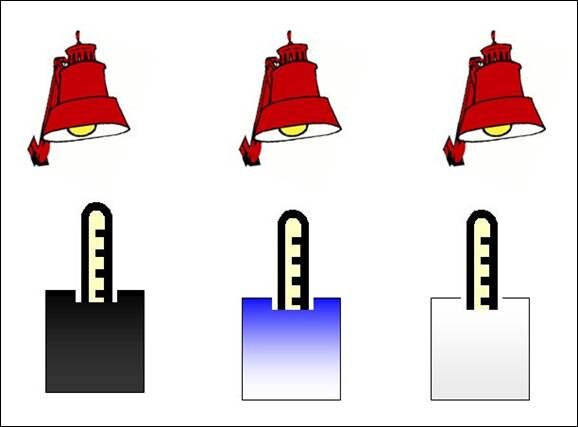
Experimentally, it is possible to simulate the effect of radiation on bodies of different colours. If a thermometer is inserted into three differently coloured cardboard pockets — one black, one blue, and one white — and these pockets are placed under a lamp for a while (which simulates solar radiation), a difference in the temperature of the three thermometers can be observed.

The thermometer placed in the black pocket will indicate a temperature higher than that indicated by the other two thermometers. The lowest temperature will be the one in the white pocket.
Temperature is the measure of the degree of agitation of particles in a substance. It can therefore be concluded that the particles of matter are more agitated in the black pocket than in the white pocket since the temperature of the former is higher. Consequently, a dark object does not reflect the sun's rays in the same way as light-coloured objects do.
Theoretically, we consider that:
an ideal black body (blackbody) absorbs all the visible light it receives and transforms it into heat;
an ideal white body (white body) behaves in the opposite way: it reflects all visible light rather than absorb it;
objects of intermediate colours reflect part of the visible light and absorb the other part.
The diagram below illustrates the possible behaviours of light when it encounters the surface of a body (flux of incident energy in yellow). The body can:
absorb all or part of the light received (flux of energy absorbed in red);
reflect all or part of the light received (flux of energy reflected in blue).
In fact, dark bodies do not reflect solar rays, or reflect them very little. Instead of bouncing them back (reflecting) as white bodies do, blackbodies absorb the rays and convert them into heat.
This absorption of energy leads to an increase in the temperature felt since the light energy is then transformed into thermal energy.
A perfect blackbody would absorb all the flux of energy that reaches it (the flux of incident energy). See what would happen below.
With a perfectly white body, the material reflects all the incident light.
With an intermediate colour (like green), part of the incident light will be absorbed and transformed into heat while the other part will be reflected.
A German physicist, Max Planck (1858-1947) demonstrated using a complex mathematical relationship that the radiation emitted by a body depends on temperature. Its law is based on the behaviour of an ideal blackbody.
In fact, Planck's law tells us about the intensity of light as a function of wavelength and temperature. By capturing the radiation emitted by a body, it is possible to deduce its temperature. Although the blackbody is an ideal body that does not exist in reality, the behaviour of real bodies can be more or less similar to that of a blackbody, which makes it possible to use Planck's law to measure the temperature of a body.
The higher the temperature of a body, the shorter the wavelength of colour emitted will be. This results in high intensity radiation.
Planck's law is useful when it is not possible to determine the temperature of a body by experimental measurements. It is, among others, the case when the temperature of celestial bodies (stars for example) has to be determined.
In meteorology, this behaviour pertaining to surfaces of different colours absorbing solar energy differently has consequences on climate. A white surface, such as snow, will reflect more radiation than a green surface, such as grass. Asphalt, which is black, will absorb more radiation than light beige sand or wheat fields.
This property of matter to reflect solar radiation is called reflectivity, or the albedo effect. It depends on the nature of the soil surface and its colour. The reflectivity is given as a percentage and represents the percentage of the incident energy, which is reflected by matter, the remainder being absorbed by this matter.