Subjects
Grades
 100%

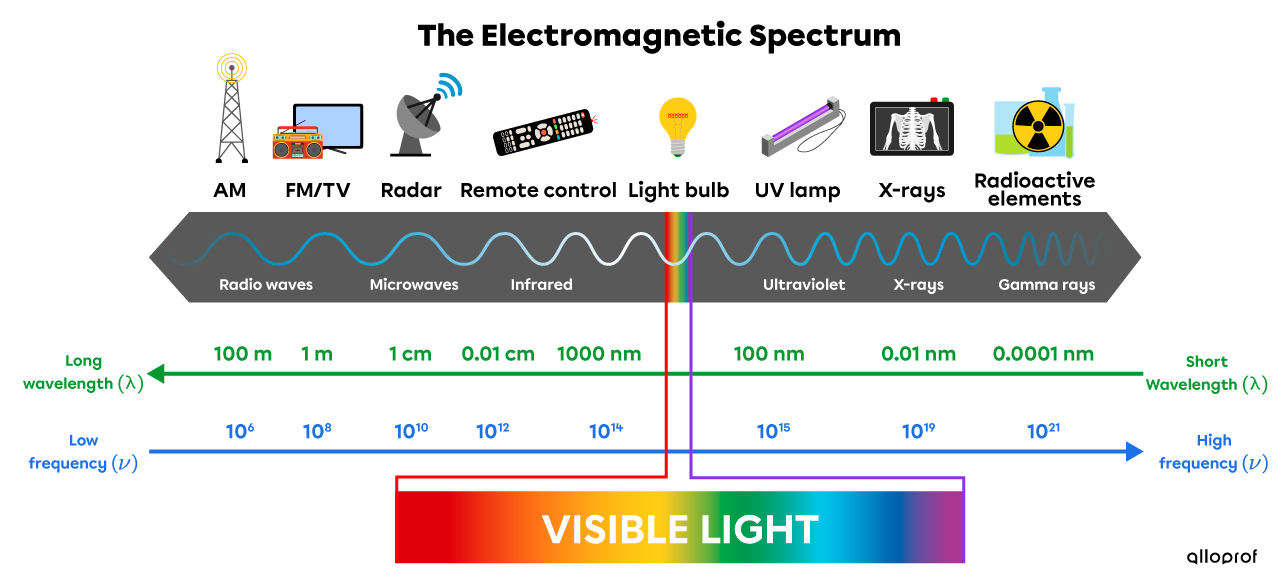
Light is an electromagnetic wave. It is a form of radiant energy.
Light has seven main properties.
Visible light is an electromagnetic wave that can be perceived by the human eye.
Other electromagnetic waves, such as X-rays or infrared rays, are not detected by our eyes. It is what we call non-visible light.

Light can be emitted by a natural source, such as the Sun and other stars.
Light can also be emitted by an artificial source, such as a light bulb.
Light carries energy which is called luminous energy or radiant energy. This energy can be transformed into thermal energy when it comes into contact with a surface.
The propagation of light is almost instantaneous. In a vacuum, it travels at a speed of 299 792 458 m/s.
Light cannot go around an object; instead, it will be deflected or blocked by it.
This is the property that creates shadows. When an opaque object blocks light rays travelling in a straight line, it creates a shadow behind it.
Some of the light that strikes an object is reflected by it, allowing us to see it. The other part of the light is absorbed.
The way light is reflected varies depending on whether the surface it strikes is perfectly flat (e.g., a mirror) or irregular.
Sunlight appears white to us, but it is actually made up of a mixture of all the colours of the rainbow!
When white light passes through a prism (a triangular piece of glass), it splits into its different colors. This phenomenon is called the dispersion of light.