Subjects
Grades
 100%
100%
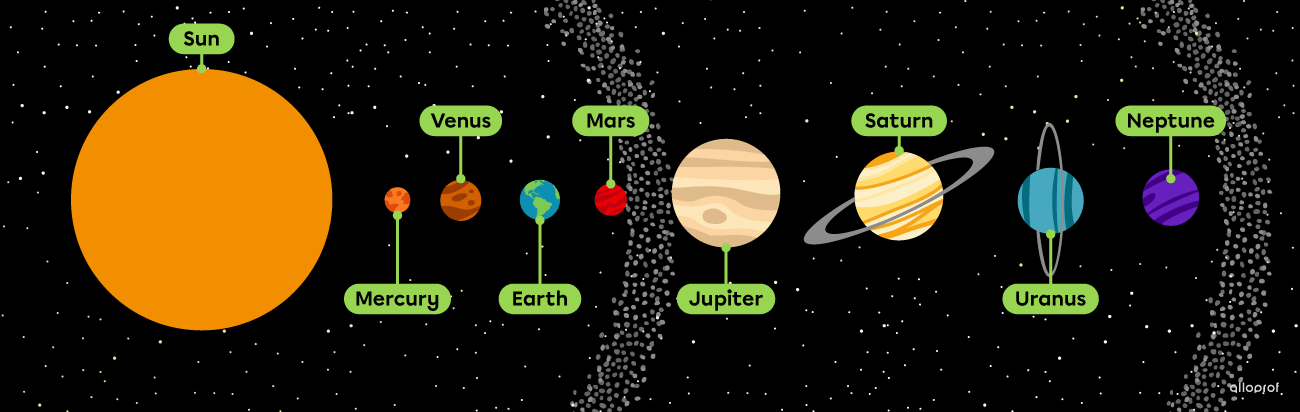
A planet is a spherical celestial body that orbits around a star.
A celestial body has to respect certain conditions to be considered a planet:
It has a mostly spherical, or round, shape.
It orbits, or revolves, around a star.
It does not emit light.
It has cleared its orbit and nearby orbits of any other celestial bodies of comparable size, except its natural satellites, or moons.
Starting from the Sun, the planets in our solar system are found in the following order:
Mercury
Venus
Earth
Mars
Jupiter
Saturn
Uranus
Neptune

The planets of our solar system
Note: The dimensions of the celestial bodies and the distances are not to scale.
Here is a common trick to remember the order of the planets in the solar system starting from the Sun. This is a mnemonic device where the first letter of each word in the sentence corresponds to the first letter of the planet's name. You can also come up with your own sentence.
My Very Educated Mother Just Served Us Nachos.
Mercury Venus Earth Mars Jupiter Saturn Uranus Neptune
Telluric planets, often called terrestrial planets or rocky planets, are planets made of rocks and metals.
Jovian planets, often called gas giants, are planets with a gaseous surface.
|
Planet type |
Terrestrial (telluric) |
|---|---|
|
Average distance from the Sun |
57 900 000 km |
|
Diameter at the equator |
38% of Earth’s diameter |
|
Mass |
5% of Earth’s mass |
|
Gravity |
38% of Earth’s gravity |
|
Revolution period (around the Sun) |
88 Earth days |
|
Rotation period (around its axis) |
59 Earth days |
|
Surface temperature |
-180 to 430°C |
|
Natural satellites |
None |
Source: Canadian Space Agency, 2020[1] and NASA, 2023[2] |
|
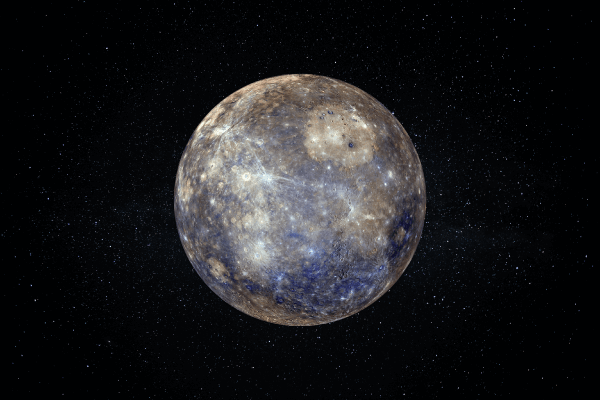
Mercury
Mercury is the smallest and lightest planet in the solar system. It has a large iron core and its surface is covered with craters.
It has almost no atmosphere, so its surface temperature varies greatly depending on its exposure to the Sun. In addition, because the bottoms of some craters near the poles are never exposed to the Sun, some scientists speculate that ice may be found there.
|
Planet type |
Terrestrial (telluric) |
|---|---|
|
Average distance from the Sun |
108 208 000 km |
|
Diameter at the equator |
95% of Earth's diameter |
|
Mass |
82% of Earth's mass |
|
Gravity |
90% of Earth's gravity |
|
Revolution period (around the Sun) |
224.7 Earth days |
|
Rotation period (around its axis) |
243 Earth days |
|
Surface temperature |
Approximately 460°C |
|
Natural satellites |
None |
Source: Canadian Space Agency, 2020,[3] and NASA, 2023[4] |
|
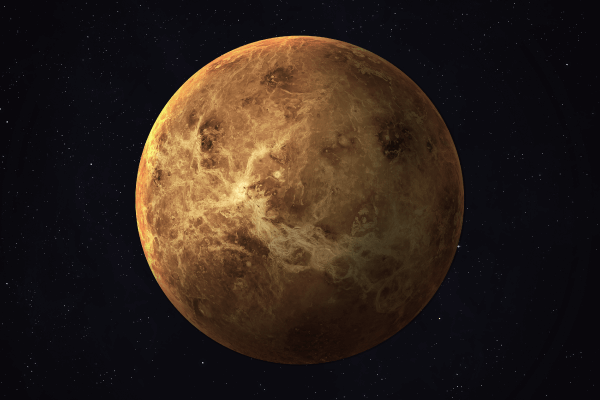
Venus
Venus is a slightly smaller and lighter planet than Earth. There are several volcanoes on its surface, probably more than on Earth.
It is covered in clouds and has a very thick atmosphere, made up of carbon dioxide |(\text{CO}_2),| which is a greenhouse gas. Its proximity to the Sun and its atmosphere make it the hottest planet in the solar system.
All the planets in the solar system rotate around their axis in the same direction, except Venus and Uranus, which rotate in the opposite direction. On Venus, the Sun rises in the West and sets in the East.
Spacecraft have landed on the surface of Venus to study it, but because of very hot temperature and extreme weather conditions, they could not function for more than 127 minutes[3].
| Planet type | Terrestrial (telluric) |
| Average distance from the Sun | 150 000 000 km |
| Diameter at the equator | 12 742 km |
| Mass | |5.97\times10^{24}\ \text{kg}| |
| Revolution period (around the Sun) | 365.25 days |
| Rotation period (around its axis) | 24 hours |
| Surface temperature | -89.2 to 56.7°C |
| Natural satellites | 1 moon |
Source: Canadian Space Agency, 2020,[5] | |
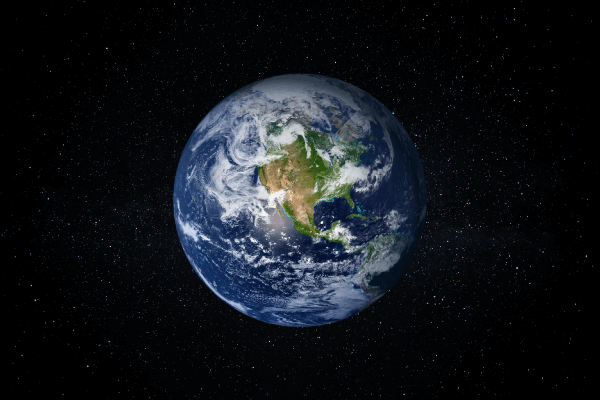
Earth
Earth is a planet with an internal structure consisting of a core, a mantle and a rocky crust. Most of the Earth's surface is covered with liquid water.
It has an atmosphere composed mainly of nitrogen |(\text{N}_2)| and oxygen |(\text{O}_2),| which keeps the surface temperature of the planet fairly constant.
The presence of liquid water and the rather mild temperatures are favourable conditions for the development of life. So far, the Earth is the only place in the universe where there is evidence of life.
The Earth's axis of rotation is tilted, which creates the seasons.
The Earth has one natural satellite, called the Moon, which is about four times smaller than the Earth.
|
Planet type |
Terrestrial (telluric) |
|---|---|
|
Average distance from the Sun |
227 939 200 km |
|
Diameter at the equator |
50% of Earth’s diameter |
|
Mass |
10% of Earth’s mass |
|
Gravity |
38% of Earth’s gravity |
|
Revolution period (around the Sun) |
687 Earth days |
|
Rotation period (around its axis) |
24 hours 40 minutes |
|
Surface temperature |
-140 to 30°C |
|
Natural satellites |
2 moons |
Source: Canadian Space Agency, 2020[6] and NASA, 2023[7] |
|
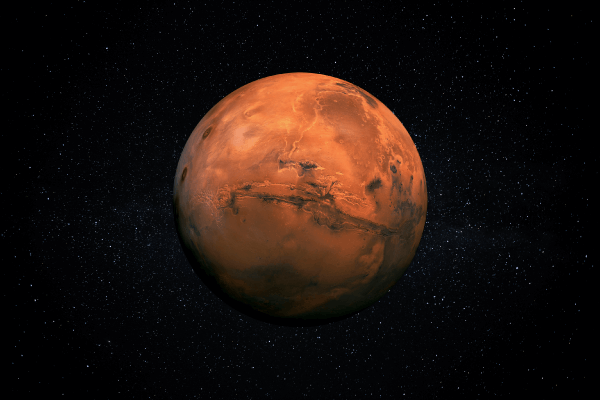
Mars
Mars is a planet half the size and ten times lighter than Earth. Its surface has an orange hue. It has both the highest mountain and the deepest canyon in the solar system.
There is no liquid water on Mars. However, its atmosphere contains a small amount of gaseous water. In addition, water in the form of ice has been found under the carbon dioxide glaciers |(\text{CO}_2)| covering the poles. Scientists speculate that liquid water may have been present on Mars in the past.
Mars is the most explored planet (apart from Earth). Since 1975, several spacecraft have landed on Mars. Other spacecraft are also orbiting the planet to study it.
The two natural satellites of Mars are Phobos and Deimos.
|
Planet type |
Jovian (gas giant) |
|---|---|
|
Average distance from the Sun |
778 600 000 km |
|
Diameter at the equator |
11 times bigger than Earth’s diameter |
|
Mass |
318 times bigger than Earth’s mass |
|
Gravity |
2.36 times Earth’s gravity |
|
Revolution period (around the Sun) |
11.8 Earth years |
|
Rotation period (around its axis) |
10 hours |
|
Surface temperature |
-161 to -108°C |
|
Natural satellites |
79 moons |
Source: Canadian Space Agency, 2020[9] and NASA, 2023[10] |
|
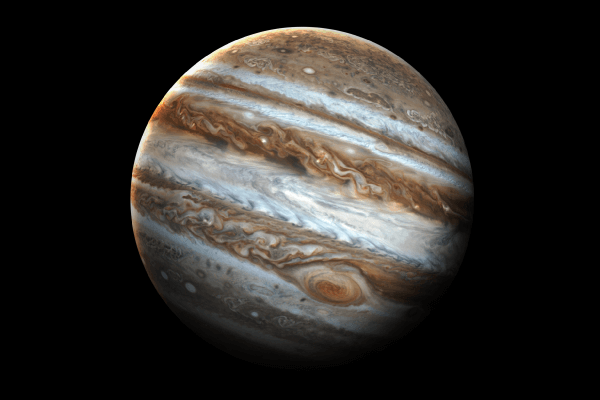
Jupiter
Jupiter is a gas giant. It is the biggest and heaviest planet in the solar system. It is about 11 times bigger and 300 times heavier than Earth. This makes it the planet with the highest gravity in our solar system.
It has at least 79 natural satellites. Some of them have not yet been named. The largest and best known satellites are Io, Europa, Ganymede and Callisto. Europa is thought to be suitable for life and Ganymede is bigger than Mercury.
Jupiter has a thick atmosphere in which it is possible to observe swirling storms. The most visible storm is called the Great Red Spot. This spot, visible in the southern hemisphere of the planet, has been observed by astronomers for several hundred years.
Since Jupiter's surface is gaseous, no spacecraft has landed there. However, a few spacecraft have orbited Jupiter to collect data.
|
Planet type |
Jovian (gas giant) |
|---|---|
|
Average distance from the Sun |
1.43 billion km |
|
Diameter at the equator |
9 times bigger than Earth’s diameter |
|
Mass |
95 times bigger than Earth’s mass |
|
Gravity |
Comparable to Earth’s gravity |
|
Revolution period (around the Sun) |
29.5 Earth years |
|
Rotation period (around its axis) |
10 hours 30 min |
|
Surface temperature |
-189 to -139°C |
|
Natural satellites |
82 moons |
Source: Canadian Space Agency, 2020[11] and NASA, 2023[12] |
|
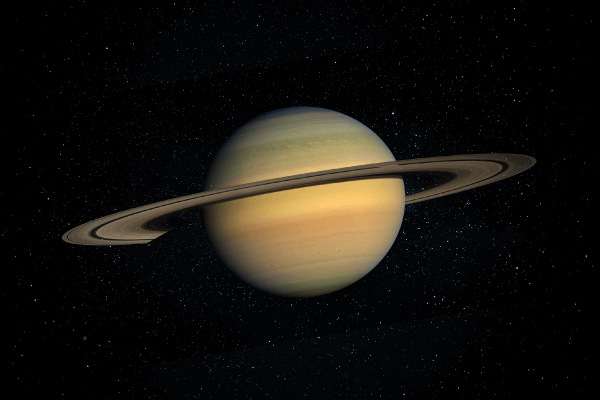
Saturn
Saturn is the second largest planet in the solar system after Jupiter. It is a gas giant with a solid core of metals and rocks surrounded by liquid hydrogen. Its surface and atmosphere are gaseous.
Saturn has several rings. These are made up of ice and rock particles orbiting the planet. It has 82 known natural satellites that also orbit the planet. The largest are Titan, Rhea, Japet, Dione, Tethys and Enceladus. Some of them may be suitable for the presence of life.
The Cassini spacecraft orbited Saturn from 2004 to 2017. It was able to collect data on Saturn's atmosphere and rings. In addition, it carried a probe that landed on Titan, Saturn's largest natural satellite.
|
Planet type |
Jovian (gas giant) |
|---|---|
|
Average distance from the Sun |
2.9 billion km |
|
Diameter at the equator |
4 times bigger than Earth’s diameter |
|
Mass |
15 times bigger than Earth’s mass |
|
Gravity |
90% of Earth’s gravity |
|
Revolution period (around the Sun) |
84 Earth years |
|
Rotation period (around its axis) |
17 hours |
|
Surface temperature |
-226 to -197°C |
|
Natural satellites |
27 moons |
Source: Canadian Space Agency, 2020[13] and NASA, 2023[14] |
|
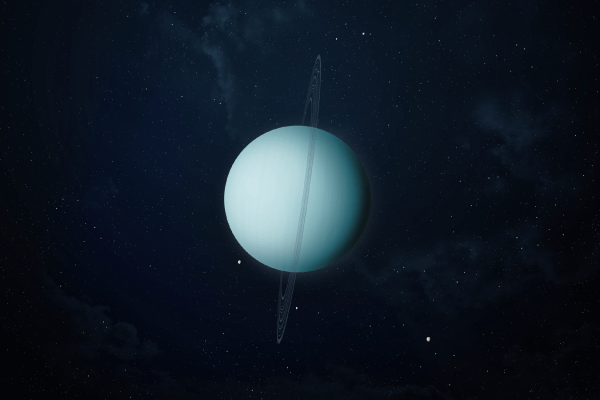
Uranus
Like Neptune, Uranus is thought to have a dense, rocky core covered by a layer of liquid water, methane and ammonia. Its surface and atmosphere are composed of gases, mainly hydrogen, helium and methane. It is the presence of methane that gives it its blue colour.
Uranus rotates around its axis in about 17 hours. The different layers rotate at different speeds. The interior of the planet rotates in 17 hours, while the upper atmosphere rotates faster, in only 14 hours. These speed differences cause strong winds in the planet's atmosphere.
The axis of rotation of Uranus is almost horizontal, so that one pole is in darkness for a quarter of the year, or about 21 Earth years. During this time, at the other pole, the Sun shines continuously.
All the planets in the solar system rotate in the same direction, except Uranus and Venus, which rotate in the opposite direction.
Only the Voyager 2 probe passed close to Uranus and was able to record data. It then continued its journey towards Neptune.
Uranus has 13 small rings and 27 known moons.
|
Planet type |
Jovian (gas giant) |
|---|---|
|
Average distance from the Sun |
4.5 billion km |
|
Diameter at the equator |
4 times bigger than Earth’s diameter |
|
Mass |
17 times bigger than Earth’s mass |
|
Gravity |
1.14 times Earth’s gravity |
|
Revolution period (around the Sun) |
165 Earth years |
|
Rotation period (around its axis) |
12-18 hours |
|
Surface temperature |
-218 to -200°C |
|
Natural satellites |
14 moons |
Source: Canadian Space Agency, 2020[15] and NASA, 2023[16] |
|
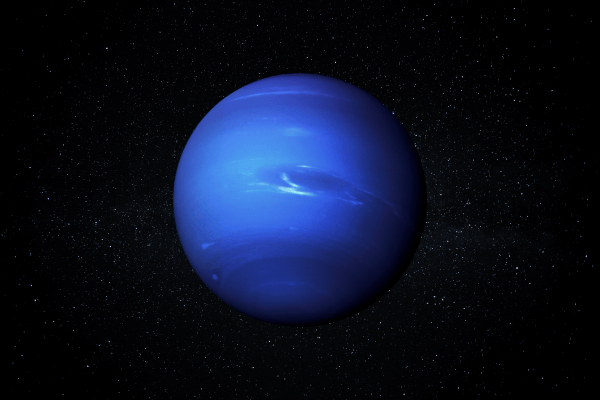
Neptune
Like Uranus, Neptune is thought to have a dense, rocky core covered by a layer of liquid water, methane and ammonia. Its surface and atmosphere are composed of gases, mainly hydrogen, helium and methane. It is the presence of methane that gives it its blue colour.
Neptune rotates in a few hours, but not all parts rotate at the same speed. The equator rotates in 18 hours, while the polar regions rotate in 12 hours. These speed differences cause strong winds in the planet's atmosphere.
Only the Voyager 2 probe has passed close to Neptune and has been able to record data.