Subjects
Grades
Population density is a measure of the number of individuals of a given species occupying a specific portion of an environment or territory.

Moments in the video :
To calculate the number of individuals of a species occupying a given territory, we simply need to use the following population density equation:
|D = \dfrac{n}{A}|
where
|\text{D}| represents the population density (number of individuals per unit area)
|\text{n}| represents the number of individuals in the population (individuals)
|\text{A}| represents the area occupied by the population (units can vary).
If there are |\text{200 bears}| in a forest of |\text{170 km}^2|, what is the density of this population?
Population density is often expressed as a decimal number because it is an average. So even if the density of a hare population is |0{.}5 \text{ hares/km}^2|, in reality, there isn’t half a hare per square kilometre; this is a unit rate. And, based on this rate, we can assume that there would be on average 1 hare per |\text {2 km}^2|.
In problems involving the calculation of population density, the number of individuals in a population is not always given. It is then necessary to calculate how many individuals there are.
In this territory of |\text{100 km}^2| , we can choose to do the sampling on only |\text {50 km}^2| , divided into five samples (also called "plots" or "quadrats") of |\text {10 km}^2| each.
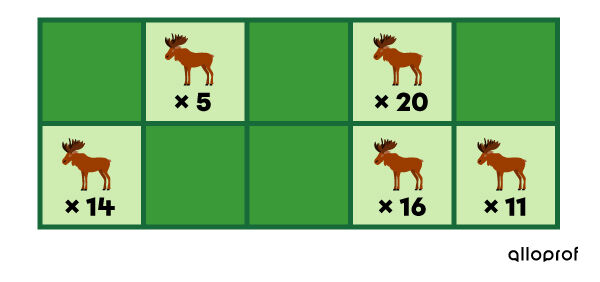

Plot sampling
To find the moose population density in this territory, count the number of individuals observed in each of the five plots and determine the area occupied by these individuals. Here are the 3 steps to follow:
1. Count the number of moose
To find the number of moose in this territory, just count the number of individuals observed in each of the five plots. The number of moose in the picture is represented as follows: |14, 5, 20, 16, 11|.
|\begin{align} N &= 14 + 5 + 20 + 16 + 11 \\
N &= \text{66 moose}
\end{align}|
There are |\text{66 moose}| .
2. Find the occupied area
To find the area occupied, simply multiply the number of plots by the area of a plot. In the picture above, there are 5 plots of |\text {10 km}^2| each.
|\begin{align} A &= 5 \times \text{10 km}^2 \\
A &= \text{50 km}^2
\end{align}|
3. Calculate the population density
To calculate the moose population density in this territory, use the following formula: |\displaystyle D = \frac{n}{A}| and replace the variables with the information that has been calculated.
|\begin{align} D = \dfrac{n}{A} \Rightarrow D&= \dfrac{\text {66 moose}}{\text {50 km}^2} \\ D &= \text {1.32 moose/km}^2 \end{align}|
So there is |\text{1.32 moose/km}^2|.
It would also be possible to estimate the total moose population in this |\text {100 km}^2| territory by multiplying the density by the total area of the territory.
|\begin{align} \text {1.32 moose/km}^2 \times 100 =\text {132 moose/km}^2 \end{align}|
Here we find |\text {132 individuals}| for a territory of |\text {100 km}^2|.