Subjects
Grades
 100%
100%
 100%
100%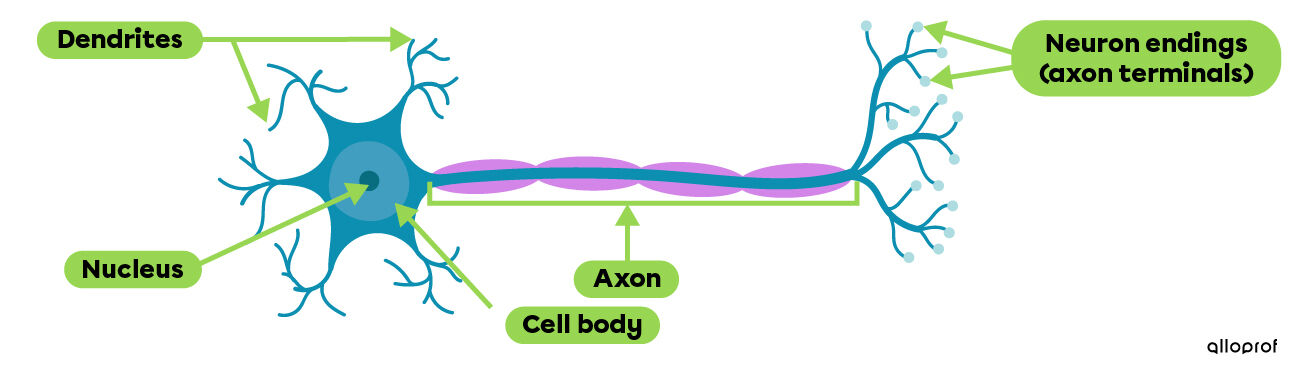 100%
100%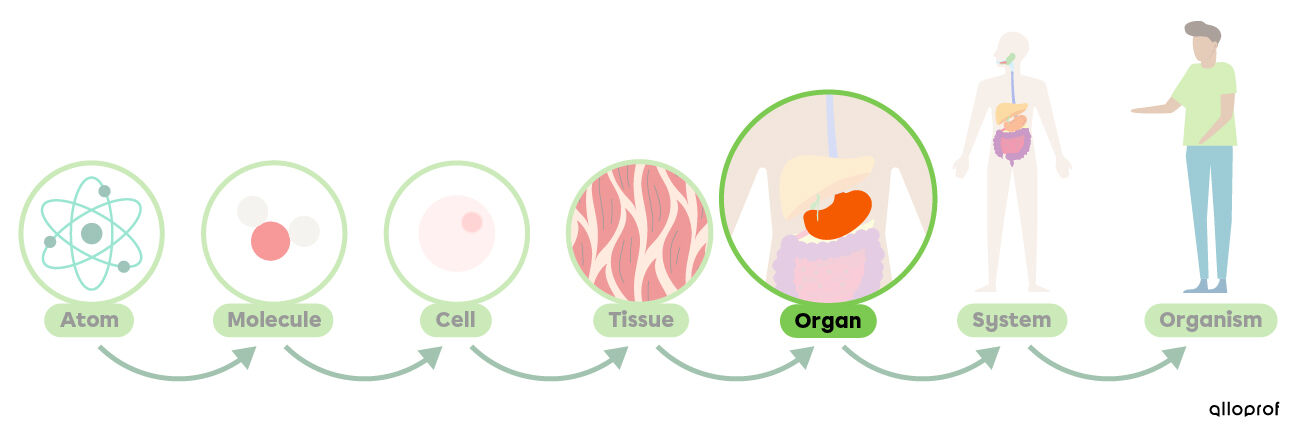 100%
100%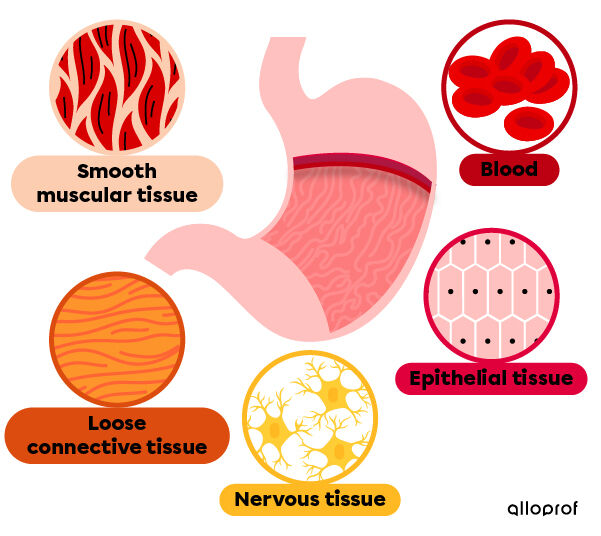
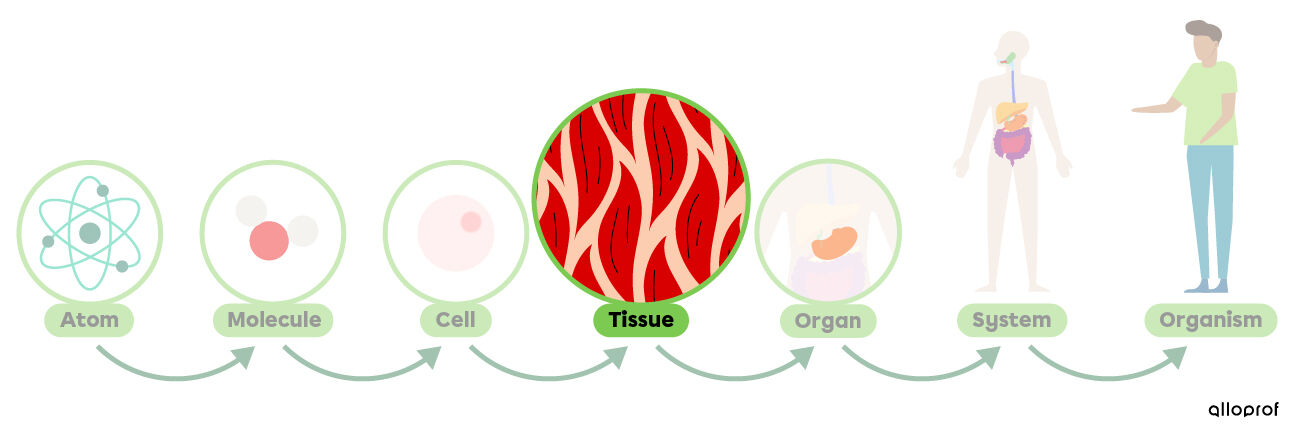
The cell is the simplest structure in the structural hierarchy of living organisms. When several cells combine, they form a tissue, a higher level of organization of living things.

To be considered a tissue, cells must adhere to each other. This adhesion is caused either by a substance covering the cells or by an interlacing of fibers between the cells.
In histology, tissues are classified according to 4 main subgroups:
Epithelial tissue (or epithelium) typically covers the outside of the body and the inner surface of organs. The cells that make up this tissue are bonded together to form a protective layer. For example, the skin and the interior of the respiratory tract and digestive tract contain several types of epithelial tissue.
The cells forming the epithelial tissue are tightly woven and layered to fulfill their barrier function, thus allowing the body to be protected against intrusion, injury and loss of fluids.
Other types of epithelial tissue specialize in roles of secretion, absorption, or filtering.

Epithelial tissue
The epithelial cells covering the respiratory tract secrete mucus to lubricate them and keep them moist, thus facilitating gaseous exchanges.
Connective tissue is found throughout the body, including tendons, nose cartilage, bones, blood, and muscles.
The main functions of connective tissue usually consist in supporting and connecting other tissues in the body.
Connective tissue also has the functions of protecting, supporting and uniting tissues. It also allows for the transport of food necessary for the organism to function.
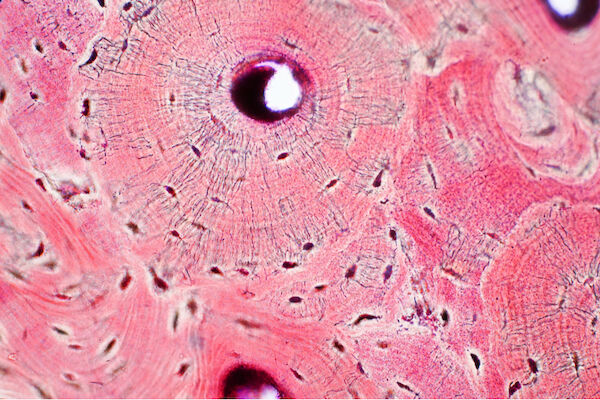
Connective tissue of a bone
Bone tissue (bones) supports the body, and fatty tissue (fat cells) stores nutrients to nourish muscle tissue.
Muscle tissue is made up of elongated cells that have the ability to contract. This type of tissue is found in the heart, bladder, and muscles like the biceps.
The cells that make up muscle tissue have 3 main characteristics. First, they are very elongated. As well, they are excitable, meaning they can react to a stimulus. Finally, they have incredible contractility compared to other types of cells.
Given the importance of movement in the majority of animals, muscle tissue is the most abundant among the 4 types of tissue. In fact, two-thirds of the mass of a healthy, physically fit human is made up of muscle tissue.
There are 3 kinds of muscle tissue: skeletal muscle tissue, smooth muscle tissue, and heart muscle tissue.
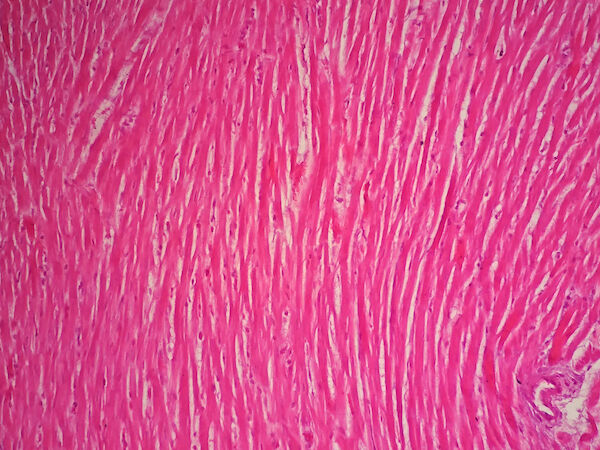
Heart muscle tissue
Nervous tissue is made up of a network of cells called neurons. This tissue forms the brain, the spinal cord and the nerves.
The functions of the nervous tissue consist in receiving external stimuli, analyzing them, and transmitting a response. In other words, it is the neurons of the nervous tissue that produce and conduct nerve impulses.
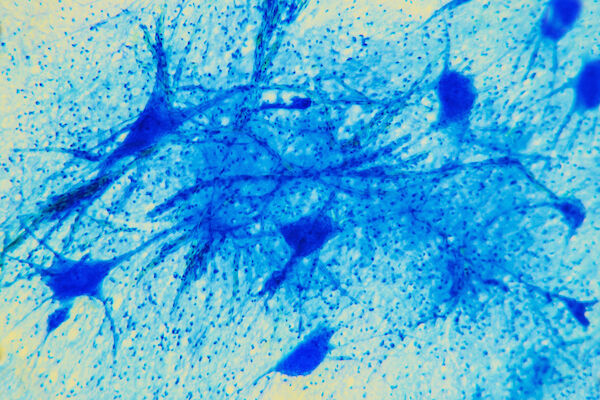
Nervous tissue
Neurons have extensions that allow them to communicate with each other. Dendrites carry nerve impulses to the cell body of the neuron. The nerve impulse continues its way passing through the axons to then reach the axon terminals. It is then transmitted to other areas of the body to elicit a response.
A neuron
An organ is a collection of different tissues performing one or more specific functions in the body.
The stomach is an organ. It contains several types of tissue, each of which performs a specific function:
Stomach tissues