Subjects
Grades
Water contamination leads to changes in the composition of the water and its properties due to the input of various substances, mainly resulting from human activities.
A contaminant is an agent that causes changes in the physical, chemical, or biological properties of an environment or organism.
Water that is safe to drink and to use for our various activities must be free of all contaminants or toxic substances. However, surface water and groundwater are often rendered unfit for consumption. In fact, there are several sources of water contamination. For example, waste that is thrown away, wastewater that is discharged, or atmospheric precipitation are all potential sources of contamination. Human activities, whether domestic, industrial, agricultural, or maritime, are also likely to affect water bodies and compromise their quality. Water pollutants are generally grouped into three main categories.
The sources of pollution can be specific, in other words, the source of pollution emanates from a well-defined geographical location. For example, the discharge of wastewater into a lake will impact a very specific area, namely the lake. On the contrary, other sources of pollution are diffused, since they affect a large area and their exact origin is difficult to trace. This is the case, for instance, for contaminants brought in by atmospheric precipitation. These contaminants have travelled widely through the atmosphere before falling to the ground as precipitation.
Certain aquatic organisms, such as plants and bacteria, have the ability to break down certain types of pollutants. Thus, they manage to preserve the balance of aquatic ecosystems whose integrity depends on the temperature, oxygenation, and water chemical composition. However, when pollutants are too toxic or in a too large quantity, living organisms can no longer maintain the environmental balance. The environment is then said to become polluted since the quality of the water and the ecosystem is compromised.
Biological pollutants include pollutants such as microorganisms (bacteria, viruses, parasites) and organic matter produced by living organisms (excrement, sugars, fats, etc.).
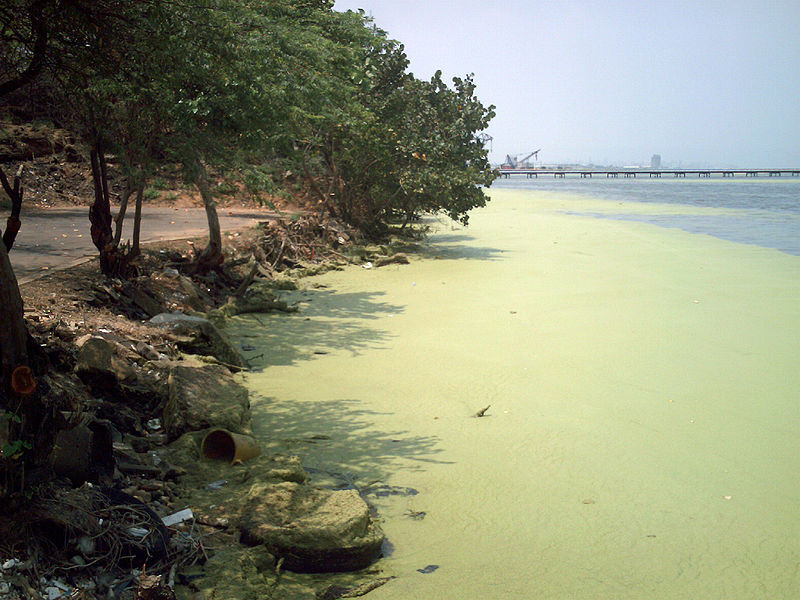
These pollutants mainly come from domestic and industrial wastewater (via sewers) as well as animal breeding (slurry, manure). Organic materials are generally easy to break down. However, when too abundant, the degradation of organic matter enriches the water with nutrients, which promotes eutrophication of the aquatic environment. As a consequence, water contaminated with microorganisms can cause diarrhea, vomiting, and parasitic disease when consumed by humans.
Chemical pollutants are chemicals that are normally absent or naturally present in the environment in very low concentrations.
Chemical pollutants are grouped into five main types. Regardless of the type of chemical pollutant, daily consumption of water polluted with traces of these substances can have adverse effects on human health.
|
Main pollutants |
Main sources of contamination |
Main effects on the environment or on human health |
|
Nitric and sulfuric acids |
Acid rain |
Makes lakes and rivers acidic, decimates aquatic flora and fauna. |
|
Nitrates and phosphates |
Fertilizers and detergents |
Contribute to the development of algae in lakes and streams. |
|
Heavy metals |
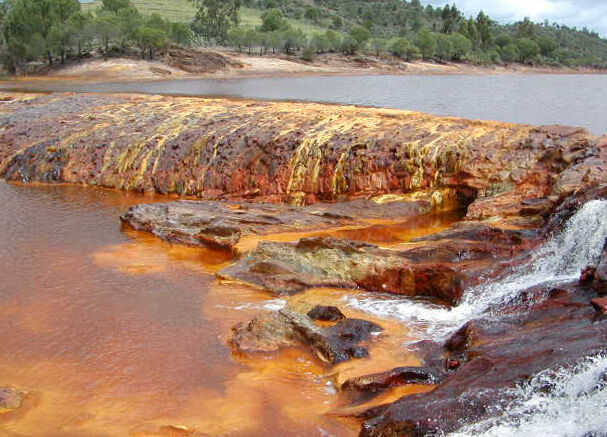
Mines, metallurgy, deforestation |
Accumulate in organisms and impact the nervous system. |
|
Hydrocarbons |
Oil extraction, transport, and storage |
Cause "oil slicks", that is serious damage to shores and to the seabed. |
|
Persistent Organic Pollutants (POPs) |
Pesticides, solvents, cleaning products |
Accumulate in organisms and have variable impacts: carcinogens, mutagens, etc. |
Physical pollutants include insoluble and nondegradable debris, as well as hot water discharged by cooling systems.
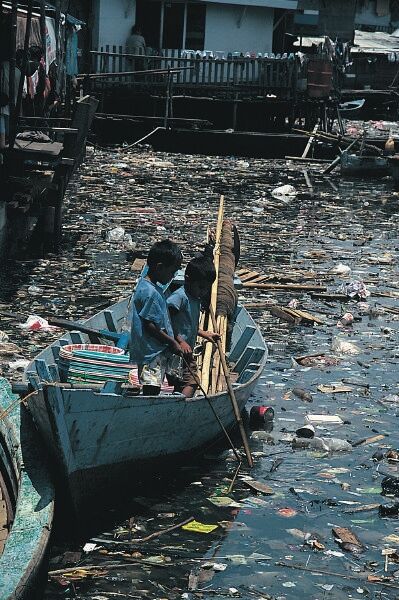
Solid waste can injure or suffocate some aquatic animals. They can also accumulate and form huge floating discharges that drift with sea currents. Another type of physical pollutant is the hot water discharged from the cooling systems of thermal and nuclear power plants. Indeed, this type of water warms up aquatic ecosystems, which can be harmful to fish, among other things, as it reduces the oxygen concentration in the water and promotes eutrophication. This phenomenon is sometimes referred to as thermal water pollution.