Subjects
Grades
 100%

 100%
Wind is the movement of air masses caused by the unequal heating of the Earth, among other things.
Cold air is denser and tends to fall, while warm air is less dense and tends to rise. The combination of these two movements contributes a rotating motion called a convection cell.
A mass of cold air that falls forms a high-pressure area at ground level. Conversely, a mass of warm air that rises forms a low-pressure area at ground level.
Air masses always move from a high-pressure area toward a low-pressure area.
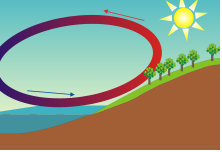
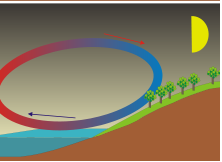
Sea breezes and land breezes illustrate how a convection cell works.
During the day, the Sun's rays fall on the sand and heat up the ground. The air that touches the hot ground also becomes warmer. Warm air is less dense than cold air, so it rises.
At the same time, the air that touches the sea is cooled by the fresh water. Since cold air is denser than the warm air, it tends to fall.
The movement of these masses of cold and warm air creates a sea breeze.

Movement of Air Masses Forming a Sea Breeze
At night, the Sun's rays no longer warm the sand, making it colder. The air that touches the sand is also cooled. Since cold air is denser than warm air, it falls.
Above the sea, the air gradually warms. Since warm air is less dense than cold air, it rises.
The movement of these masses of cold and warm air creates a land breeze.
Movement of Air Masses Forming a Land Breeze