Subjects
Grades
 100%
100%
Since the mid-20th century, environmental problems have become an increasingly important and studied issue. These problems affect many countries. Governments have the most power in tackling environmental issues. Global organizations cannot force governments to do anything. Several international organizations (IO) are trying to find solutions by working in multiple countries at the same time. IOs are sometimes called Intergovernmental Organizations (IGO) when they are run by governments of different countries that have joined forces. Their members are national representatives.
These organizations are referred to as international, which shouldn’t be confused with global. IOs are not global in the true sense of the word because they do not include all the nations of the world. IOs are international in the sense that they involve different countries. IOs have the power to take action in the different member countries.
An international organization (IO) is an alliance of several sovereign nations. This alliance is formalized by an agreement or the signing of an international treaty. IOs bring together government representatives from different countries to organize actions that involve several countries. They do this by consulting, discussing and negotiating to solve various problems. The emphasis here is on IOs that focus on protecting and restoring the environment.
These are very important international organizations since most environmental problems involve multiple countries. For example, if a country produces a huge amount of CO2, this affects the ozone layer because the thinning of the ozone layer causes global warming. The actions of one country can have consequences for all countries.
An international organization is an organization that brings together representatives of different countries to achieve common goals on global issues.
This is a program within the United Nations (UN). The UNEP helped draft the Brundtland Report in 1987. This is the first time that sustainable development was addressed.
|
Objectives |
Action |
|---|---|
|
|
Official Website: UNEP - United Nations Environment Programme
Sustainable development is a principle according to which a society meets the needs of the present without compromising the ability of future generations to meet their needs.
The Global Environment Facility (GEF), established in 1991, provides money to developing and emerging countries to help them meet targets set out in international environmental conventions. These most vulnerable countries are disproportionately affected by environmental problems because poorer countries have trouble managing and recovering from environmental problems. These countries lack the means (mainly money) necessary to prevent these problems or to adapt and mitigate the consequences.
A developing country is less industrialized and the standard of living for people is often low.
An emerging country is a country experiencing rapid economic growth with an unequal increase in the standard of living among its people. Its gross domestic product (GDP) per capita is lower than the GDP of developed countries and its economy has not reached the same level of development.
The GEF provides funding for projects with a global reach in the areas of biodiversity, climate change, ozone depletion (caused by greenhouse gases), the protection of international waters, land degradation and toxic pollutants.
From 2013 to 2019, the GEF financed a green energy project for the Changning District in Shanghai, China. The city wants to reduce its carbon emissions and promote a shift to green electricity. The GEF’s investment in this project (from the organization itself and from other partners) amounted to US$256 150 000, equal to approximately CAD$371 470 010. This money was used to:
bring buildings close to zero carbon emissions using renewable energy sources
improve public transport and bicycle path infrastructure
implement measures to encourage people to purchase electric and hybrid vehicles or small vehicles
This organization is not part of the UN and is the world’s largest source of environmental public funding. The money that goes into this fund comes mainly from donors from richer, industrialized countries, since these countries have better resources than developing countries.
This organization has made a huge financial contribution. Since it was created, it has granted $20.5 billion and raised $112 billion by leveraging other partners to support more than 4 800 projects in over 170 countries. The list of projects can be found on the organization’s official website: Global Environment Facility | Investing in Our Planet. The organization also has a YouTube channel with various projects and conferences.
Founded in 1948, it was the first environmental union that brought together multiple governments and organizations with the common goal of protecting nature.

This organization is sometimes called an NGO. When it was first created, it was an international organization, but governments began to play a less active role in its projects.
Its objective is to encourage countries to preserve the quality and diversity of nature. It also promotes collaboration between countries and provides scientific data on the environment to guide governments on how to take action.
One way it does this is by encouraging sustainable development by ensuring that all countries use their natural resources fairly and sustainably.
The IUCN (formerly known as the World Conservation Union) uses the following main means of action:
publishing a comprehensive list of threatened species (Red List of animals and plants at risk of extinction) which aims to raise awareness among nations and citizens
acting as a mediator, arbitrator or negotiator between biodiversity conservation stakeholders and economic development stakeholders to find common ground and compromises
establishing international environmental and sustainable development standards, rules and criteria to be observed by all countries
Official website: IUCN
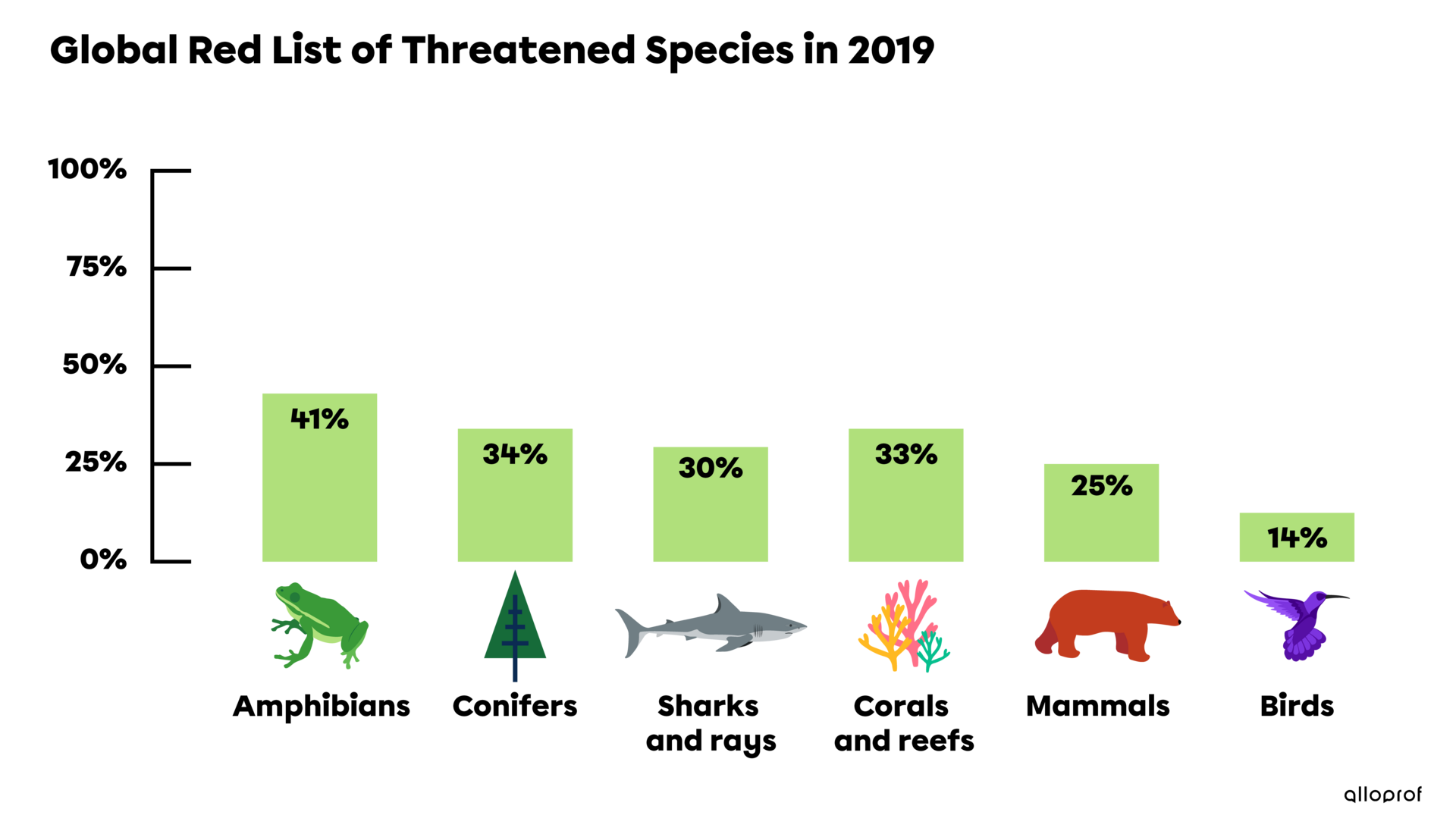
The 2019 Red List claims that 30 178 of the 112 432 species studied are classified as threatened. The following graph shows the percentage of threatened species in six different categories. The diagram shows that 41% of amphibian species are threatened. There are several causes for the reduction of biodiversity.

You can see the evolution of the different species in danger of extinction between 1996 and 2019 on the environmental issues page.
Biodiversity refers to all living organisms (animals and plants) inhabiting the planet.
GEF. (n.d.). GEF Globe and Acronyme [image]. https://www.thegef.org/gef-logo
Global Environment Facility. (n.d.). Green Energy Schemes for Low-Carbon City in Shanghai, China. https://www.thegef.org/project/green-energy-schemes-low-carbon-city-shanghai-china
Gouvernement du Canada. (n.d.). Fonds pour l'environnement mondial. https://www.canada.ca/fr/environnement-changement-climatique/organisation/affaires-internationales/partenariats-organisations/fonds-environnement-mondial.html
Gouvernement du Québec. (n.d.). Pays en voie de développement. Thésaurus de l'activité gouvernementale. http://www.thesaurus.gouv.qc.ca/tag/terme.do?id=9057
IUCN. (2009). IUCN logo [image]. Wikimedia. https://commons.wikimedia.org/wiki/File:IUCN_logo.svg
Organisation des Nations Unies. (1969). Convention de Vienne sur le droit des traités. https://legal.un.org/ilc/texts/instruments/french/conventions/1_1_1969.pdf
UICN. (n.d.). La Liste rouge mondiale des espèces menacées. https://uicn.fr/liste-rouge-mondiale/
UICN. (n.d.). Une brève histoire de l'UICN. https://www.iucn.org/fr/une-breve-histoire-uicn
UNEP FI. (2011). PNUMA logo [image]. Wikimedia. https://commons.wikimedia.org/wiki/File:PNUMA_logo.png