Subjects
Grades
 100%
100%
| When to do it |
| Before reading the text |
| While reading the text |
| After reading the text |
| Reading intention |
| Before: to get a general idea of what the text is about while previewing |
| While: to see what is next |
| After: to refresh your memory by taking a another look at a text you’ve already read |
| Outcome |
| Get a general overview of the text → Big picture |
| Help make predictions |
| Refresh memory |
| When to do it |
| Before reading the text |
| While reading the text |
| After reading the text |
| Reading intention |
| Find specific information quickly |
| Find keywords and repetitions |
| Outcome |
| Quickly find & gather specific information |
Skimming and scanning are strategies to find information quickly.
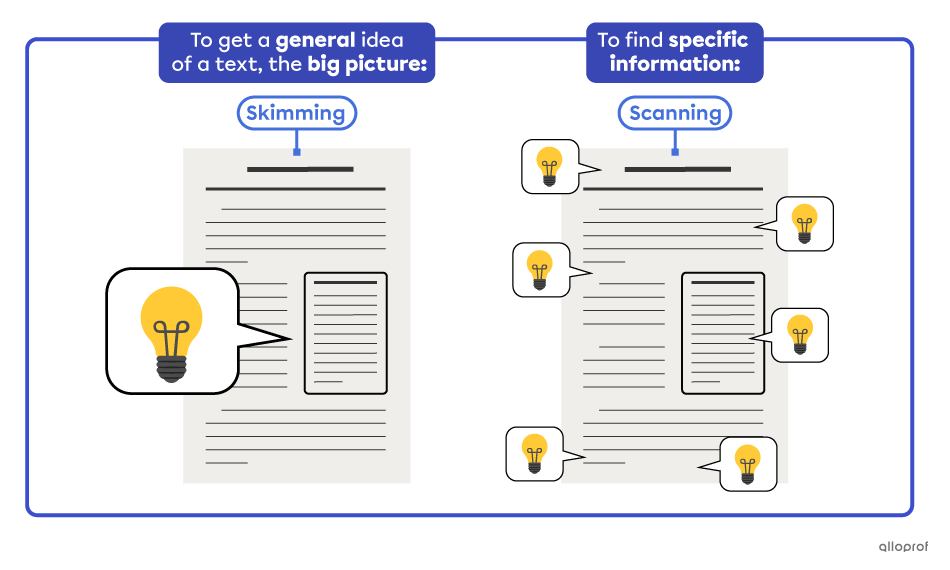
Skimming is giving some parts of a text a quick read.
| When to do it |
| Before reading the text |
| While reading the text |
| After reading the text |
| Reading intention |
| Before: to get a general idea of what the text is about while previewing |
| While: to see what is next |
| After: to refresh your memory by taking a another look at a text you’ve already read |
| Outcome |
| Get a general overview of the text → Big picture |
| Help make predictions |
| Refresh memory |

How to Do It
Read titles & headings
Look for bold, italicized or highlighted text
Quick read of the introduction & conclusion
Quick read of the first sentence of paragraphs
Scanning is looking for specific information without reading the whole text.
| When to do it |
| Before reading the text |
| While reading the text |
| After reading the text |
| Reading intention |
| Find specific information quickly |
| Find keywords and repetitions |
| Outcome |
| Quickly find & gather specific information |
How to Do It
You must know what you are looking for beforehand
Use text features & visual markers
Look for keywords
When in doubt about which to use, the rule of thumb is:
To learn more about a strategy, click its name.
|
Skimming & Scanning |
||
|
Get an overview of the text. |
Quickly search & find information |
Ask yourself questions |
|
Create mental pictures |
Relate to the text |
Read between the lines |
|
Write down notes & comments |
Understand challenging words |
Sum up main idea & key elements |
|
Explore sources to come up with new perspectives |
Form an opinion on the quality of the text |
Look at the structure and techniques used |