Subjects
Grades
Need a trusty sidekick for your next midterm or final exam? Enter the cheat sheet—your personal, teacher-approved reference sheet where you can write down essential information and details to help you out during an exam. Depending on the subject, it may also be referred to as a memory aid, study aid, or note sheet. Read on for essential tips on how to build a highly effective cheat sheet for your next exam.
 100%
100%


It will be hard to include everything you learn in class onto one study aid or cheat sheet. Nevertheless, it’s important to look through all your course material before you begin. Gather up as much as you can, including these items:
With your study materials handy, compile a list of essential information you’ll need for your exam. Pay special attention to content you’ve underlined or highlighted, concepts or skills covered on previous tests, and details included on earlier study aids or cheat sheets. Look through Alloprof’s review guides to identify key information. Finally, include everything that your teacher says might be on the exam. Then, ask yourself these:
Before starting on your cheat sheet, consider what you can leave out. A great cheat sheet is one that’s perfect for you. Too much information can clutter the page, resulting in an overwhelming resource that’s hard to navigate. Consider excluding details and concepts you know well to free up crucial space and make it more user-friendly for you.
Keep in mind that in many cases, cheat sheets must be approved by your teacher. Ensure that it meets all applicable rules and guidelines, and consult your teacher before the exam if you aren’t sure of some of the content. You don’t want to find out that you can’t use it on the day of the exam!
Here’s a list of materials to have on hand to create the perfect cheat sheet:
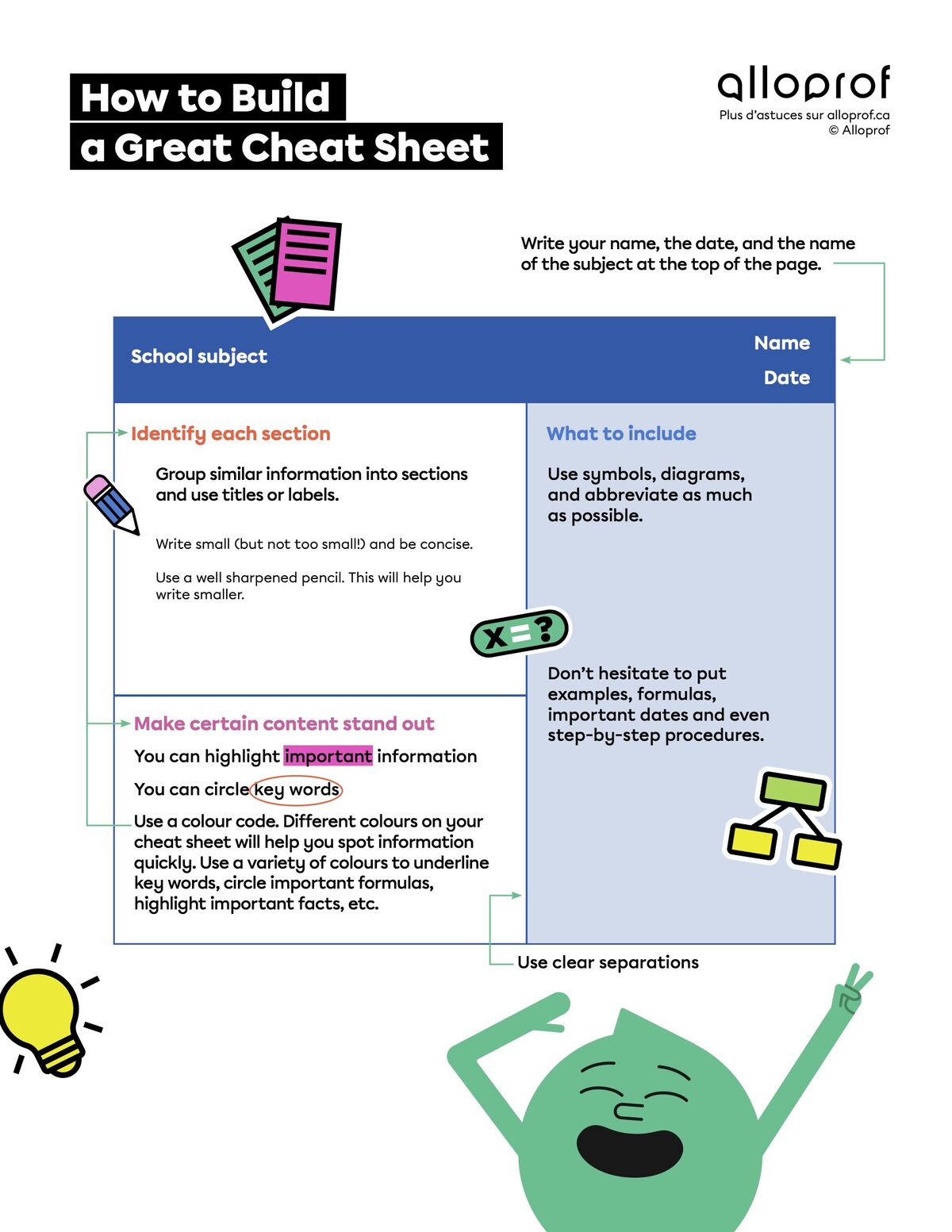
When constructing your cheat sheet, follow these steps:
Once the draft of your cheat sheet or study aid is ready, it’s important to take it for a test drive. Use it while you study or as you complete practice exercises or exam simulations. This will help you in two ways. First, you’ll become familiar with where the information is located on your cheat sheet so you can find it quickly. Second, it will help you figure out whether it needs to be fine-tuned. You may discover that certain details are more important than you thought, so you need to include them. On the contrary, you might notice that something’s not as helpful. Erase it to make room for something else. Once you’ve practised using it, you can write your final copy. Good luck!