Subjects
Grades
It’s one thing to know a historical figure or a date, but what are we supposed to do with this knowledge? How is this information used? How are links created between different areas of historical information?
This is where intellectual operations are used to give meaning to information we already have. For example, two facts can be used to complete several intellectual operations.
What could we say in connection with these two facts?
The dissemination of humanist ideas
The invention of the printing press
We could say that the printing press was invented before the broad dissemination of humanist ideas. This means that the invention of the printing press came before the broad dissemination of humanist ideas.
We could also say that the invention of the printing press led to humanist ideas being spread on a broader scale. Because the printing press made it much easier to reproduce texts, they became more accessible and could be read by a greater number of people. On the other hand, we could say that the broad dissemination of humanist ideas was a consequence of the invention of the printing press, for the same reasons.
This single example illustrates two intellectual operations, Situate in time and Determine causes and effects.
If you wish to learn more about the printing press and the dissemination of humanist ideas, see the concept sheet on Science During the Renaissance.
This example comes from the material available for Secondary 2.
Intellectual operations are methods developed to make it easier to study history and understand historical facts.
The word task and the word question are used to indicate the same thing, which is the action you must take.
A fact may be an event or an action that is confirmed and supported by evidence.
All intellectual operations are based on establishing a fact. Facts must be established so that we can distinguish similarities, determine causes or even set a chronological order.
This intellectual operation calls for the use of geographic maps and timelines in order to connect a fact with the right location. It can also refer to associating a fact with the right place in time. It can happen that a single element provides information about both space and time.
To establish a connection between facts means to associate a fact shown in a document with the right historical fact or the right historical reality.
In order to identify similarities, you must find the link which explains that two or more facts are alike. On the contrary, the differences between two facts can be used to contrast. This approach can also be applied to perspectives of historical players or historians. What do their positions have in common? How are their points of view different?
This intellectual operation is the ability to identify the cause of an event or the result of an event.
Three facts must be linked together in order to establish causal connections. The first fact must be linked to the second, then the second to the third (fact A → fact B → fact C). In this type of task, the documents are used to define the three facts with the intention of linking them together. Sometimes, we call this intellectual operation “the three-pronged question”.
We can distinguish what stays the same—or nearly the same—from what changes by comparing different facts. In other words, we must identify what continues or what changes.
Each intellectual operation requires a different way of thinking. However, it is still possible to use the same four steps to complete the tasks linked to these intellectual operations. These steps are:
The description of this approach relates to general cases only. To learn about the cases that are specific to any one of the intellectual operations, we must look at the concept sheet describing this operation.
It is important to read the question carefully when you are faced with a task. It is likely that you will not answer correctly if you do not understand what you must do.
Read the statement carefully, then take the time to examine its main elements:
Use one colour to highlight the action verb that indicates what you must do (indicate, explain, associate, classify, etc.).
Using a different colour, highlight (or circle) the main subject of the task (What is it about? What is important in this question?).
In some cases, highlight the element that you must emphasize (change, continuity, similarity, difference, cause, effect).
Indicate an element of change in the way computers worked in 1990 and 2020.
The action verb
The main subject
The element that must be emphasized
Documents are very important in executing intellectual operations. At times they are filed in a documentary record and the statement in the question does not mention which of them will be necessary for each task. In these cases, we ourselves must make associations.
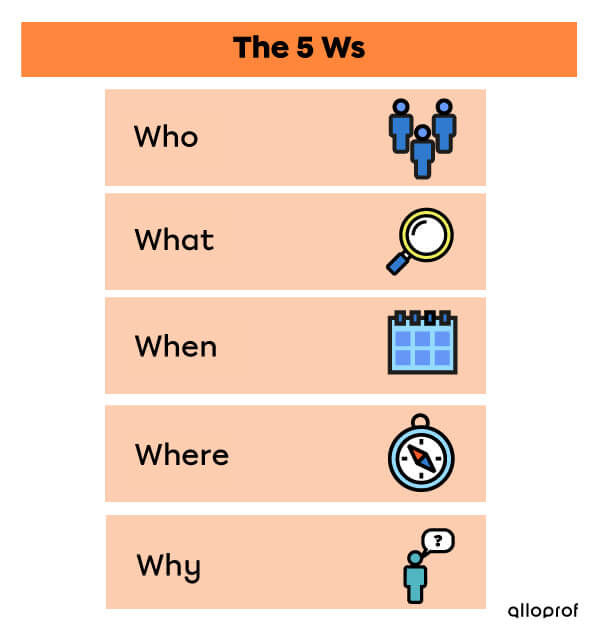
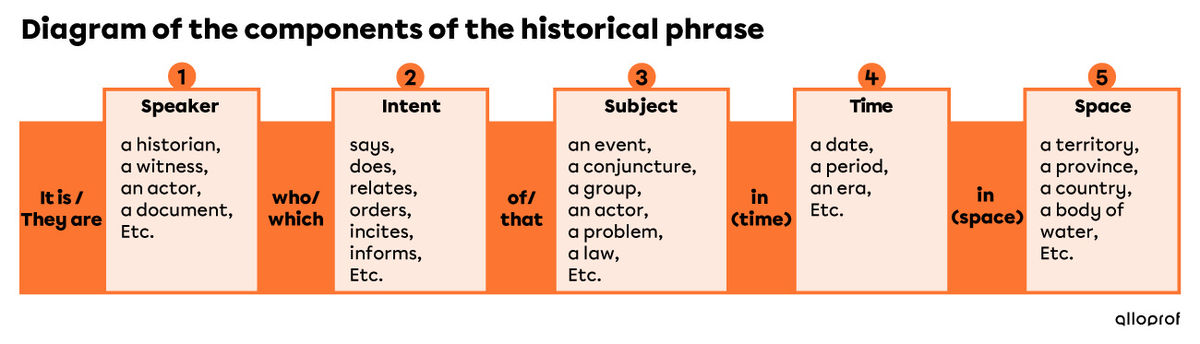
Once you have determined what you must do, and identified the documents needed to do so, you are ready to analyze these documents. Who What When Where Why (The 5 W’s) and the historical phrase are two methods you can use for document analysis.
The Who What When Where Why (The 5 W’s) method is used to quickly identify the important elements of the document (Who? What? When? Where? and Why?).
You use the historical phrase to summarize, in one sentence, the important elements of the document.
You can use whichever method you prefer for document analysis.
The examples of document analysis using the Who What When Where Why (The 5 W’s) method show the answers organized in a table. You do not have to draw this table when you are analyzing your documents: you only have to find the answer.
The table is designed to help you understand how to find each of the answers to the Who What When Where Why (The 5 W).
Both of these methods enable you to summarize the document by taking note of the essential information. You must still call on your personal knowledge in order to understand what is being discussed within the documents and, sometimes, to supplement with more information that does not appear in the document.
Now that you know what you must do, and you have analyzed the documents related to the task, you must make connections between the information taken from these documents and your own knowledge. What do you know and what can you say about the task to complete and the documents you have read?
You don’t need to recall all of the knowledge you have on a subject. Tell yourself that the documents were chosen to help you remember what is essential, and to focus on what is most important for this task. In order to organize your knowledge you may want to take some notes.
Every intellectual operation leads to different tasks. Sometimes you must fill in a table with the letter or number that matches the documents; other times you will have to make complete sentences in order to identify continuity or change; or you may even need to arrange the documents in chronological order. At this point, you must adapt to each intellectual operation.
The important thing to remember is that you must always give a complete answer to what is being asked in the task. Normally, tasks require specific answer formats.
For example, if you must write the letter of a document in a table, you will not have to circle the letter or document itself. Answer format to the intellectual operation Determine Changes and Continuities must be in the form of complete sentences and follow this kind of format: “An element of continuity is (...). “An element of change is (...).”
Assemblée nationale. (1940). Débats de l’Assemblée législative. 21e Législature — 1re session. Vol. 1 - Séances du 20 février au 17 mai 1940 [Document PDF]. https://www.bibliotheque.assnat.qc.ca/DepotNumerique_v2/AffichageNotice.aspx?idn=49473
Auteur inconnu. (15e siècle). Clovis tue Alaric II [Enluminure]. Wikipedia. https://commons.wikimedia.org/wiki/File:Clovis_tue_Alaric_II.jpg
Auteur inconnu. (1540). Heures à l’usage de Rome - Labour et semailles [Enluminure]. Initiale. Catalogue de manuscrits enluminés. http://initiale.irht.cnrs.fr/decor/1360
de la Broquière, B. (1401-1500). Voyage en la terre d’oultre mer [Manuscrit]. Bibliothèque nationale de France. https://archivesetmanuscrits.bnf.fr/ark:/12148/cc542021
Champlain, S. (1632). Carte de la Nouvelle France, augmentée depuis la dernière, servant à la navigation faicte en son vray meridien, par le Sr. de Champlain capitaine pour le Roy en la Marine lequel depuis l’an 1603 jusques en l’année 1629 ; a descouvert plusieurs costes, terres, lacs, rivières et nations de sauvages, par cy devant incognuës, comme il se voit en ses relations quil a faict imprimer en 1632, ou il se voit cette marque ... ce sont habitations qu’ont faict les François [Carte]. Bibliothèque et Archives nationales du Québec. https://numerique.banq.qc.ca/patrimoine/details/52327/2246880
Kurz & Allison. (1896). Fac-simile of the original draught of the Declaration of Independence in general Congress assembled 4th July, 1776 [Document]. Library of Congress. https://www.loc.gov/pictures/item/2003656533/
Leclerc, J. (s.d.). Constitution des États-Unis d’Amérique (1787) - Traduction du gouvernement des États-Unis. L’aménagement linguistique dans le monde. https://www.axl.cefan.ulaval.ca/amnord/USA-Constitution1787.htm
Méliot, J. (15e siècle). Vie et miracles de Notre Dame, en prose française [Manuscrit]. p. 19 r. https://gallica.bnf.fr/ark:/12148/btv1b8451109t/f49.item.zoom
The Miriam and Ira D. Wallach Division of Art, Prints and Photographs: Picture Collection. (1856). Destruction of the tea in Boston Harbour [Image]. New York Public Library. https://digitalcollections.nypl.org/items/510d47e0-f4ed-a3d9-e040-e00a18064a99
Walker, J.H. (1880). La nouvelle façon : 300 paires par jour, 1880 [Gravure]. Musée McCord. http://collections.musee-mccord.qc.ca/scripts/viewobject.php?Lang=2§ion=false&accessnumber=M930.50.5.142&imageID=303037&pageMulti=1