Subjects
Grades
For more concept sheets in the Tools in Geography unit, go to the See also section.
 100%
100%
 100%
100%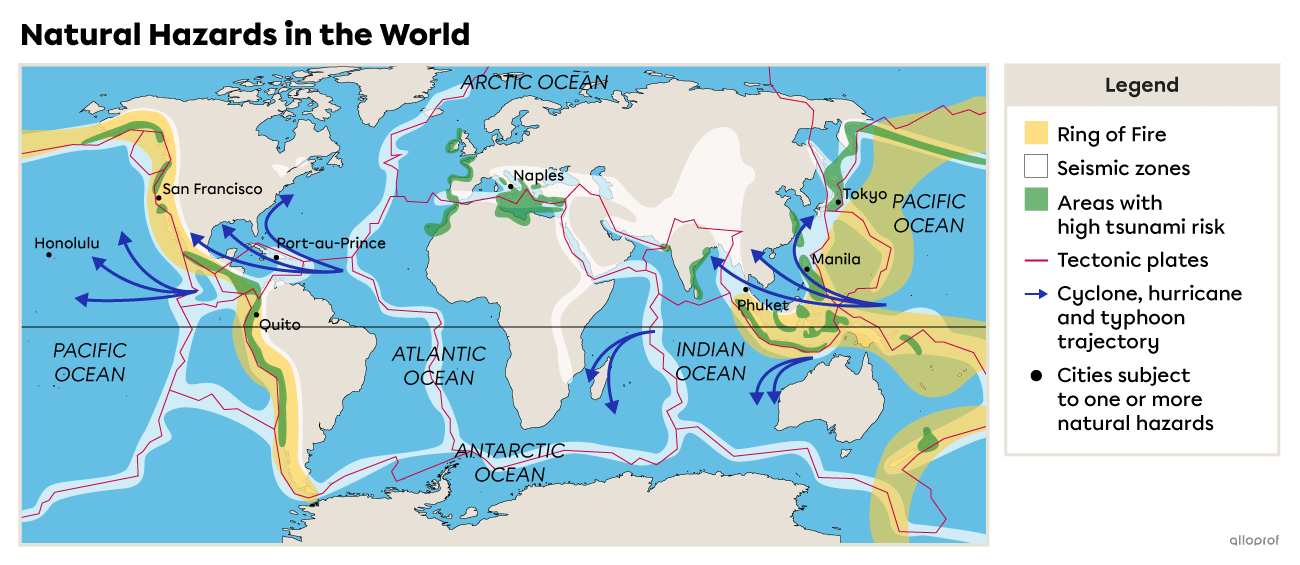 100%
100% 100%
100%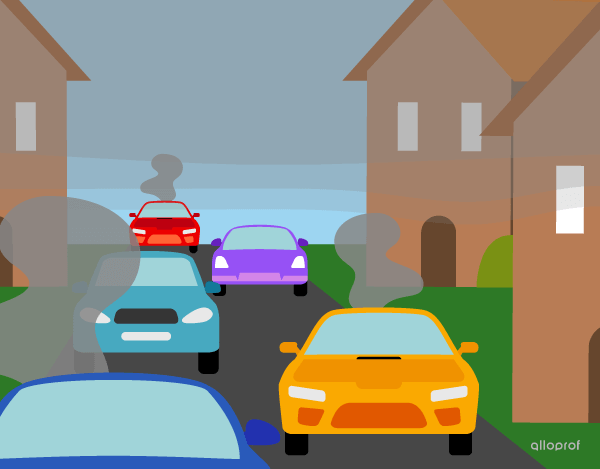 100%
100%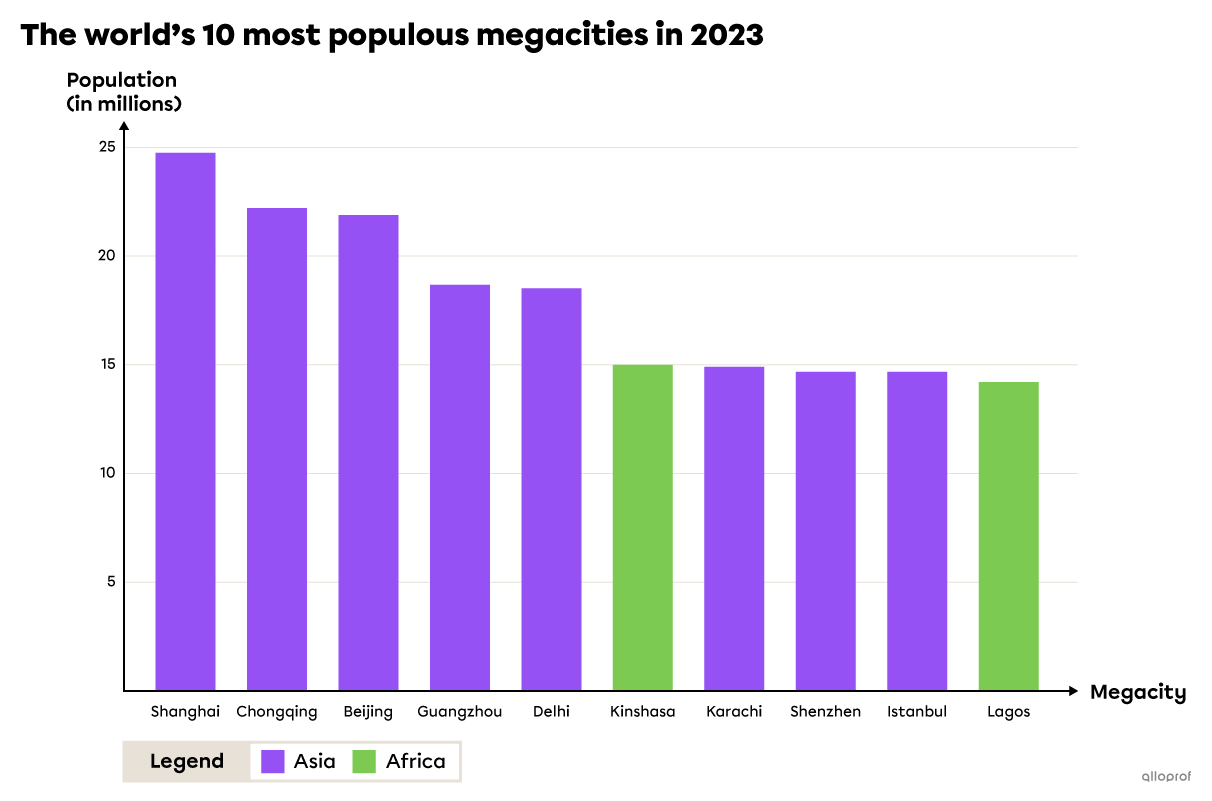
There are many tools used when studying geography. They provide valuable information that can help you better understand the units you are working on.
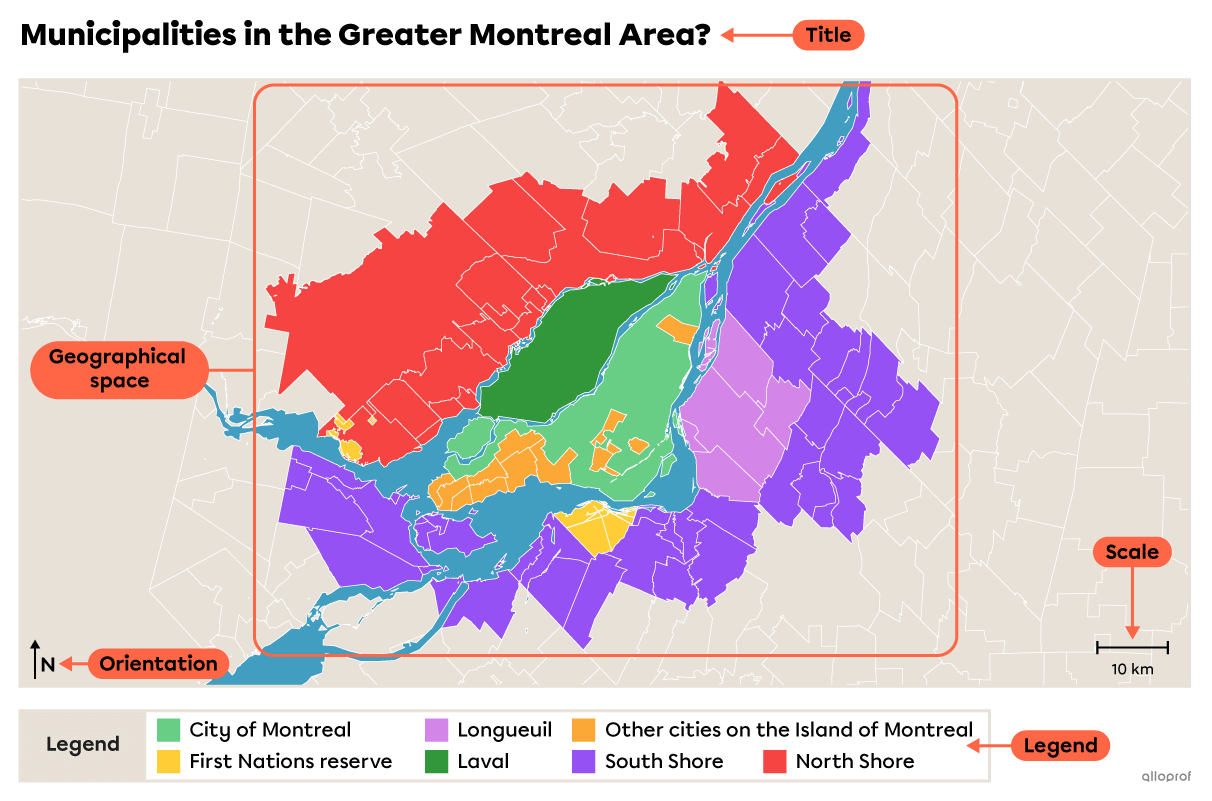
Maps are very useful in geography, as they illustrate the characteristics of a territory. A map can show a small area, such as a city or even a neighbourhood. It can also represent something much bigger, like a continent or even the world.
The information on a map varies according to its type.
Some elements are found on all maps, regardless of type. These elements are useful when interpreting a map:
Title
Orientation and scale
Geographical space
Signs and symbols of the legend

Here are the steps to follow to correctly interpret a map.
Read the title.
It provides information about the subject of the map and the territory that’s represented.
Look at the map’s orientation and scale.
Orientation is represented by a compass rose and the scale shows the size of the area on the map.
Identify the geographical space represented on the map.
What territory do you see on the map? Is it a continent, country, region, city, etc.
Look at the legend.
Study the symbols and signs in the legend, then locate them on the map.
Interpret the information on the map.
After observing the different elements on the map, you will be able to interpret the information presented on it.
What information can be gathered from this map on natural hazards?
In geography, a landscape is presented through a photograph. A landscape can be made up of buildings, fields, roads, rivers, mountains, and more. To fully understand and explain what the landscape shows, you need to observe all its elements. Here’s a 4-step method to do so.
Determine the location of the landscape. There are several clues that can help. Pay attention not only to what you see in the image, but also to the accompanying title, text, and source.
Determine what you are looking for by analyzing the landscape. In other words, what’s your goal? Depending on what you’re looking for, you will observe different elements.
Look at all the elements in the picture and identify which are natural and which were made by humans.
Identify the information in the landscape that’s relevant to your goal. How is the area organized? What do you see?
Knowing that the subject being studied is the planning and development of a tourist area, what are the important elements of this landscape? How could this be interpreted?
A beach in Cancún, Mexico with hotels and facilities
Mexico welcomes millions of tourists every year. The city of Cancún is a popular destination for travellers.
A visual document, also known as an iconographic document, can be a painting, photograph, engraving, drawing, or caricature. In short, it’s an image.
Here are the 6 steps to extract relevant information from a visual document.
Read the title and caption.
What do they tell you about the visual document?
Identify the nature of the document.
Is the visual document a photograph, a drawing, or a caricature? By identifying the nature of the document, you can determine whether it represents reality (like a photograph) or an interpretation of an event or place (like an illustration or caricature).
Find the source and date.
These will tell you who created the document and when the document was produced.
Determine the subject.
What is the subject of the document? What was the creator’s intention in creating it (to show reality or to share a personal vision)?
Gather information about the location, the people, and the circumstances.
By looking at the document, you can determine the place depicted, the activities that take place there, the people involved, the developments in the area, etc.
Identify what is the most relevant.
What useful information does the document give you for analyzing the region?
When studying the issues that affect a metropolis, what information can you extract from this visual document?
Travel in a metropolis
Every day, many cars are driven from the suburbs to downtown.
A written document can take several forms:
A newspaper article
A letter
A contract
A brochure
Etc.
A text contains a great deal of information. The 5W method is very useful to help you find it. By asking yourself the who, what, where, when, and why questions, you’ll be able to extract the key information.
For more information on this method, consult the concept sheet Document Analysis: The 5W and the 5W+H.
When studying issues affecting heritage cities, what information can you extract from this written document?
“UNESCO manages several heritage lists, including one for heritage sites that are in danger. These sites are at risk of serious deterioration or of disappearing altogether. UNESCO created this list to highlight the risk to these sites so that, ideally, they can be better conserved and can receive more assistance to protect them. In 2021, there were 36 cultural heritage sites on the List of World Heritage in Danger.”[2]
Tables are used to organize and present data in a clear and concise way.
To properly interpret the information in a table, there are four steps to follow.
Read the title.
This tells you the subject of the table.
Read the column and row headings.
They often give clues about the units of measurement used.
Determine the nature of the information.
What type of information is in the table? Is it quantitative or qualitative data?
Interpret the table.
Using the information you now have, what information and conclusions can you draw from the table?
| Category |
Wind speed (km/h) |
Possible damage |
|---|---|---|
|
F0 |
104 to 137 km/h |
|
|
F1 |
138 to 177 km/h |
|
|
F2 |
178 to 217 km/h |
|
|
F3 |
218 to 266 km/h |
|
|
F4 |
267 to 322 km/h |
|
|
F5 |
322 km/h and over |
|
SSource of the data: The Weather Channel, 2020[2]. |
||
Graphs are very useful for presenting data in a visual way. There are different types of graphs, depending on the data used. Here are the main ones.
Here is a 4-step method for interpreting any type of graph.
Identify its type.
Is is a bar graph? A pie chart?
Read the title and legend.
What is the graph’s subject? What is it about? What information is provided in the legend?
Look at the axes (x and y).
What information do they give about the unit(s) of measurement used and the categories presented?
Compare the data collected and interpret the graph.
What information can you find by interpreting this graph?
To access the rest of the unit, please consult the Tools in Geography concept sheet.