Subjects
Grades
To access the other concept sheets in the Metropolis module, check out the See Also section.
 100%
100%
 100%
100%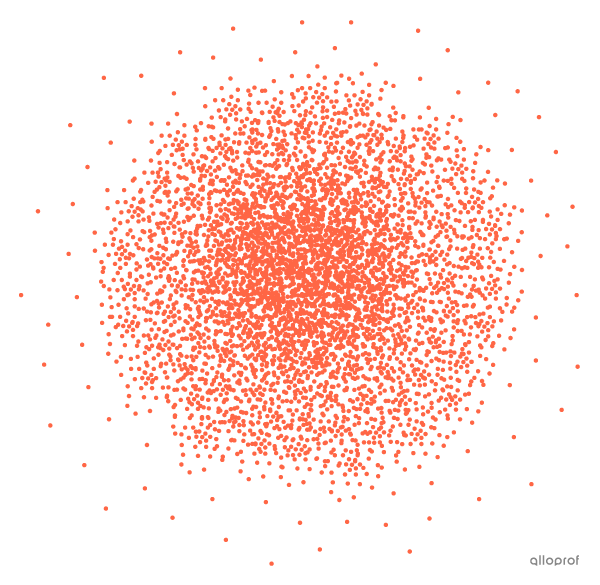 100%
100%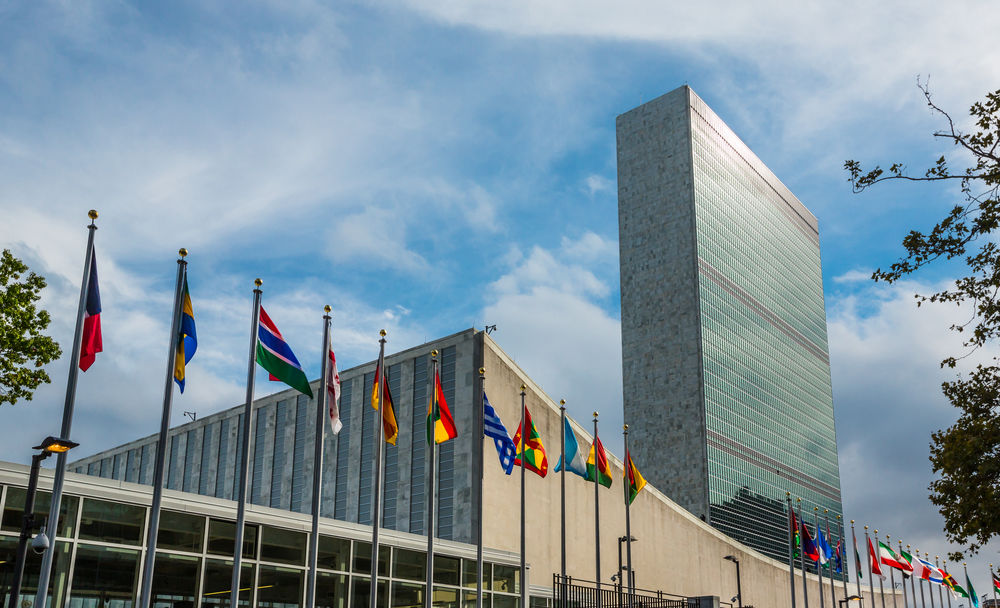 100%
100%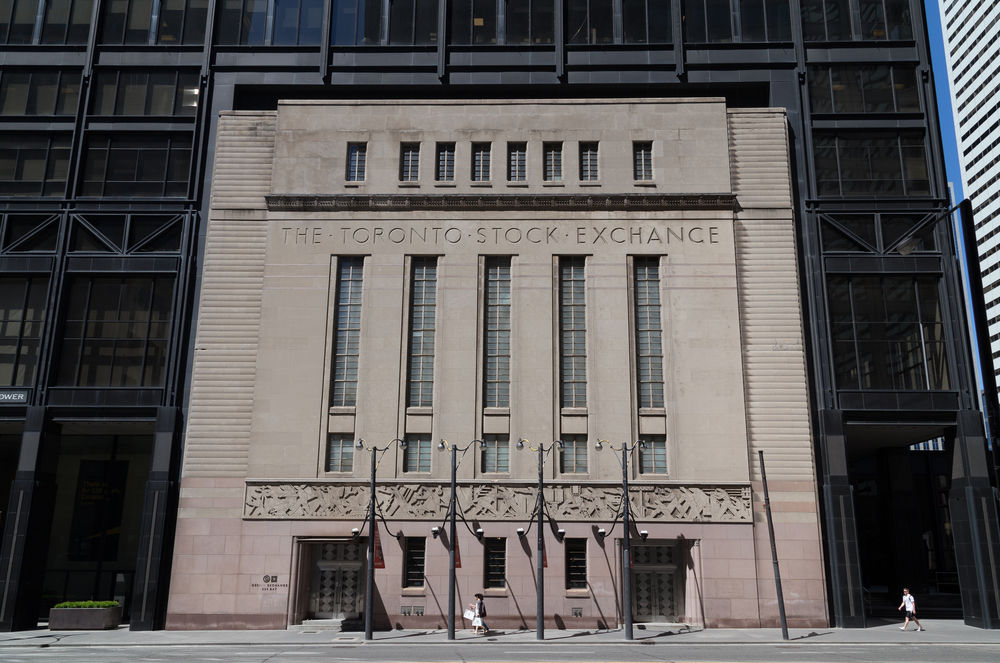
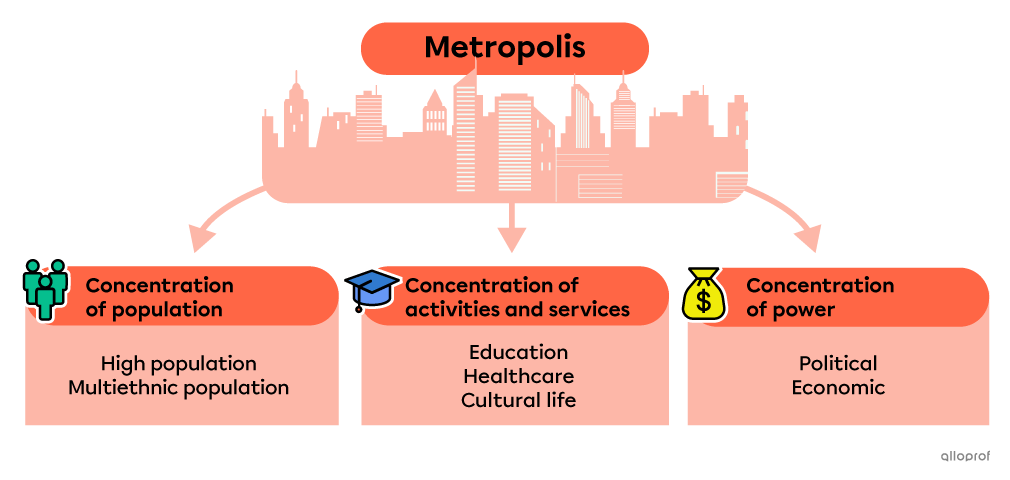
A metropolis is characterized by the following elements.

Concentration refers to a grouping of several elements on the same territory.
A metropolis is distinct from a city in that it includes a concentration of the elements listed above. Cities also have services, head offices and so on, but a metropolis has many more.
One of the main characteristics of a metropolis is that a lot of people live there. In other words, it has a high concentration of population.
Tokyo is a metropolis in Japan. In 2021, it had a population of more than 42 million people[1]. In comparison, the population of Canada the same year was approximately 38 million people[2]. This metropolis has a greater population than an entire country!
An agglomeration is an urban area made up of a main city surrounded by other cities or municipalities.
The map below presents certain cities and metropolises around the world. It shows the difference in population between metropolises as well as between cities and metropolises.
A metropolis is also characterized by a high population density. However, a city with a dense population is not automatically a metropolis. This is one of the elements that characterizes a metropolis.
Population density refers to the average number of individuals living in a given area. It measures the number of inhabitants per square kilometre (inhabitants/km2).
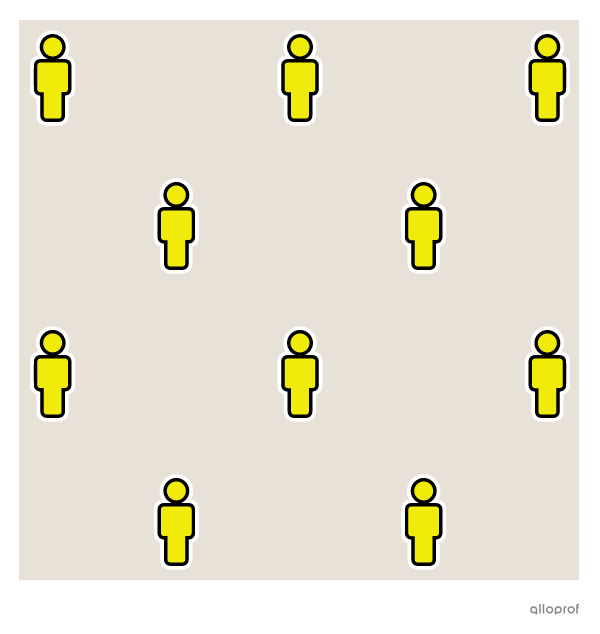
Low density
The lower the density, the fewer the number of people living in a given area.
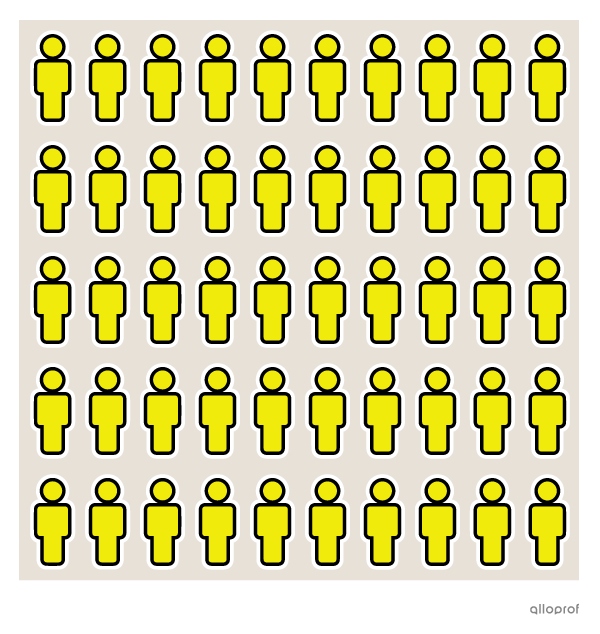
High density
The higher the density, the greater the number of people living in a given area.
Population density can be calculated using the following equation.
|\text{Population density} = \dfrac{\text{total population}}{\text{total area}}|
The metropolis of Tokyo has a population of 42 796 714 inhabitants and an area of 13 495 km2 [3].
What is its population density?
The city of Nagano has a population of 371 749 inhabitants[4] and an area of 834.81 km2 [5].
What is its population density?
A metropolis is characterized by a diverse population. Many immigrants settle in metropolises because there are generally more jobs and services than in cities and towns. The fact that immigrants settle in metropolises leads to the development of different cultural communities. New immigrants tend to settle where people of the same ethnic origin are already living, giving metropolises a multiethnic character.
Multiethnicity is a term that describes a population composed of people from different origins living in the same area.
The metropolis of Vancouver has a large number of immigrants. According to the 2016 census, more than 950 000 of the 2 500 000 inhabitants in the metropolis were born outside Canada. Of these immigrants, 70.5% were of Asian origin and 17.3% were of European origin[6].
A metropolis is also characterized by the concentration of powers. This can be divided into two categories:
Political power
Economic power
A metropolis usually has a concentration of political power. Various political institutions are located there, such as embassies, government departments and international organizations. Sometimes, it is the capital of the country or a region.
In the United States, Washington, D.C. is a metropolis as well as the capital of the country.
A metropolis is not necessarily a capital. For example, in Quebec, Montreal is the metropolis of the province, but Quebec City is the capital.
Even if a metropolis is not a capital, it can still have a concentration of political power at the international level with the presence of international political organizations.
The headquarters of the United Nations (UN) is located in New York City, in the United States. The UN is an international organization with various missions, such as peacekeeping, global security and the protection of human rights.
United Nations headquarters in New York City
The concentration of economic power distinguishes a metropolis from a city. Several economic institutions, such as the stock exchange, banks and large companies have their head offices in metropolises.
The exchange is a place where company stock are bought and sold.
Headquarters: Location of the main operations of governmental and non-governmental organizations (NGO)
The Toronto Stock Exchange is located in the metropolis of the same name.
Toronto Stock Exchange Building
A metropolis is also distinct from a city because of the concentration of its activities and services.
| General examples | Specific example | |
|---|---|---|
| Activities |
|
Each year, London hosts one of the most important tennis tournaments: the Wimbledon Championships. |
| Services |
|
Boston is a renowned student metropolis with more than 15 universities, including the prestigious Harvard University and the Massachusetts Institute of Technology (MIT)[7]. |
To access the rest of the module, you can consult the following concept sheets.
Population Data. (2021, September 29). Japon. https://www.populationdata.net/pays/japon/
Statistics Canada. (2021, December 16). Canada’s population estimates, third quarter 2021. Gouvernement of Canada.https://www150.statcan.gc.ca/n1/daily-quotidien/211216/dq211216c-eng.htm?indid=4098-1&indgeo=0
[Larousse. (n.d.). Tokyo. https://www.larousse.fr/encyclopedie/ville/Tokyo/146987
Ville de Nagano. (2021, December 23). 長野市の人口及び世帯数(令和4年4月1日現在)[Population et nombre de ménages dans la ville de Nagano (au 1er décembre, 3e année de Reiwa)]. https://www.city.nagano.nagano.jp/soshiki/shimado/2097.html
Ville de Nagano. (2018, April 1). 人口・面積・自然 [Population / superficie / nature]. https://www.city.nagano.nagano.jp/site/enkaku-gaiyo/5451.html
Statistics Canada. (2019, July 18). Focus on Geography Series, 2016 Census.https://www12.statcan.gc.ca/census-recensement/2016/as-sa/fogs-spg/Facts-cma-eng.cfm?LANG=Eng&GK=CMA&GC=933&TOPIC=7
uniRank. (2021). Top Universities in Massachusetts. https://www.4icu.org/us/massachusetts/
Davidson, C. (s.d.). Dubai. Encyclopedia Britannica. https://www.britannica.com/place/Dubai-United-Arab-Emirates
Government of the district of Columbia. (n.d.). New Population, New Year, New Housing. https://mayor.dc.gov/release/new-population-new-year-new-housing
Institut national de la statistique et des études économiques. (2022, January 17). Comparateur de territoire. https://www.insee.fr/fr/statistiques/1405599?geo=UU2020-00851
Joburg. (n.d.). About de City. https://www.joburg.org.za/about_/Pages/About%20the%20City/About%20Joburg/Population-and-People.aspx
Macrotrends. (n.d.). Gwangmyeong, South Korea Metro Area Population 1950-2022. https://www.macrotrends.net/cities/21751/gwangmyeong/population#
M. Pitt, L. (2022, May 19i). Los Angeles. Encyclopedia Britannica. https://www.britannica.com/place/Los-Angeles-California
Normand, G. (2016, October 13). La population de Londres a augmenté deux fois plus vite que le reste du pays. La Tribune. https://www.latribune.fr/economie/union-europeenne/la-population-de-londres-a-augmente-deux-fois-plus-vite-que-le-reste-du-pays-607447.html
Population Data. (n.d.). Palmarès - Les plus grandes villes du monde. https://www.populationdata.net/palmares/villes/
Statistics Canada. (2019, July 18). Focus on Geography Series, 2016 Census. Government of Canada. https://www12.statcan.gc.ca/census-recensement/2016/as-sa/fogs-spg/Facts-cma-eng.cfm?LANG=Eng&GK=CMA&GC=535&TOPIC=1
Statistics Canada. (2019, 18 July 18). Focus on Geography Series, 2016 Census. Government of Canada. https://www12.statcan.gc.ca/census-recensement/2016/as-sa/fogs-spg/Facts-cma-eng.cfm?LANG=Eng&GK=CMA&GC=933&TOPIC=1
Statistics Canada. (2021, October 27). Census Profile, 2016 Census. Government of Canada. https://www12.statcan.gc.ca/census-recensement/2016/dp-pd/prof/details/page.cfm?Lang=F&Geo1=CSD&Code1=2466023&Geo2=CD&Code2=2466&SearchText=Montreal&SearchType=Begins&SearchPR=01&B1=All&TABID=1&type=0
Stefon, M. (2022, May 26). Boston. Encyclopedia Britannica. https://www.britannica.com/place/Boston
Ville de Nagano. (2021, December 23). 長野市の人口及び世帯数(令和4年4月1日現在)[Population et nombre de ménages dans la ville de Nagano (au 1er décembre, 3e année de Reiwa)]. https://www.city.nagano.nagano.jp/soshiki/shimado/2097.html
Ville de Québec. (n.d.). Portrait - Ville de Québec. https://www.ville.quebec.qc.ca/apropos/portrait/quelques_chiffres/ville/index.aspx
Yu, W.-i. (n.d.). Seoul. Encyclopedia Britannica. https://www.britannica.com/place/Seoul/History