Subjects
Grades
To access the other sheets in the Metropolis unit, check out the See Also section.
 100%
100%
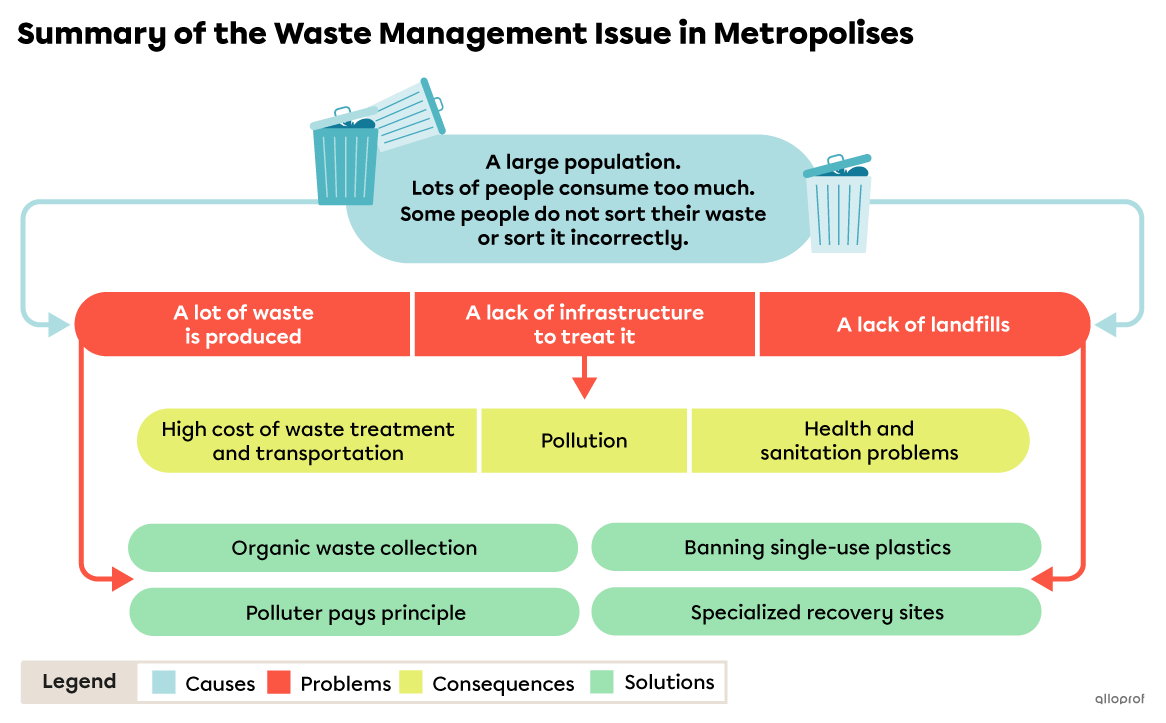
Several causes account for the waste management issue in metropolises:
a large population
a high level of consumption of goods
inadequate waste sorting
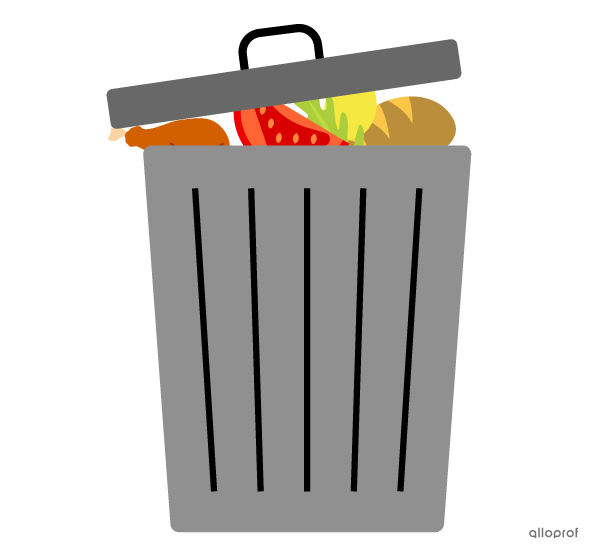
In geography, an issue is a problem related to the use or planning and development of a territory. An issue can be environmental, economic, political, social, etc.
The production of a large quantity of waste
Large populations and high consumption result in the production of a large quantity of waste. Since this waste is not always sorted, some of it that could have been recycled or composted, ends up in the garbage.
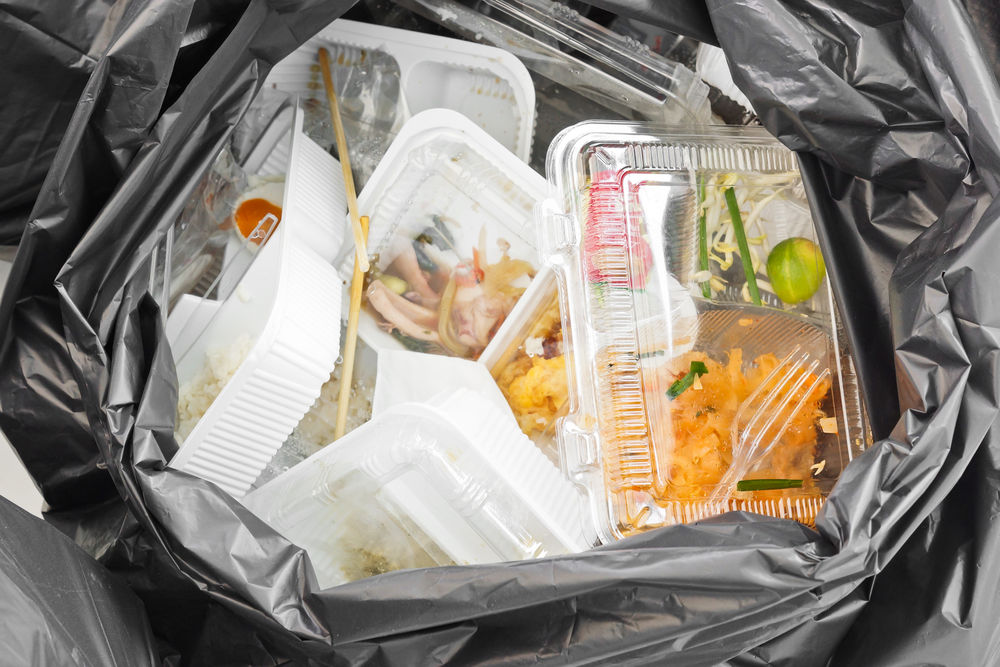
Unsorted waste
The lack of waste treatment infrastructure
Not all metropolises have the infrastructure required (sorting centre, incinerator, ecocentre, etc.) to treat the various types of waste.
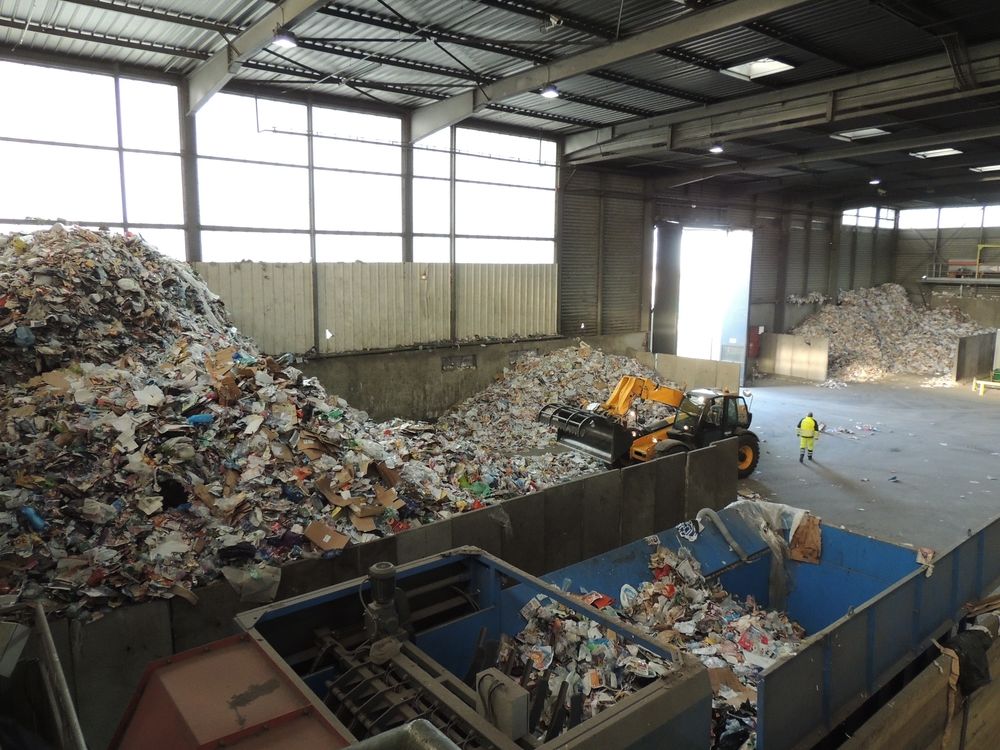
Recycling centre
Lack of landfill sites
Several landfills located near metropolises are full. New sites tend to be located far from major urban centres, requiring more management by the city.
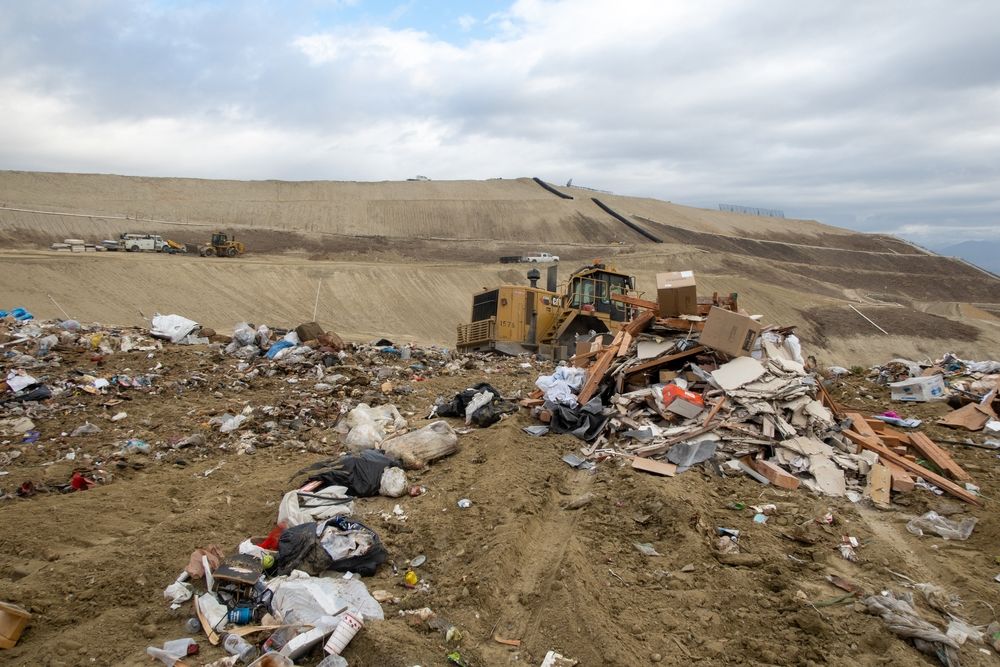
Landfill site in California
A landfill site is a place where household and industrial waste is buried.
The production of large quantities of waste, inadequate infrastructure and a lack of landfill sites are all problems with major impacts on the economy, the environment and health.
| Consequences | Explanations |
|---|---|
| High costs and problems of waste transportation | The lack of space for burying waste requires metropolises to find landfill sites further and further away. This adds to costs and also causes problems related to waste transportation. |
| Pollution | Two ways of getting rid of waste are to bury it or burn it. However, both of these methods are bad for the environment, with the production of polluting gases and the contamination of waterways. |
| Health and sanitation problems | In developing countries, many people live surrounded by waste because landfills are often situated in slums. In some cases, people live close to waterways that have been polluted by waste. |
Here are a few examples of solutions that could be implemented to address problems related to waste management.
Implement the polluter pays principle. The more waste someone throws out, the more they must pay. Having to pay for waste encourages people to cut down on their waste production.
Collect organic waste in order to make compost or convert it into energy. Various technologies exist or are currently being tested to convert biomass into energy, such as electricity.
Ban single-use plastics, such as straws, utensils and grocery bags to prevent the rapid production of waste.
Open up specialized recovery sites to recover electronic devices, car and other batteries, paint and other items that are difficult to recycle.
Open up recovery centres, like ecocentres, to direct waste to the appropriate place for recycling.
Biomass refers to organic matter like firewood, agricultural waste and animal excrement.
Organic waste is waste that comes from a plant or animal.
In fall 2021, the City of Montreal introduced a regulation to limit the distribution of single-use plastics in two phases. On September 1, 2022, the distribution of plastic bags was banned, and on March 1, 2023, the ban was extended to all single-use plastics under the regulation, such as polystyrene food containers.
To find out more about this City of Montreal initiative, check out the following article:
To access the rest of the module, you can consult the following concept sheets.
