Subjects
Grades
Many languages are spoken in Canada. In Quebec, special emphasis is placed on protecting the French language, particularly on public signage and in schools. Across Canada, measures are being taken to support Indigenous languages.
Since the 2000s, Quebec’s population has been changing: A growing proportion of residents has a mother tongue that is neither French nor English. In 2021, 13.9% of the Quebec population had a mother tongue other than French or English[1].
To promote the French language in the province, the Quebec government prioritizes immigrants who already speak French. Francization courses or welcome classes (classes d’accueil) are also offered to help immigrants learn French. Thanks to these efforts, French remains the language used every day by the vast majority of the population. Although many immigrants speak another language at home, they use French to participate in everyday life in Quebec.
In 2021, there were nearly a million Francophone Canadians living outside Quebec. The number of bilingual people was even higher. These populations are mainly found in Ontario, New Brunswick, and Alberta[2].
The work of the Laurendeau-Dunton Commission highlighted the socio-economic inequalities experienced by Francophones, who were often given lower wages and less respected. This led the Canadian government to pass the Official Languages Act in 1969, recognizing the equality of English and French and guaranteeing the provision of federal services in both languages.
Driven by concerns over demographic decline and the growing anglicization of immigrants, Quebec passed several laws to make French its primary language.
This effort culminated in 1977 with the adoption of Bill 101 (the Charter of the French Language). This law transformed society in Quebec by establishing French as the sole official language of the province. It mandated the use of French on public signage and in the workplace and, most importantly, made French-language schooling mandatory for the majority of children from immigrant backgrounds.
A number of legal challenges have resulted court rulings, leading to amendments to to Bill 101 since its adoption.
The requirement to use only French for public signage was one of the most contentious aspects of Bill 101. In response, Anglophone groups in Quebec mobilized to repeal or amend this part of the law.
| 1988 - Supreme Court of Canada Ruling | This ruling stated that the obligation to use only French in commercial and public signage violates freedom of expression. However, it would be possible to require a clear predominance of French in such signage. |
| 1988 - Adoption of Bill 178 | French remained the only language for outdoor signage, but indoors, both French and another language was used. However, French had to be predominant (more visible). |
| 1993 - Bill 86 | Bilingual signage was generally permitted (both indoors and outdoors), but French had to be predominant. |


Home Depot storefront
Since the store’s name is in English, the company chose to add French text to the storefront. This text describes what shoppers will find inside the store: home renovation supplies.

Bureau en gros storefront
Elsewhere in Canada, this company is known as Staples. Since this is an English name, the company decided to change to a French name, Bureau en gros, for its locations in Quebec. The rest of the storefront signage is in French.
The adoption of Bill 101 marked a major turning point: It made French the primary language of instruction in schools. Before this law, rules around language of instruction were more flexible, favouring English.
From this point on, the majority of students in Quebec, including the children of immigrants, would be required to attend French-language schools. Access to English-language schools would be restricted to children whose parents themselves received their primary education in English in Canada.
The language of instruction became a source of contention and conflict. Many parents would have liked to send their children to English-language schools, but Bill 101 severely restricted access.
In the early 1980s, to get around the rules of Bill 101, some parents sent their children to unsubsidized private English schools. These schools acted as “bridges”: once a child had attended a private English-language school for one year, they could be admitted to the public English-language system. This allowed parents to bypass the rules and send their children to English schools instead of French ones.
Over time, the rules for attending English schools became stricter. In the 2000s, a number of laws were passed and then amended to make access to subsidized English-language schools through so-called bridging schools more complicated. For example, in 2010, a law set criteria such as attendance at a private, unsubsidized English school for at least three years before being able to transfer to the public or subsidized network.
There are over 70 Indigenous languages in Canada[3]. They are classified into 12 language families, such as Algonquian, Inuit, and Iroquoian. In Quebec, around a dozen Indigenous languages are still actively spoken.
These languages are an important means of transmitting the culture, history, and knowledge of Indigenous peoples. However, these languages are not officially recognized in the Constitution Act, 1982.
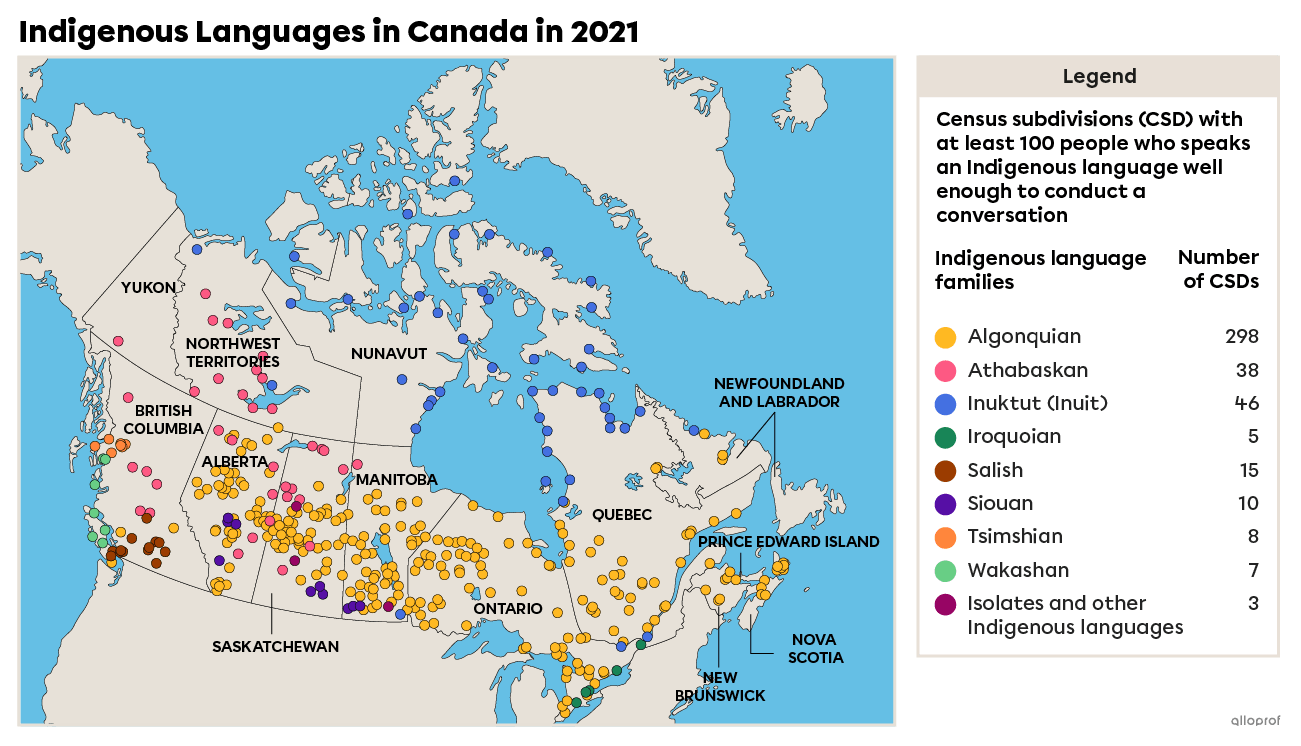
The majority of Indigenous languages in Canada are at risk of extinction, given the small number of people still able to speak them. Today, around 40 Indigenous languages are spoken by 500 people or fewer[4]. This situation is the result of assimilation policies put in place by the federal and provincial governments, such as residential schools and the Indian Act. These measures have prevented older generations from passing on the language and culture to their children.
Inuktitut is the only Indigenous language in Canada not considered endangered, as there are enough speakers in Nunavut and Quebec to ensure its viability.
The territory of Nunavut has 3 official languages:
Nunavut’s Official Languages Act, for example, guarantees the right to receive government services in the language of one’s choice.
This territory has also adopted the Inuktitut Protection Act. Its aim is to help protect and promote the Inuktitut language, both for learning it and for working in it (in territorial institutions).
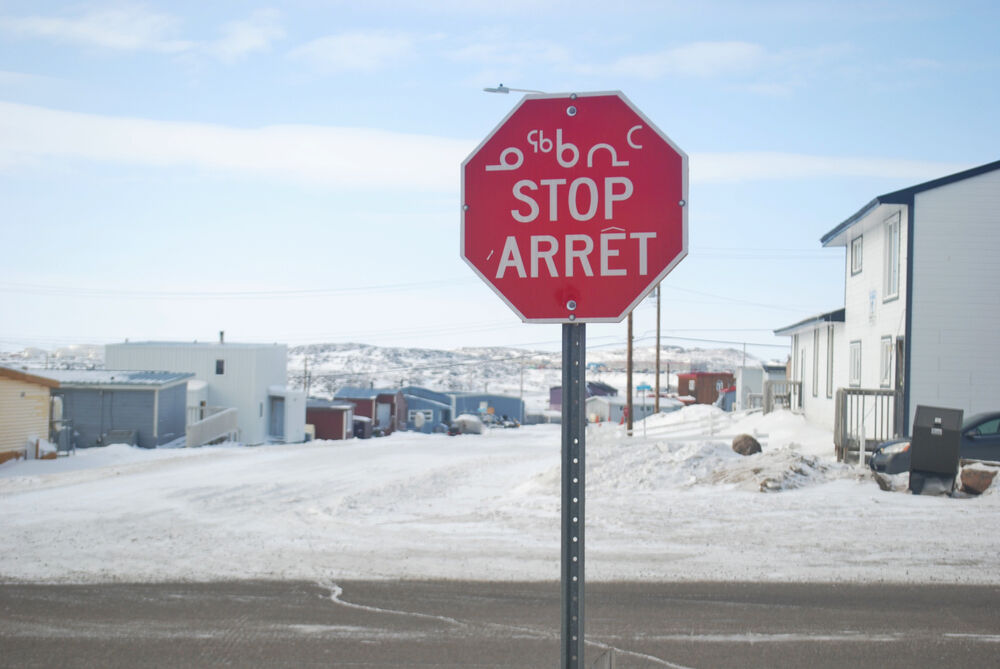
A trilingual stop sign in Iqaluit, Nunavut
Various measures are in place to support the use of Indigenous languages. In 2019, the federal government passed the Indigenous Languages Act. This law provides tools for the protection and promotion of these languages.
According to census data, more and more Indigenous people are learning their ancestral language as a second language. This learning is encouraged by immersion programs in schools, standardization of spelling, and the teaching of these languages in the classroom. Organizations have also been set up to support Indigenous languages and help pass them on.