Subjects
Grades
 100%
100%
 100%
100%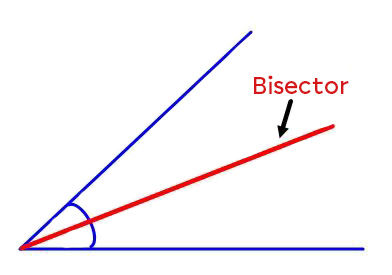
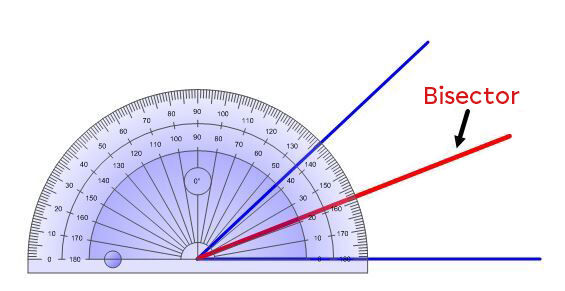
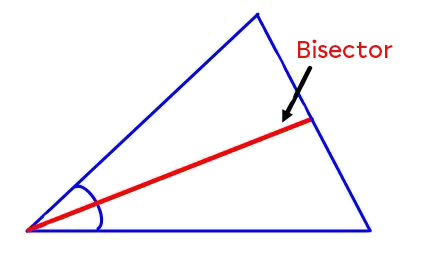
The bisector is a line (or line segment) that divides an angle into two equal angles.
A bisector can be considered the axis of symmetry of an angle. Thus, each point belonging to a bisector is located the same distance from the two sides that make up the angle.
We can draw the bisector of an angle in two ways:
We can construct the bisector of an angle, whether it is included in a plane figure or not.

Open the compass and keep the same opening for all steps of the construction.
Place the compass’ sharp point on the angle’s apex (vertex) and draw an arc that intersects both sides of the angle.
Place the compass’ sharp point on an intersection of the circle’s arc and one side of the angle. Draw a new arc in the angle opening. Repeat the operation from the other intersection point.
Using a ruler, draw the straight line that connects the angle’s vertex to the intersection point of the last two drawn arcs. This straight line is the bisector of the angle.
Open the compass and keep the same opening for all steps of the construction.
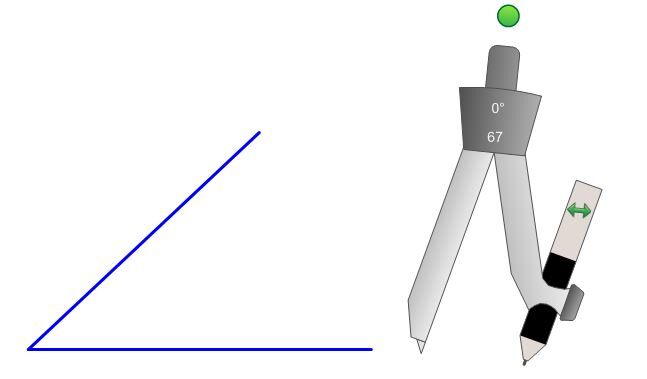
Place the compass’ sharp point on the angle’s apex (vertex) and draw an arc that intersects both sides of the angle.
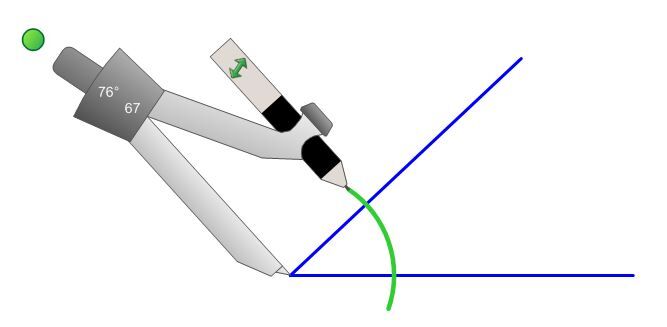
Place the compass’ sharp point at an intersection of the circle’s arc and one side of the angle. Draw a new arc in the angle opening. Repeat the operation from the other intersection point.
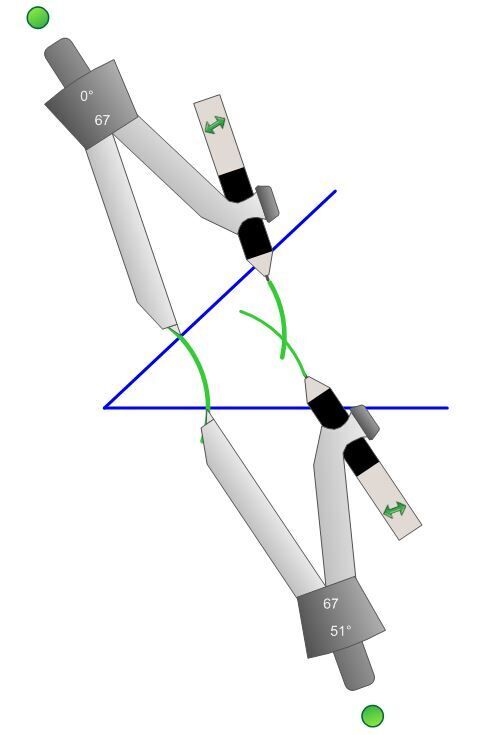
Using a ruler, draw the straight line that connects the angle’s vertex to the intersection point of the last two arcs drawn. This line is the angle’s bisector.
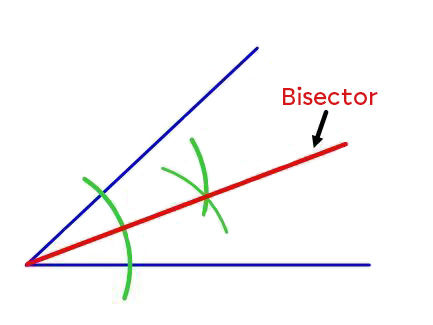
You can use a protractor to draw the bisector of an angle by following these steps:
With a protractor, measure the angle you want to separate into two equal parts.
Divide the angle value in half.
Trace the angle calculated in step 2 using the protractor and a ruler.
Using a protractor, measure the angle you want to separate into two equal parts.
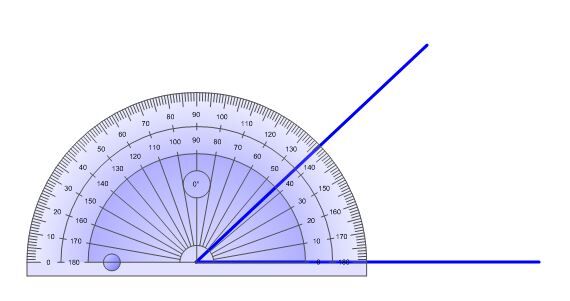
Divide the angle’s value in half.
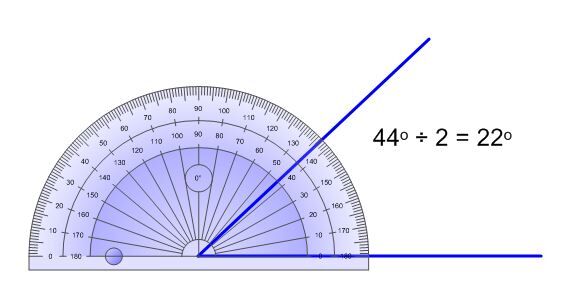
Draw the angle calculated in step 2 using the protractor and a ruler.