Conversion of Units of Measure for Length - Cycle 3

| Mathematics

How Can a Length Measurement Be Converted to a Smaller Unit Using a Table?

Be careful!

You need to know the equivalencies between units of measure for length before learning to make conversions.

To see these equivalences, you can read the concept sheet Units of Measure for Length.

To convert a length measurement to another unit, you can use a units of measure for length table. In the table, the largest unit of measure the kilometre (km), is on the far left.
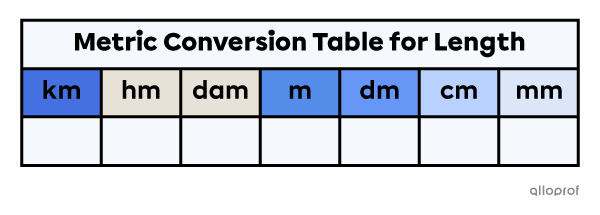
Units of measure for length table with, from left to right, km, hm, dam, m, dm, cm and mm.

Rule

Follow these steps to convert a length measurement to a smaller unit:

  1. I find the column with the unit of measure of the starting number.
  2. In this column, I write the digit that is in the ones position.
  3. I write the remaining digits, one per column, of the number. If there is a decimal point, I write it too.
  4. I find the column of the new unit of measure.
  5. If there is a decimal point, I move it to the right of the column of the new unit of measure.
  6. I put a 0 in each empty column up to the column of the new unit of measure.
Example

Convert 459 m into cm.

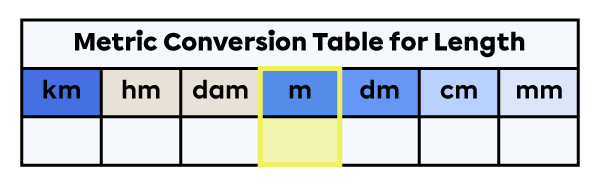
  1. I find the column with the unit of measure of the starting number.
Units of measure for length table with the metres column highlighted.
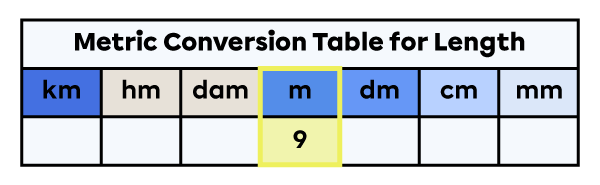
  1. In this column, I write the digit that is in the ones position.
Units of measure for length table with a 9 placed in the metres column.
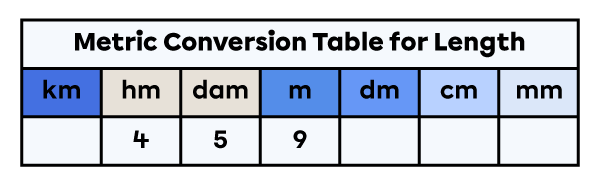
  1. I write the remaining digits, one per column, of the number. If there is a decimal point, I write it too.
Units of measure for length table with 459 metres placed in it.
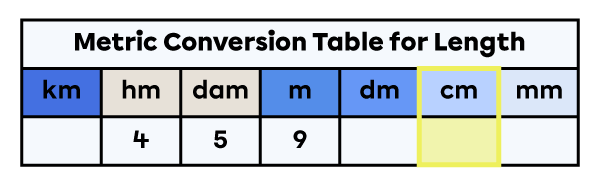
  1. I locate the column of the new unit of measure.
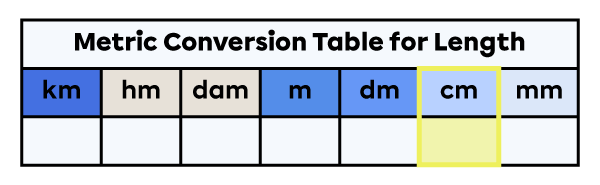
Units of measure for length table with the centimetre column highlighted.
  1. If there is a decimal point, I move it to the right of the column of the new unit of measure.
Since there is no decimal point, I skip to the next step.
  1. I put a 0 in each empty column up to the column of the new unit of measure.
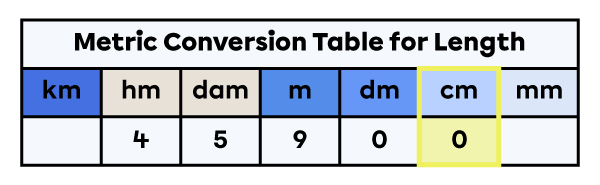
Units of measure for length table with 459000 centimetres placed in it.

459 m is equivalent to 45 900 cm.

Example

Convert 5.6 km into m.

  1. I find the column with the unit of measure of the starting number.
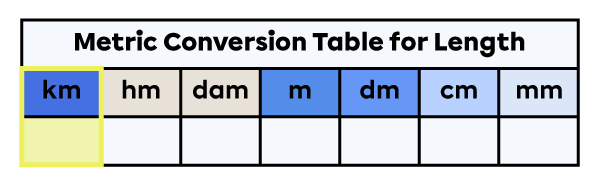
Units of measure for length table with the kilometre column highlighted.
  1. In this column, I write the digit that is in the ones position.

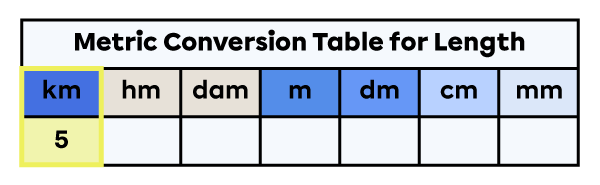
    In the number 5.6, the digit in the ones position is 5.

Units of measure for length table with a 5 placed in the kilometre column.
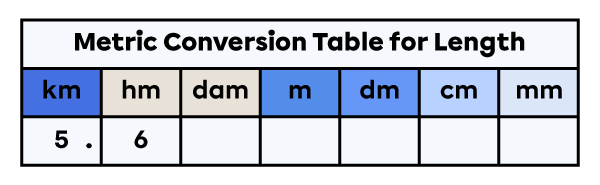
  1. I write the remaining digits, one per column, of the number. If there is a decimal point, I write it too.
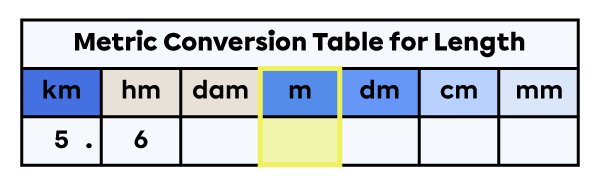
Units of measure for length table with the 5.6 kilometre measurement in it.
  1. I locate the column of the new unit of measure.
Units of measure for length table with the metre column highlighted.
  1. If there is a decimal point, I move it to the right of the column of the new unit of measure.
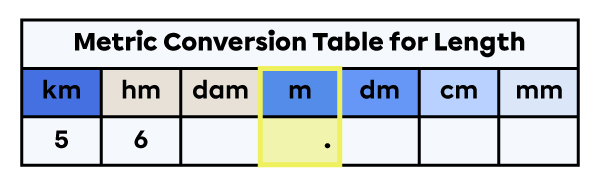
Units of measure for length table in which a decimal point is placed on the right in the metres column.
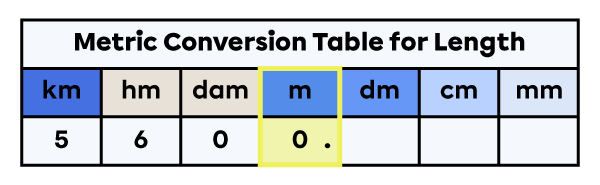
  1. I put a 0 in each empty column up to the column of the new unit of measure.
Units of measure for length table with 5600 metres placed in it.

5.6 km is equivalent to 5600 m.

How Can a Length Measurement Be Converted to a Larger Unit Using a Table?

Be careful!

You need to know the equivalencies between units of measure for length before learning to make conversions.

To see these equivalences, you can read the concept sheet Units of Measure for Length.

To convert a length measurement to another unit, you can use a units of measure for length table. In the table, the largest measurement unit, the kilometre (km), is on the far left.
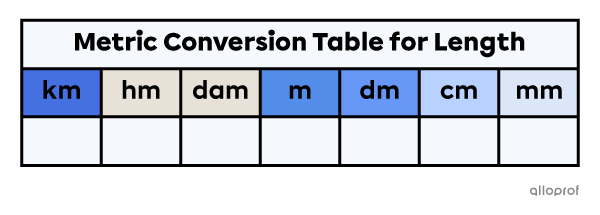
Units of measure for length table in which there are, from left to right, km, hm, dam, m, dm, cm and mm.

Rule

I follow these steps to convert a length measurement to a larger unit:

  1. I find the column with the unit of measure of the starting number.
  2. In this column, I write the digit that is in the ones position.
  3. I write the remaining digits, one per column, of the number. I also write the decimal point, if there is one.
  4. I find the column of the new unit of measure.
  5. I place the decimal point to the right of the column of the new unit of measure.
  6. I put a 0 if there is no number in the new unit column or in any of the empty columns to the right of the decimal point.
Example

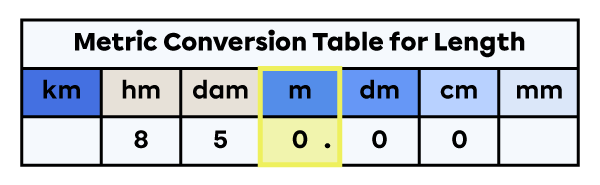
Convert 85 000 cm into m.

  1. I find the column with the unit of measure of the starting number.
Units of measure for length table with the centimetre column highlighted.
  1. In this column, I write the digit that is in the ones position.

    In the number 85 000, the digit in the ones position is 0.

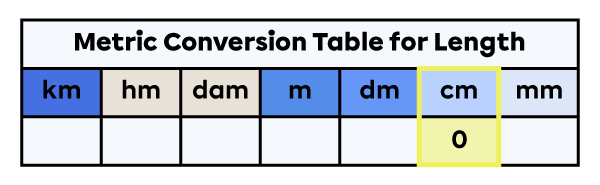
Units of measure for length table with a 0 in the centimetre column.
  1. I write the remaining digits, one per column, of the number. I also write the decimal point, if there is one.
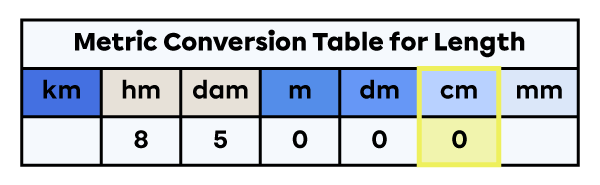
Units of measure for length table with 85000 centimetres placed in it.
  1. I find the column of the new unit of measure.
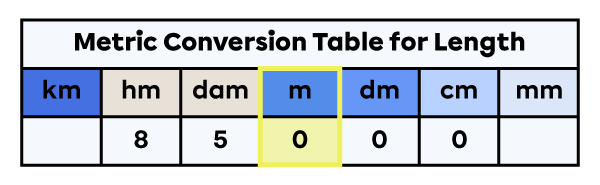
Units of measure for length table with the metres column highlighted.
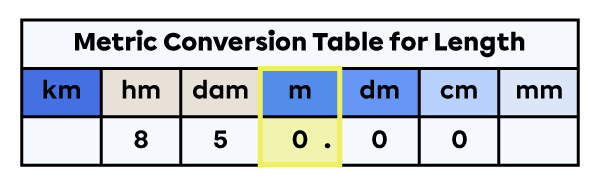
  1. I place the decimal point to the right of the column of the new unit of measure.

    Since there is no decimal point in the number 85 000, I add one.

Units of measure for length table with a decimal point on the right in the metres column.
  1. I put a 0 if there is no number in the new unit column or in any of the empty columns to the right of the decimal point.

    Since there is a number in the new unit column and in the columns to the right of the decimal point, I don't have to do this step.

Units of measure for length table with 850 metres placed in it.

85 000 cm is equivalent to 850 m.

Example

Convert 795 m into km.

  1. I find the column with the unit of measure of the starting number.
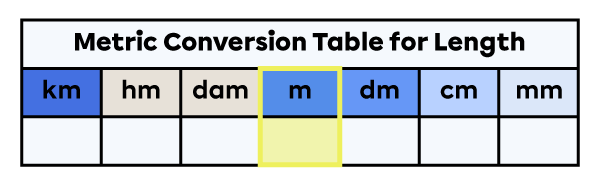
Units of measure for length table with the metre column highlighted.
  1. In this column, I write the digit that is in the ones position.

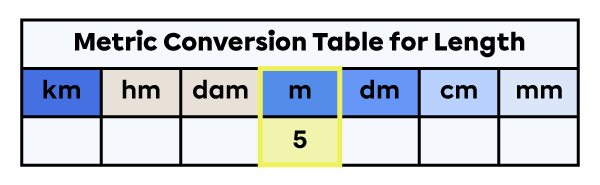
    In the number 795, the digit in the ones position is 5.

Units of measure for length table with a 5 in the metre column.
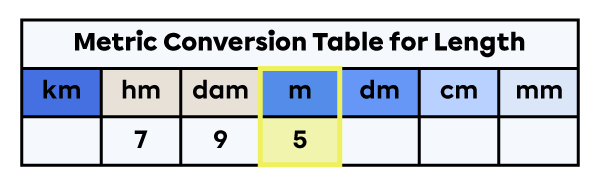
  1. I write the remaining digits, one per column, of the number. I also write the decimal point, if there is one.
Units of measure for length table with 795 metres placed in it.
  1. I find the column of the new unit of measure.
Units of measure for length table with the kilometre column highlighted.
  1. I place the decimal point to the right of the column of the new unit of measure.
Units of measure for length table with a decimal point to the right in the kilometre column.
  1. I put a 0 if there is no number in the new unit column or in any of the empty columns to the right of the decimal point.
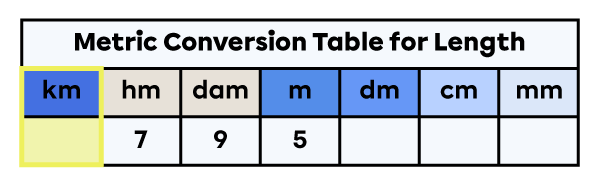
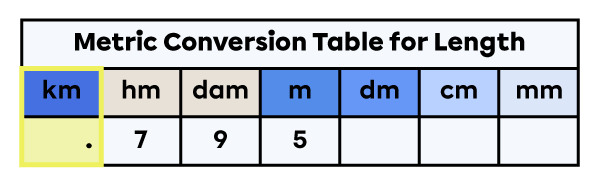
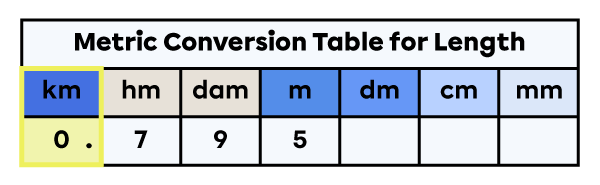
Units of measure for length table with 0.795 kilometres placed in it.

795 m is equivalent to 0.795 km.

How Can a Length Measurement Be Converted to a Smaller Unit Using Multiplication?

Be careful!

You need to know the equivalencies between units of measure for length before learning to make conversions.

To see these equivalences, you can read the concept sheet Units of Measure for Length.

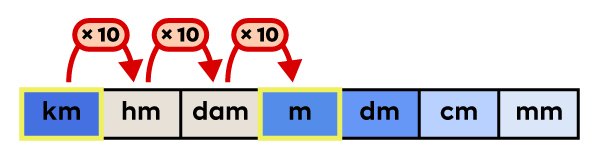
To convert a length measurement to a smaller unit, you must multiply the measurement by 10 each time you convert it to a smaller unit.
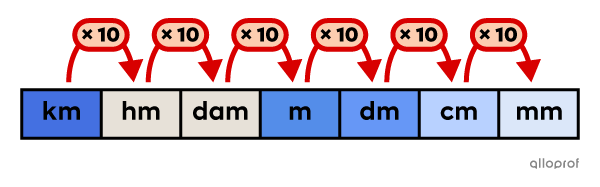
Tableau de conversion des unités de mesure de longueur montrant les proportions entre chacune d’elles.

Rule

Follow these steps to convert a length measurement to a smaller unit:

  1. Identify the starting unit of measure of the number.
  2. Determine the new unit of measure.
  3. Multiply the measurement by 10 for each smaller unit of measure until the new unit of measure is reached.
Example

Convert 7.5 km into m.

  1. Identify the starting unit of measure of the number.

    The starting measurement unit is kilometres.

7,5 km
  1. Determine the new unit of measure.

    The new unit of measure is metres.

7,5 km = ? m
  1. Multiply the measurement by 10 for each smaller unit of measure until the new unit of measure is reached.

    To go from km to m, I multiply the measurement by 10, 3 times.

    7,5 km × 10 = 75 hm
    75 hm × 10 = 750 dam
    750 dam × 10 = 7 500 m

    To save some time, I can also multiply by 1000.

    7,5 km × 1 000 = 7 500 m

Conversion table of units of measure for length with kilometres and metres highlighted.

7.5 km is equivalent to 7500 m.

How Can a Length Measurement Be Converted to a Larger Unit Using Division?

Be careful!

You need to know the equivalencies between units of measure for length before learning to make conversions.

To see these equivalences, you can read the concept sheet Units of Measure for Length.

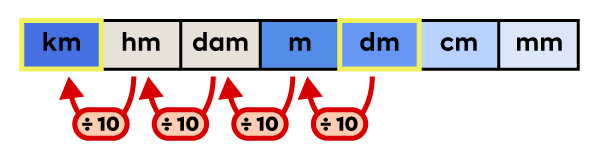
To convert a length measurement to a smaller unit, you must divide the measurement by 10 each time you convert it to a larger unit.
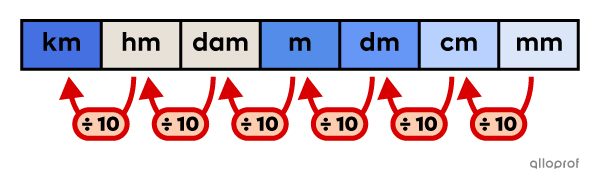
Tableau de conversion des unités de mesure de longueur montrant les proportions entre chacune d’elles.

Rule

Follow these steps to convert a length measurement to a larger unit:

  1. Identify the starting unit of measure of the number.
  2. Determine the new unit of measure.
  3. Divide the measurement by 10 for each larger unit of measure until the new unit of measure is reached.
Example

Convert 450 dm into km.

  1. Identify the starting unit of measure of the number.

    The starting unit of measure is decimetres.

450 dm
  1. Determine the new unit of measure.

    The new unit of measure is kilometres.

450 dm = ? km
  1. Divide the measurement by 10 for each larger unit of measure until the new unit of measure is reached.

    To go from dm to km, divide the measurement by 10, 4 times.

    450 dm ÷ 10 = 45 m
    45 m ÷ 10 = 4,5 dam
    4,5 dam ÷ 10 = 0,45 hm
    0,45 hm ÷ 10 = 0,045 km

    To save some time, I can also divide by 10 000.

    450 dm ÷ 10 000 = 0,045 km

Conversion table of units of measure for length with kilometres and decimetres highlighted.

450 dm is equivalent to 0.045 km.