Subjects
Grades
 100%
100%
Exponential notation is directly connected to multiplication.
Exponentiation is an operation which consists of raising a base to an exponent.
||\text{base}^\text{exponent} = \text{power}||The result of an exponentiation is a power.
In practical terms, exponential notation is composed of the following:
||\begin{align} &&&&& \color{red}{\text{base}} && = && \color{red}{4} \\ \color{red}{4}^\color{blue}{3}&= \color{magenta}{64} &&\large\Rightarrow && \color{blue}{\text{exponent}} && = && \color{blue}{3} \\ &&&&& \color{magenta}{\text{power}} && = && \color{magenta}{64} \end{align}||
Generally, there are two ways to read exponential notation.
|
124 |
|
|---|---|
|
1st way |
2nd way |
|
"12 to the 4th power" |
"12 to the power of 4" |

Depending on the value of the exponent, more precise terms can be used.
Exponent 2
When a number is raised to the exponent |2,| the term "square" is used. For example, |5^2| usually reads |5| squared. For this reason, the power |(25)| is called a square number.
Exponent 3
When a number is raised to the exponent |3,| the term "cube" is used. For example, |5^3| usually reads |5| cubed. For this reason the power |(125)| is called a cubic number.
Exponential notation is a way to express a number as a power |a^b,| where |a| is called the base and |b,| the exponent.
The exponent corresponds to the number of times that we multiply the base by itself.
||a^n=\underbrace{a\times a\times \ldots\times a\times a}_{n\text{ times}}||
In other words, exponentiation is a series of multiplications by the same number.
||\begin{align} 4^3 &= \underbrace{4 \times 4 \times 4}_{3 \ \text{times}} \\ &=64 \end{align}||
Moreover, the number of times this number appears in the series of multiplications is directly related to the value of the exponent.
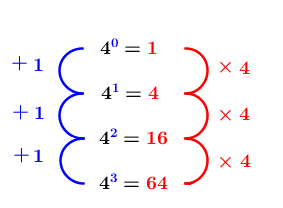
Therefore, each time the exponent increases by |1,| the previous power must be multiplied by the value of the base, in this example, by |4.|