Subjects
Grades
 100%
100%
 100%
100%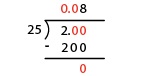
In some situations, it may be useful to convert a fraction into a decimal number or vice versa. The following concept sheet suggests methods to perform these conversions successfully.
A fraction can be seen as a division that has not yet been carried out. Thus, it can be converted to decimal form by simply performing the division represented by the fraction.
Divide the numerator of the fraction by the denominator.
Write the result of the division.
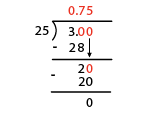
Express |\displaystyle \frac{3}{4}| as a decimal number.
Divide the fraction’s numerator by the denominator.

Write the result of the division.
The result is | \frac{3}{4}=0.75|.
Express |\displaystyle \frac{2}{25}| as a decimal number.
Divide the fraction’s numerator by the denominator.
Write the result of the division.
The result is |\displaystyle \frac{2}{25}=0.08|.
Some fractions cannot be written as decimals.
Dividing the numerator by the denominator may not result in a decimal number, but in a periodic number.
For example, the following |\frac{1}{3}=0.33333...=0.\overline{3}|.
To learn how to convert a fraction to a periodic number and vice versa, consult the following concept sheet.
It is possible to express a decimal number as a fraction, as follows.
Identify the number of decimal places after the decimal point to determine the denominator to use.
|
Number of decimal places |
Denominator |
|
|1| |
|10| |
|
|2| |
|100| |
|
|3| |
|1000| |
|
... |
... |
Write a fraction where the numerator is the decimal number without the decimal point and the denominator is the one chosen in step 1.
Simplify the fraction if necessary.
A decimal number can simply be read to express it as a fraction.
For example, the number |0.2| reads as: “two tenths”.
Therefore, the fraction representing the number is |\displaystyle \frac{2}{10}|. The fraction also reads "two tenths".
The final step is to simplify the fraction!
Express |0.54| as a simplified fraction.
Identify the number of decimal places after the decimal point to determine the denominator to use.
Note that there are two digits after the decimal point in |0.54|. The number |100| will be used as the denominator.
Write a fraction where the numerator is the decimal number without the decimal point and the denominator is the one chosen in step 1.
||\displaystyle 0.54=\frac{54}{100}||
Simplify the fraction if necessary.
||\displaystyle \frac{54\color{green}{\div 2}}{100\color{green}{\div 2}}=\frac{27}{50}||
Thus, |\displaystyle 0.54=\frac{27}{50}|.
Express |0.333| as a simplified fraction.
Identify the number of decimal places after the decimal point to determine which denominator to use.
Note that there are three digits after the decimal point in |0.333|. The number |\small 1000| will be used as the denominator.
Write a fraction where the numerator is the decimal number without the decimal point and the denominator is the one chosen in step 1.
||\displaystyle 0.333=\frac{333}{1000}||
Simplify the fraction if necessary.
The fraction cannot be simplified further.
Thus, the result is |\displaystyle 0.333=\frac{333}{1000}|.