Subjects
Grades
 100%
100%
 100%
100%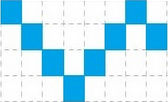 100%
100%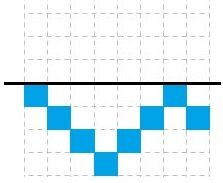 100%
100%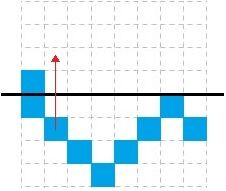 100%
100%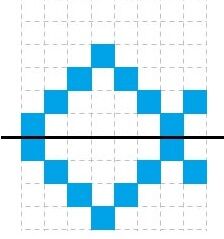 100%
100%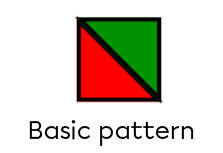 100%
100%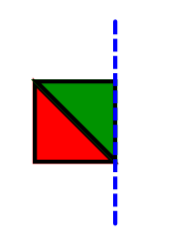 100%
100%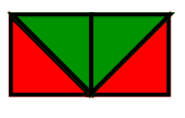 100%
100%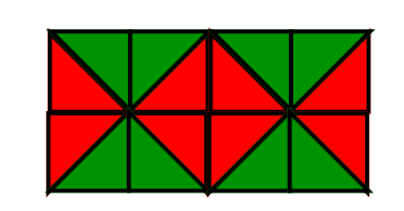
Many fabrics and materials have repeated images or patterns with a pre-established order. Mathematicians refer to these as frieze patterns (friezes) and/or tessellations.
Geometric transformations are needed to produce a frieze pattern and/or tessellation.
In general, a frieze pattern is a repeating pattern that follows a particular order.
A frieze is a continuous strip with parallel edges, formed by repeating one or more patterns. The patterns repeat regularly and harmoniously.
To create the strip, successive reflections can be used.
In a frieze pattern produced by reflection, each pattern is a reflection of one preceding it. Thus, the dimensions are preserved, but the pattern’s orientation changes.

It gets easier to create new frieze patterns when this definition and this example are kept in mind.
As in many mathematical concepts, we can establish a sequential order that enables the frieze pattern to be properly constructed.
Trace the basic pattern
Draw the frieze pattern’s axis of reflection
Perform the reflection for the pattern’s first section
Perform a reflection on the rest of the pattern
It is equally important to take into account both the basic pattern and space it occupies.
A tessellation is a surface that is completely covered in patterns. It has no empty spaces and no overlap.
A tessellation can be obtained by reflecting one or several patterns.
Trace the basic pattern
Draw a line of reflection
Perform the first reflection
Reflect as often as desired
It's important to note that lines of reflection can be drawn anywhere. The entire surface must be covered without leaving any empty spaces between patterns.