Pictographs - Cycle 2

| Mathematics

What is a Pictograph?

Definition

A pictograph presents the results of a survey using images, symbols or icons.

A pictograph can be presented in two ways: horizontally or vertically.

Examples

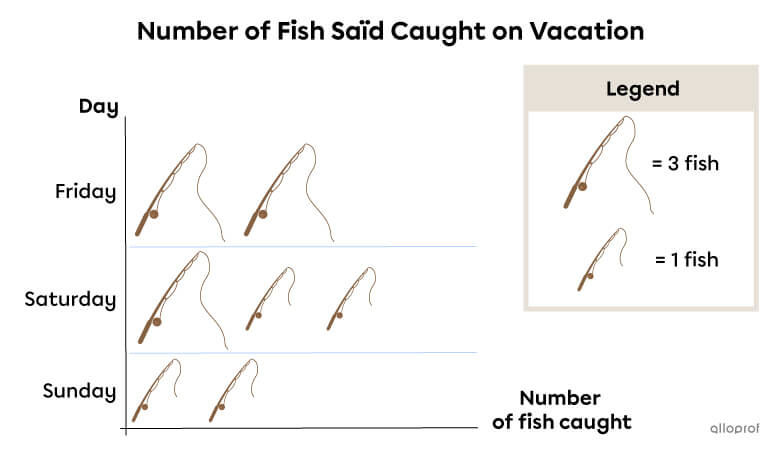
Horizontal pictograph:

Example of a horizontal pictograph.

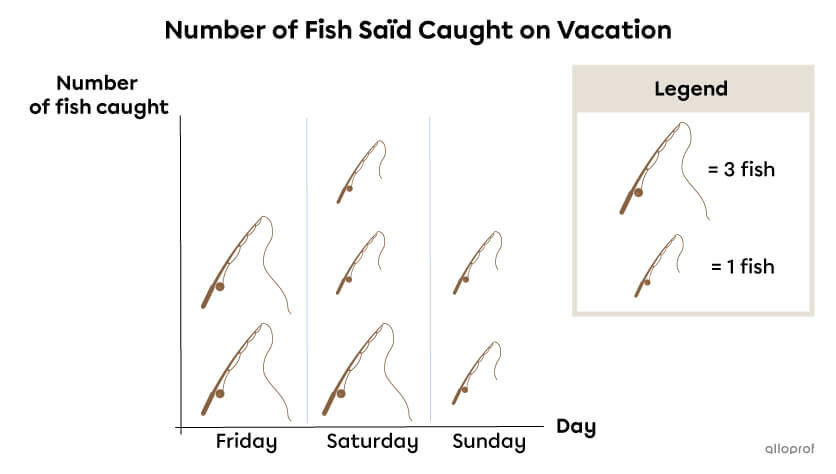
Vertical pictograph:

Example of a vertical pictograph.

What are the Parts of a Pictograph?

The title of a pictograph always presents the subject of a survey.

Example

The title indicates that this pictograph represents the number of fish caught by Saïd during his vacation.
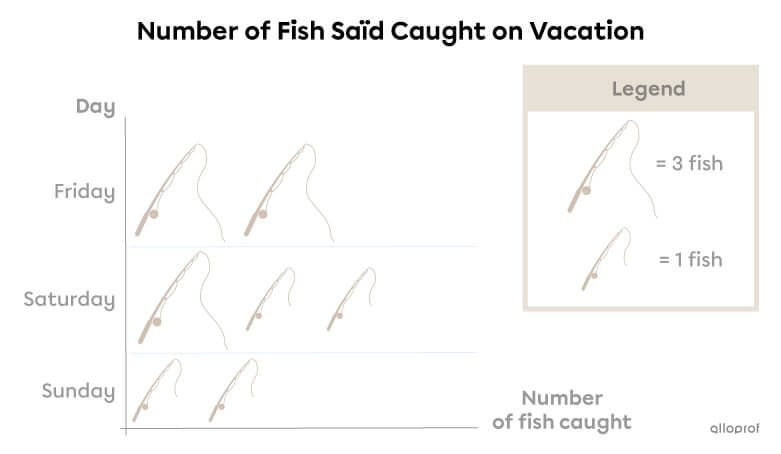
Example of a pictograph title.

A pictograph has 2 axes: the vertical axis and the horizontal axis. Each axis has a label indicating what it represents.

Example

In this graph, the vertical axis represents the days. The horizontal axis represents the number of fish caught.
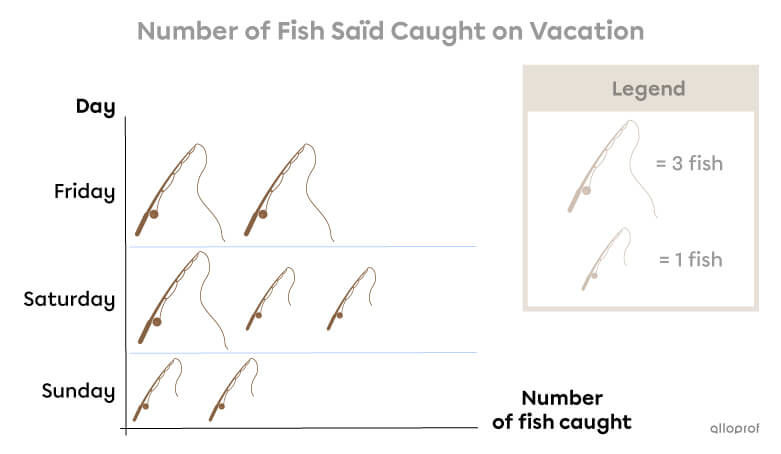
Example of the axes in a pictograph.

The categories present the information collected in the pictograph.

Example

The graph shows the number of fish caught on Friday, Saturday and Sunday.
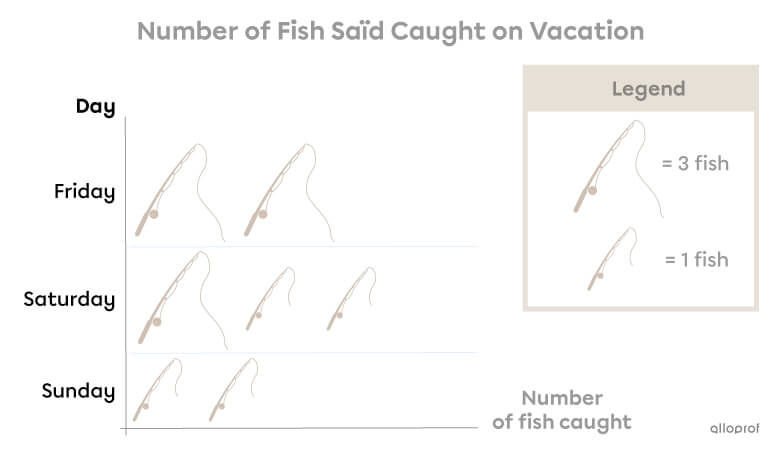
Example of categories in a pictograph.

In a pictograph, the data (results) are represented by images, symbols or icons. The legend specifies the value of each image.

Example

The legend shows that the big fishing rod represents 3 fish and the small fishing rod represents 1 fish.
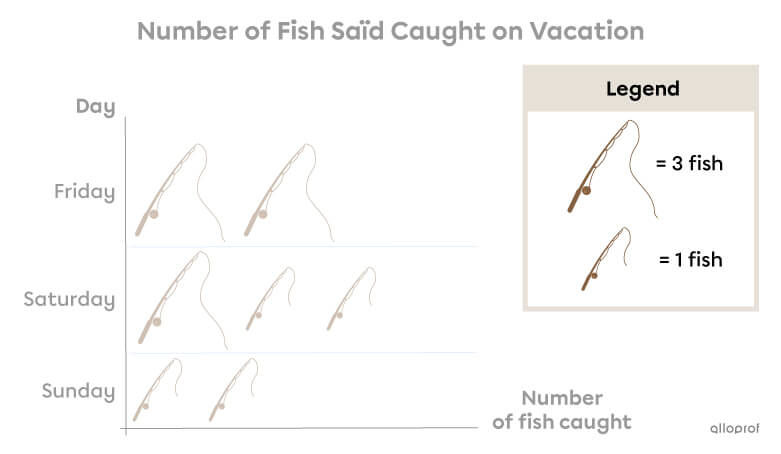
Example of a pictograph legend.

In some pictographs, half-symbols are used. Find the value of the whole symbol first, and then divide it by 2.

Example

The legend indicates that a whole basket is equal to 4 apples. To find the value of a half-basket, divide 4 by 2.

4 ÷ 2 = 2

One half-basket equals 2 apples.
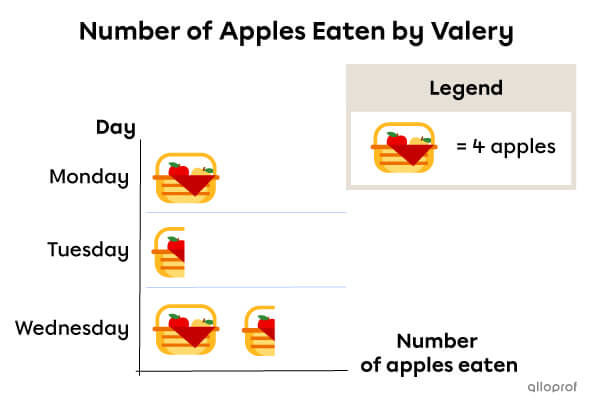
Example of a pictograph with half symbols.

How to Interpret a Pictograph?

To interpret a pictograph, you must analyze all the parts of the graph while keeping the question that was asked in mind.

Example

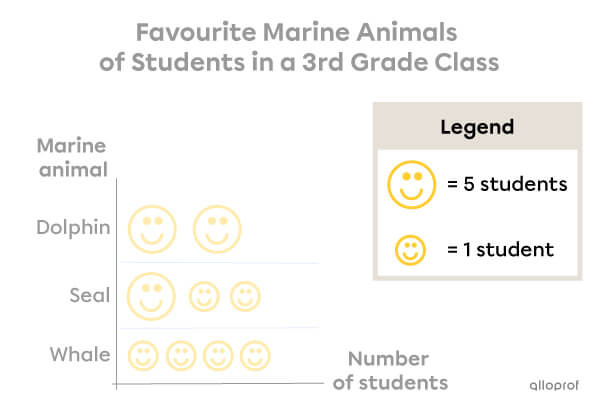
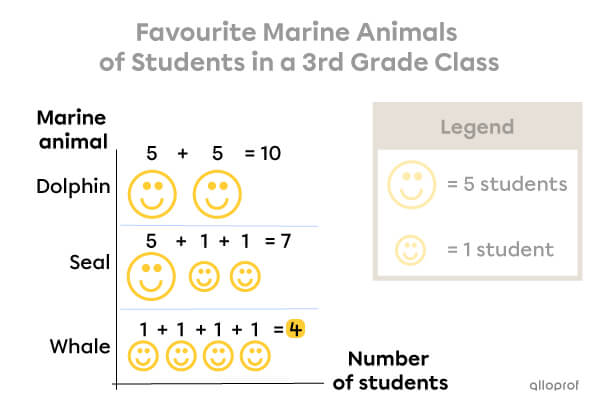
What is the least popular marine animal in this 3rd grade class?
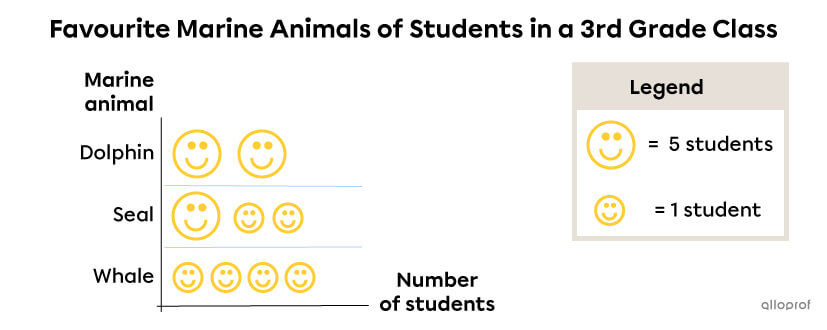
Example 1 - Interpreting a pictograph.

  1. Look at the legend to find the value of each symbol.

    The big smiley face represents 5 students, and the small smiley face represents 1 student.

Example 1 - Interpreting a pictograph.
  1. Calculate the number of students that the smiley faces represent for each type of marine animal.

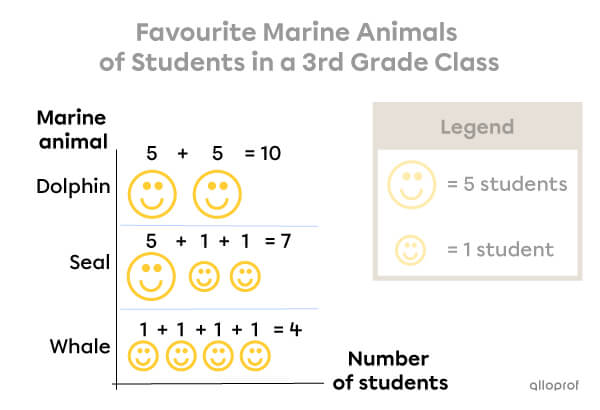
    There are 2 big smiley faces in the dolphin category. Each big smiley face equals 5 students. Since 5 + 5 = 10, 10 students like dolphins.

    In the seal category, there are 1 big smiley face and 2 small smiley faces. Each big smiley face equals 5 students, and each small smiley face equals 1 student. Since 5 + 1 + 1 = 7, 7 students like seals.

    There are 4 small smiley faces in the whale category. Each small smiley face equals 1 student. 1 + 1 + 1 + 1 = 4, so 4 students like whales.

Example 1 - Interpreting a pictograph.
  1. Look at the number of students who like each marine animal to find which one is least popular.

    There are 10 students who like dolphins, 7 students who like seals, and 4 students who like whales. The whale category, with 4 students, has the least amount of data.

Example 1 - Interpreting a pictograph.

In this 3rd grade class, the least popular marine animal is the whale.

Example

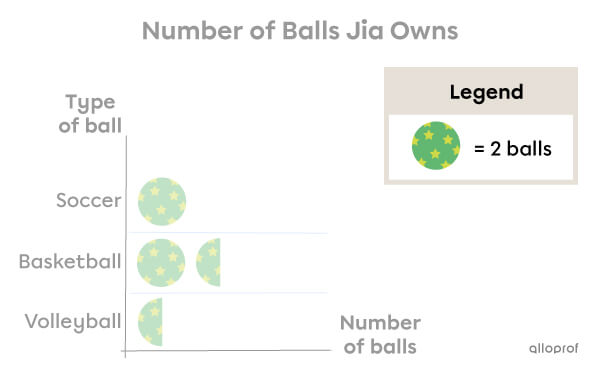
How many balls does Jia have altogether?
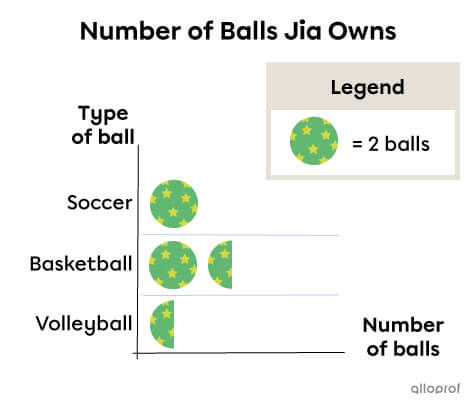
Example of interpreting a pictograph with half symbols -1.

  1. Look at the legend to find out the value of each symbol.

    The image of the whole ball equals 2 balls. A half-ball equals half the value of the whole ball. To find the value of one half ball, divide 2 by 2.

    2 ÷ 2 = 1.

    The half-ball represents 1 ball.

Example of interpreting a pictograph with half symbols -1.
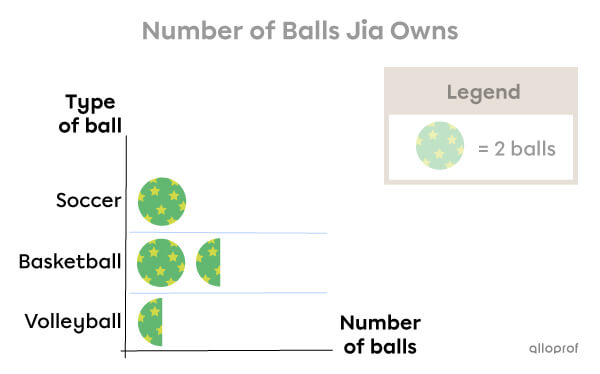
  1. Calculate the number of balls in each category.

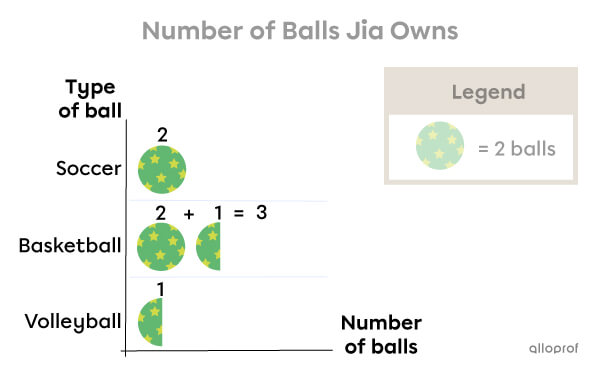
    There is 1 whole ball symbol in the soccer category. So, Jia has 2 soccer balls.

    There are 1 whole ball symbol and 1 half-ball symbol in the basketball category. Each whole symbol represents 2 balls, and each half symbol represents 1 ball. 2 + 1 = 3, so Jia has 3 basketballs.

    There is one half symbol in the volleyball category. A half symbol equals 1 ball. So you know that Jia has 1 volleyball.

Example of interpreting a pictograph with half symbols -1.
  1. Add the number of balls in each category to find the total number of balls.

    Add the 2 soccer balls, the 3 basketballs and the volleyball.

    2 + 3 + 1 = 6

Example of interpreting a pictograph with half symbols -1.

Jia has 6 balls in total.