Subjects
Grades
A prime factor is a factor that is a prime number.
To find out what a factor is, read the concept sheet Multiplying Numbers.
Example:
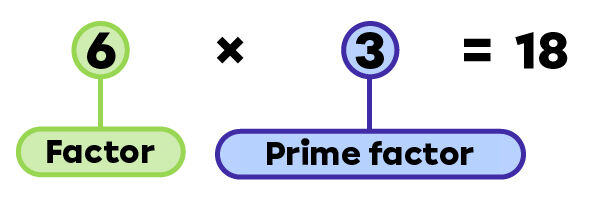
Prime factorization is decomposing a natural number greater than 1 into a multiplication equation whose factors are all prime numbers.
You obtain the prime factorization of a number when the number is decomposed into a multiplication equation whose factors are all prime numbers.
2 × 2 × 2 × 2 × 3 = 48
2 × 2 × 2 × 2 × 3 is the prime factorization of the number 48, since each factor in the multiplication equation is a prime number and their product is 48.
It is possible to use exponential notation to express the prime factorization of a number.
Example:
The prime factorization 2 × 2 × 2 × 2 × 3 can also be written as 24 × 3 = 48.
Find the prime factorization of a number by using a factor tree.
To find out how, read the concept sheet The Factor Tree.