Subjects
Grades
 100%
100%
Everyday objects around us are often in the shape of different solids. A box can remind us of a cube, while a computer tower can be defined as a rectangular prism. These solids are all similar because they are formed using width, length, and height. In other words, they are three dimensional.
A solid is a three dimensional object delimited by at least one closed surface.
Despite its relatively simple definition, solids come in different shapes, each one having its own unique characteristics and appearance.
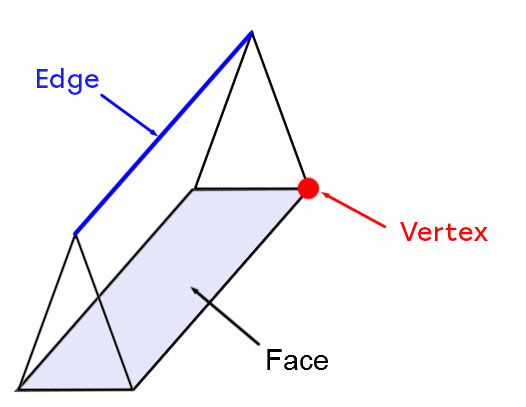
The number of edges, vertices, and faces of solids are used to classify them.
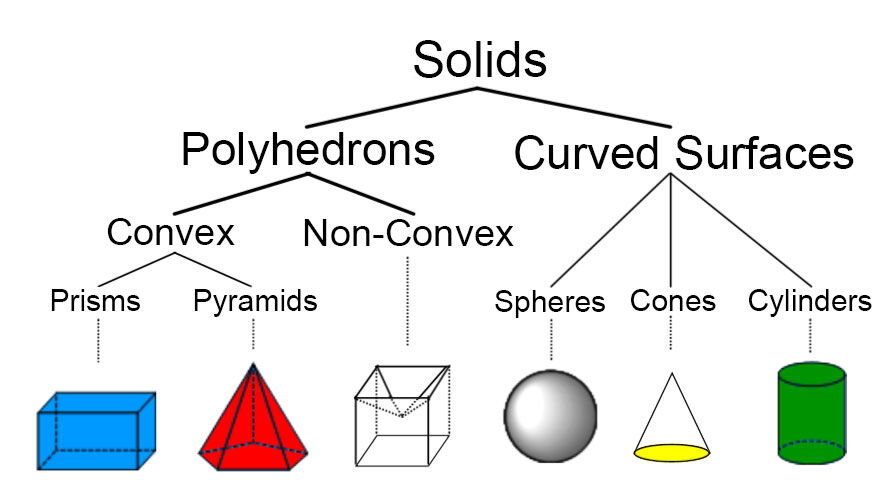
Different solids are distinguished by their form and the shapes that compose them. The following table summarizes the different categories of solids.

As the diagram illustrates, it is essential to clearly distinguish each of the families between the polyhedrons and curved surfaces. When examining non-convex polyhedrons, they usually refer to decomposable solids.