Subjects
Grades
The phases of the Moon refer to the parts of the Moon that are illuminated by the Sun, as seen from Earth.
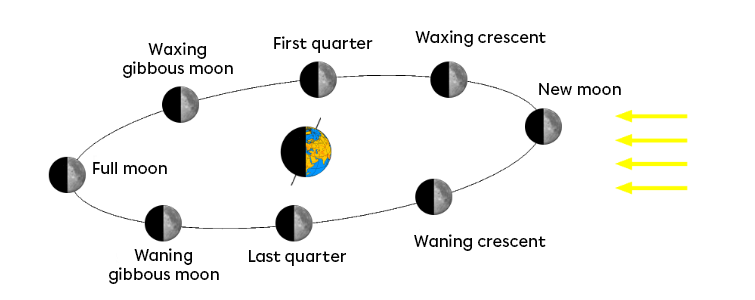
In the night sky, the Moon sometimes appears round, sometimes as a crescent, and sometimes it is simply not visible. The origin of this phenomenon lies in the Moon's position between the Sun and the Earth. Like the Earth, one part of the Moon is always illuminated by the Sun, while the other part is in darkness. Since the Moon's position changes slightly every day in relation to the Sun and the Earth, the perception of the illuminated part is not the same. As a result, the Moon appears to change of shape over time, a phenomenon known as the phases of the Moon. A complete cycle of Moon phases is called a lunation.
From our point of view, the Moon does not always appear to us in the same way. Seen from Earth, the different phases of the Moon are called as follows:
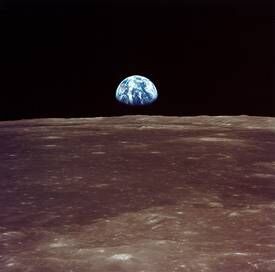
Although we can see it in the sky, it is not the Moon that emits light. The Moon shines because its surface reflects the Sun's light. In the 1960s and 1970s, American astronauts observed the same phenomenon with the Earth.
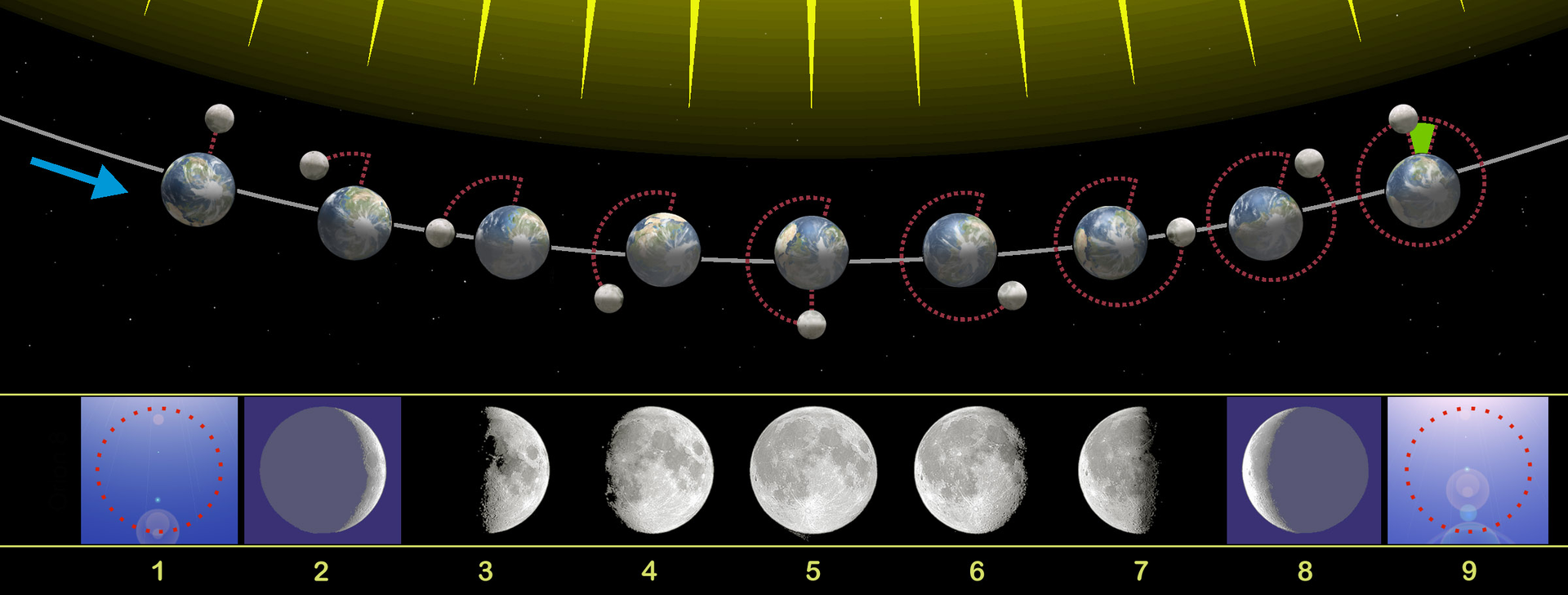
Since the Moon takes the same amount of time to turn on itself as it does to go around the Earth, i.e. around 28 days, it always shows us the same side. In other words, the Moon's period of rotation is the same as its period of revolution. As a result of this synchronised motion, the same side will always be visible from Earth. This is called the bright side of the Moon. The other side, which can never be seen from Earth, is called the dark side of the Moon. The image on the left shows the Moon's real motion, while the image on the right shows what would be visible if the Moon were not spinning on itself.