Subjects
Grades
 100%
100%
 100%
100% 100%
100% 100%
100% 100%
100%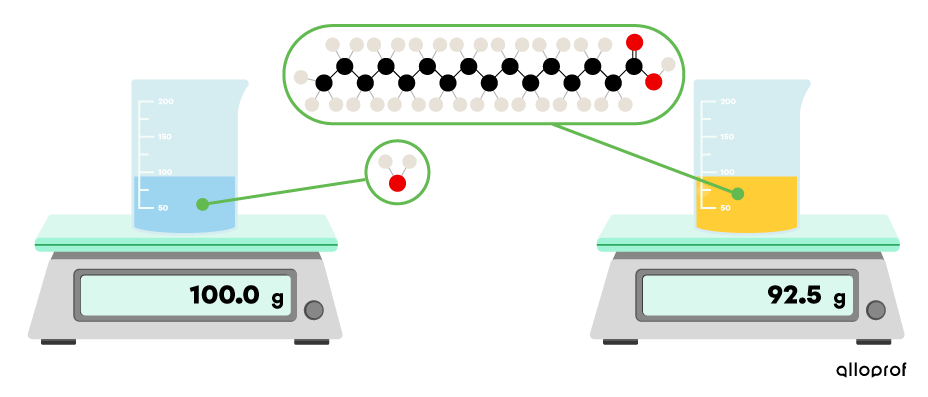 100%
100%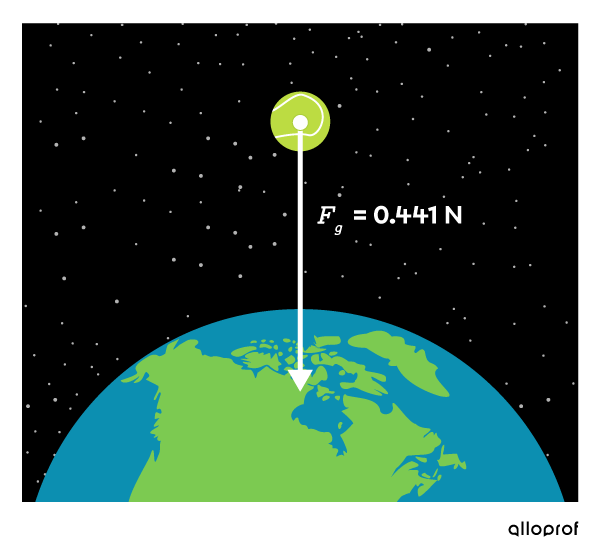 100%
100%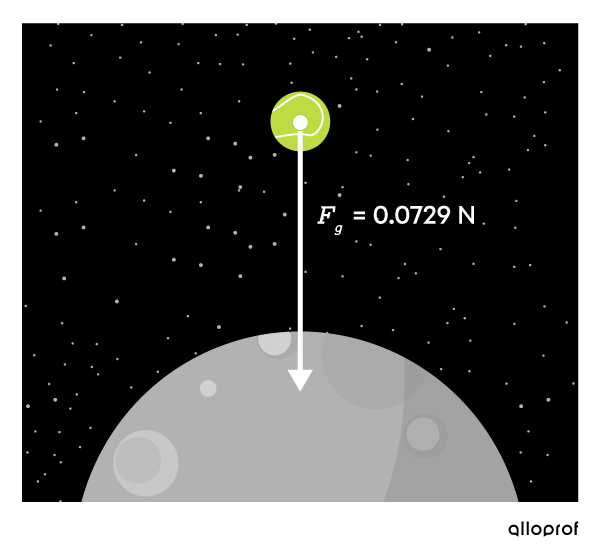 100%
100%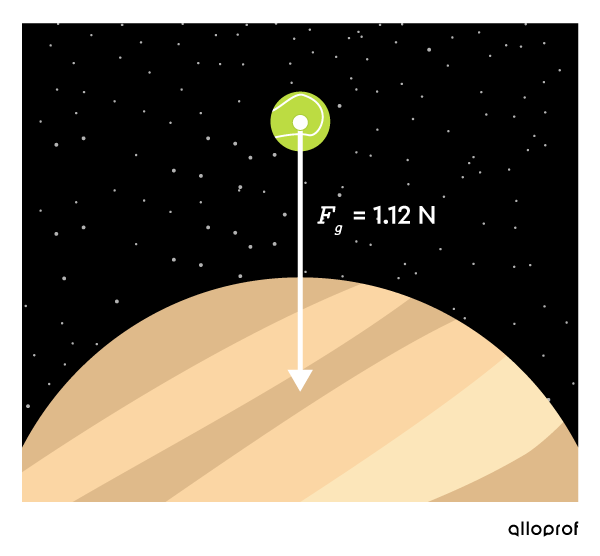
Mass represents the amount of matter in a substance or object. The mass is usually measured in grams |(\text{g}).|
To measure the mass of a substance or object, use a balance scale. Here are two models.
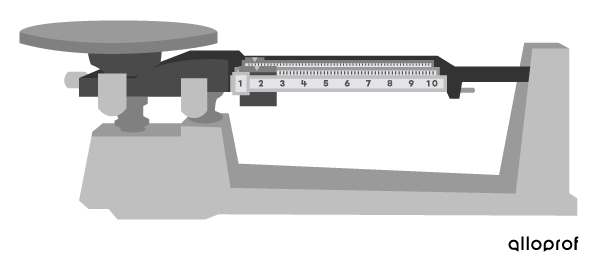
Triple beam balance
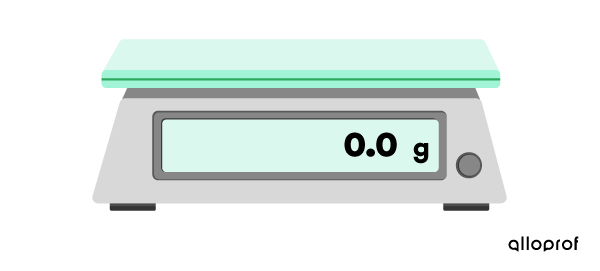
Electronic balance
The gram |(\text{g})| is the basic unit of mass, but there are other units for expressing it. Here is a table showing the most common units of measurement for mass.
| Prefix | kilo- | hecto- | deca- | deci- | centi- | milli- | |
|---|---|---|---|---|---|---|---|
| Mass unit | kilogra, |(\text{kg})| |
hectogram |(\text{hg})| |
decagram |(\text{dag})| |
gram |(\text{g})| |
decigram |(\text{dg})| |
centigram |(\text{cg})| |
milligram |(\text{mg})| |
| Value equivalent to |1\ \text{g}| | |0{.}001\ \text{kg}| | |0{.}01\ \text{hg}| | |0{.}1\ \text{dag}| | |1\ \text{g}| | |10\ \text{dg}| | |100\ \text{cg}| | |1\ 000\ \text{mg}| |
The choice of the unit of measurement is based on the object to be measured. The unit should be chosen so that the value is neither too large nor too small.
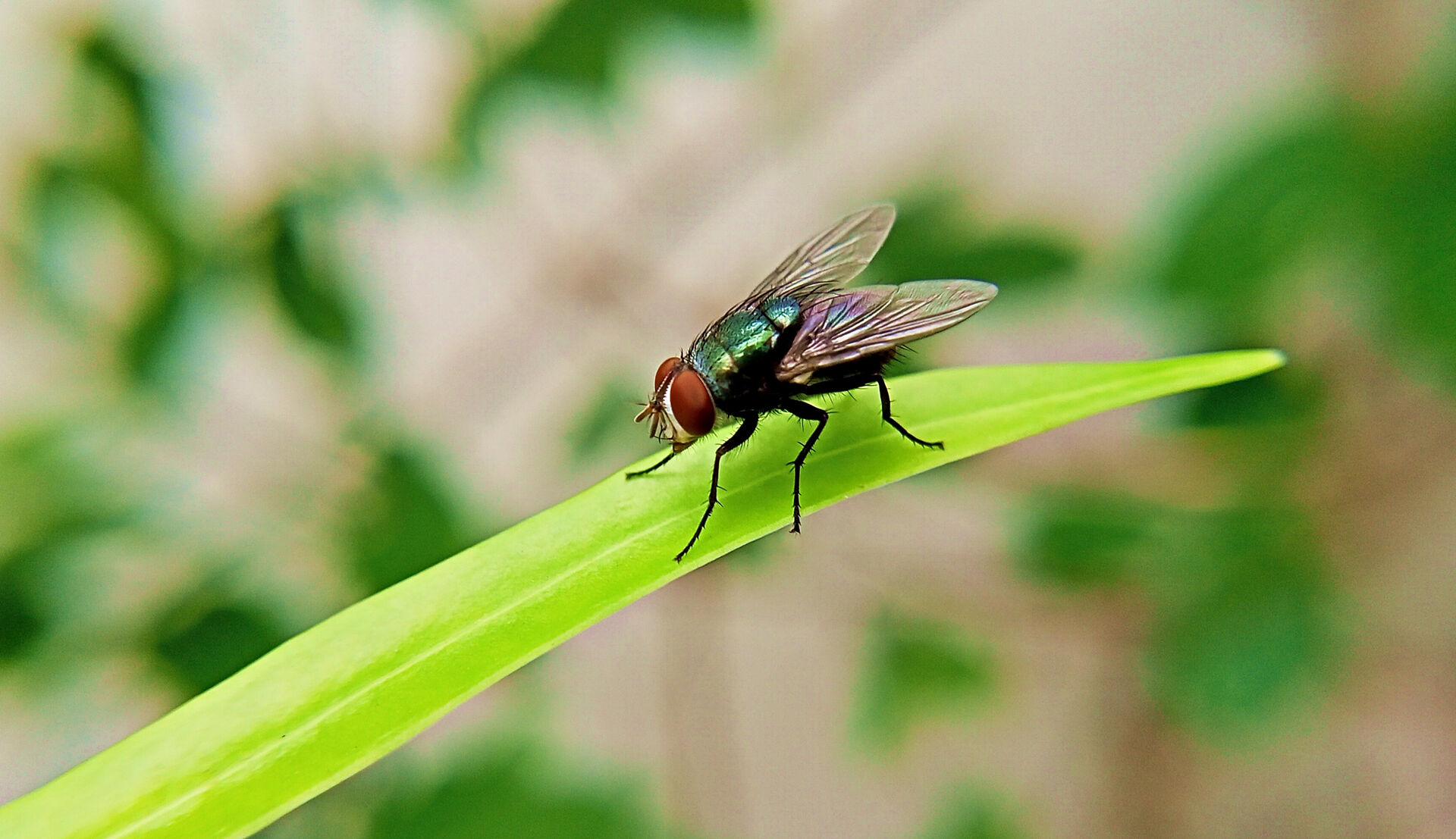
The mass of this fly is |0{.}015\ \text{g}.|
It is better to use milligrams.
The mass of this fly is |15\ \text{mg}.|

Fly
The mass of one of these tissue boxes is |175\ \text{g}.|
Gram is the appropriate unit.
Two tissue boxes
The mass of this bowling ball is |5\ 450\ \text{g}.|
Using kilograms is more appropriate.
The mass of this bowling ball is |5{.}450\ \text{kg}.|
Bowling ball
The mass of a substance varies with the amount of matter it contains. This material also occupies a space – a volume.
Wrongly, we tend to believe that the larger an object, the greater its mass, but this is not always the case.
In order to compare the mass of different substances having the same volume, it is necessary to know what substances they are.
When carrying a box full of books and another identical box full of feathers, we find that the feather box is much lighter than the book box.
The two boxes have the same volume but different masses, since they do not contain the same substance.
In the lab, the mass of |100{.}0\ \text{mL}| of water and the mass of |100{.}0\ \text{mL}| palm-based vegetable oil is measured. The following data is obtained.
| Substance | Volume |(\text{mL})| |
Mass |(\text{g})| |
|---|---|---|
| Water | |100{.}0| | |100{.}0| |
| Palm-based vegetable oil | |100{.}0| | |92{.}5| |
Even though the two substances have the same volume, their chemical composition is different. The number of atoms, the types of atoms and the distance between molecules cause the density of substances to vary.
For example, water is a small molecule consisting of 3 atoms: 2 hydrogens and 1 oxygen. Palmitic acid (component of palm-based vegetable oil) is a large molecule consisting of 50 atoms: 32 hydrogens, 16 carbons, and 2 oxygens.
Since the molecules of water and palm-based vegetable oil are very different, these two substances will not have the same properties. Likewise, water and oil do not have the same quantity of matter for the same volume.
In the end, there is less matter in |100{.}0\ \text{mL}| palm-based vegetable oil than in |100{.}0\ \text{mL}| of water. This explains why their mass is different.
The weight of an object represents the measure of the force with which the Earth (or another celestial body) attracts it. Weight is measured in newtons |(\text{N}).|
To determine the weight of an object, use a dynamometer.
The dynamometer features a spring that extends when an object is hung from it. The longer the spring stretches, the greater the weight.
There are graduations on the transparent tube, allowing the weight to be read in newtons.
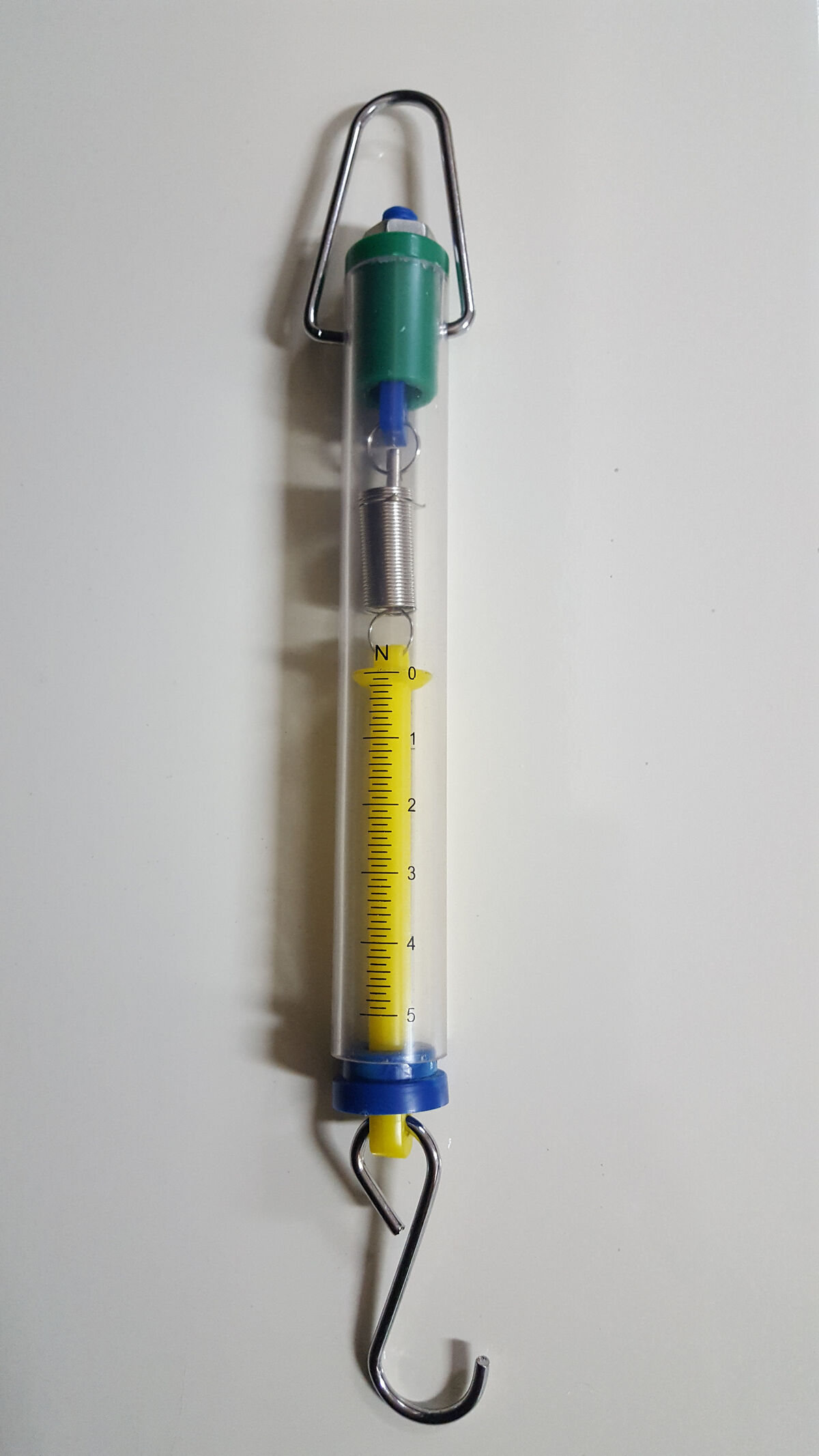
Dynamometer
The weight of an object depends on:
the mass of the object: the greater the mass, the greater the weight;
the intensity of the gravitational field of the celestial body on which it is located: the more intense the gravitational field, the greater the weight of the object.
The following table shows the strength of the gravitational field on the surface of some of the solar system’s celestial bodies.
| Celestial bodies | Gravitational field strength |(\text{N/kg})| |
|---|---|
| Sun | |274| |
| Moon | |1{.}62| |
| Mercury | |3{.}70| |
| Venus | |8{.}87| |
| Earth | |9{.}81| |
| Mars | |3{.}72| |
| Jupiter | |24{.}79| |
| Saturn | |10{.}44| |
| Uranus | |8{.}87| |
| Neptune | |11{.}15| |
The mass of an object is its amount of matter. This is fixed regardless of which celestial object the object is located on. To determine weight, it is necessary to take into account the strength of the gravitational field of the celestial body on which the object is located.
This tennis ball |45{.}0\ \text{g}| always has the same amount of atoms no matter where it is located in space.
The weight of the tennis ball on Earth is |0{.}441\ \text{N}.|
The Moon does not attract the tennis ball as strongly as Earth does, because its gravitational field is weaker.
The weight of the tennis ball is lighter on the Moon, that is |0{.}0729\ \text{N}.|
The mass of the tennis ball, which is |45{.}0\ \text{g}|, remains constant.
Jupiter attracts the tennis ball with greater force than the Earth, because its gravitational field is stronger.
The weight of the tennis ball is greater on Jupiter, it is |1{.}12\ \text{N}.|
The mass of the tennis ball, which is |45{.}0\ \text{g}|, remains constant.
Moments in the video :