Subjects
Grades
A resistor is an electrical component that reduces the flow of current in an electric circuit.
Resistors are made from materials with very low electrical conductivity, such as ceramics.
Resistors are used to reduce the current intensity flowing through the components in the electrical circuit. Among other things, this prevents damage to components that cannot withstand a current of too great intensity.
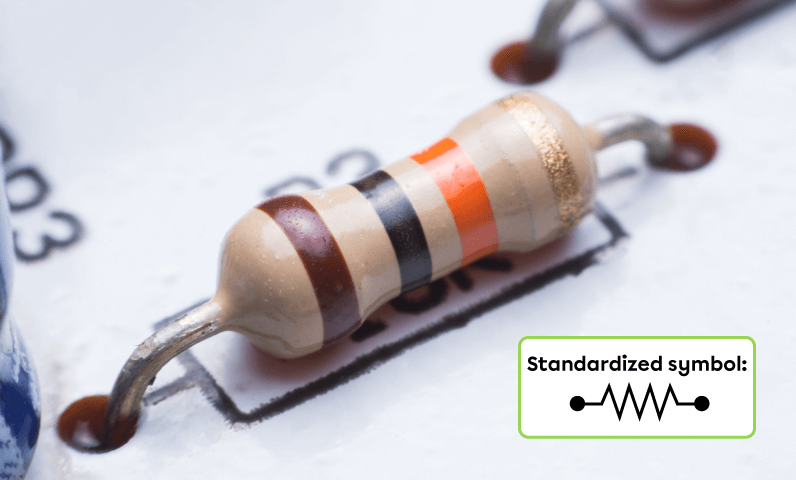
A resistor
When an electric current flows through a resistor, it tends to heat up. This is because part of the electrical energy of the circuit is transformed into thermal energy by the resistor.
However, a resistor is not classified as a component responsible for energy transformation, because the purpose of the resistor is not to generate heat. The function of a resistor is to reduce current intensity.
The ability of a resistor to reduce the flow of current is called resistance, and is measured in ohms |(\Omega).| The mathematical relationship between potential difference, resistance and current intensity in an electric circuit is called Ohm's law.
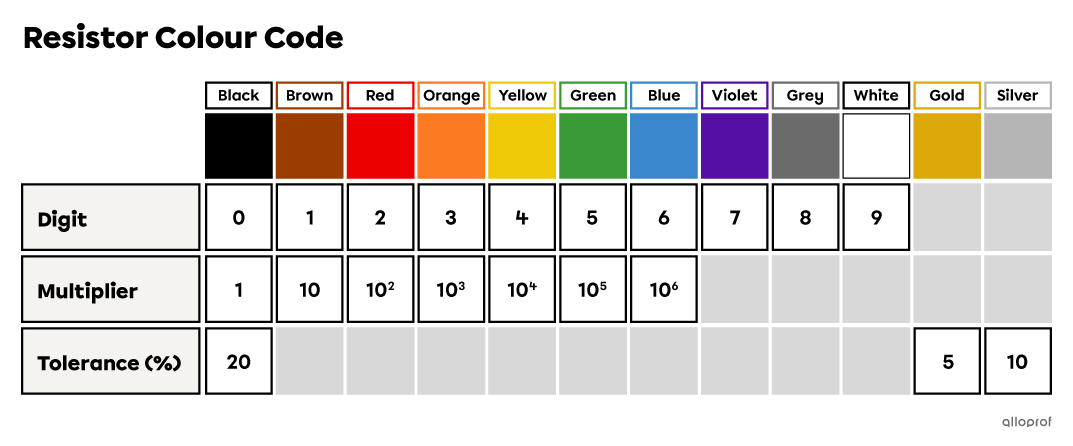
The resistance value is usually indicated on the resistor using a colour code.

A resistor generally has four colour bands. The following colour code can be used to determine the resistance of a resistor in ohms |(\Omega)| and the accuracy of this value.
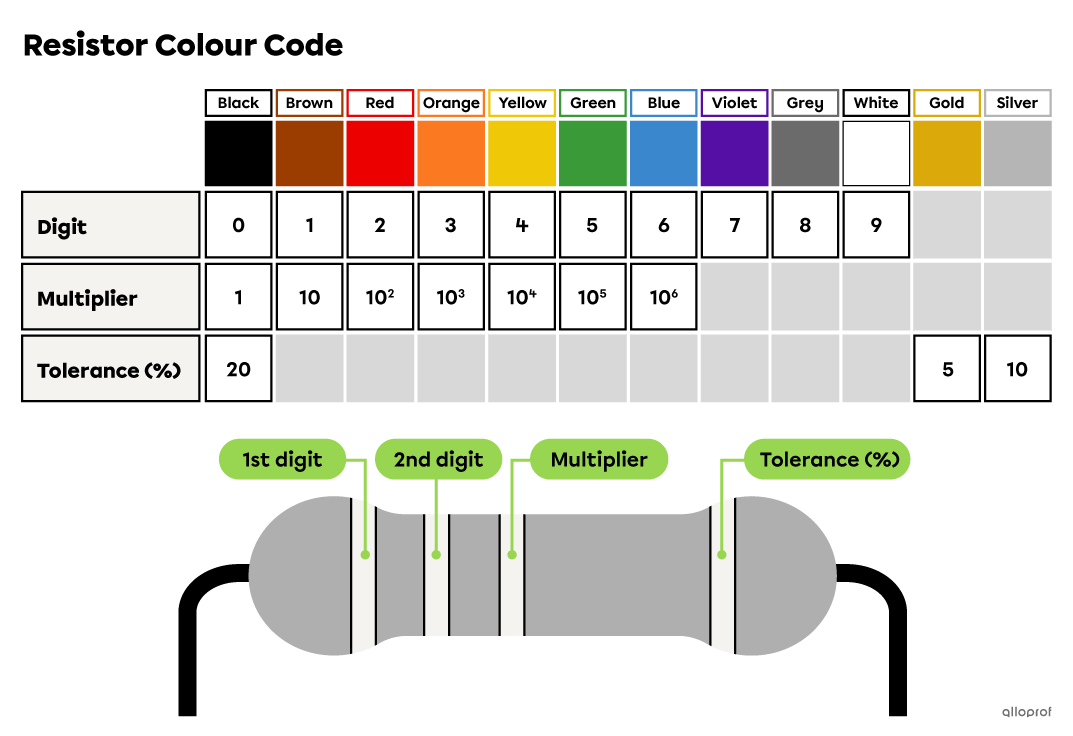
The resistor colour code is used as follows:
The first band indicates the first digit.
The second band indicates the second digit.
The third band indicates the multiplier.
The fourth band indicates the tolerance, which is the precision of the value in percent (%).
What is the resistance of a resistor whose colour bands are brown, black, orange and gold, in this order?

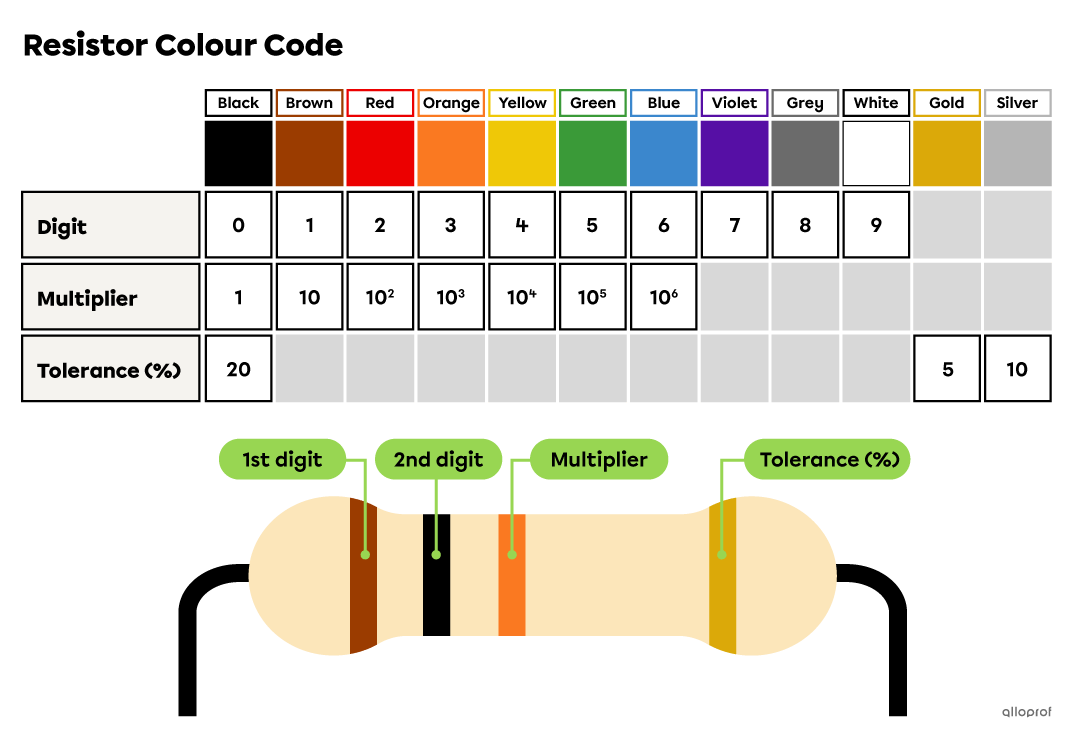
What colour bands should be used for a resistor with a resistance of |85\ \Omega\ \pm\ 10\%|?