Subjects
Grades
 100%
100%
 100%
100%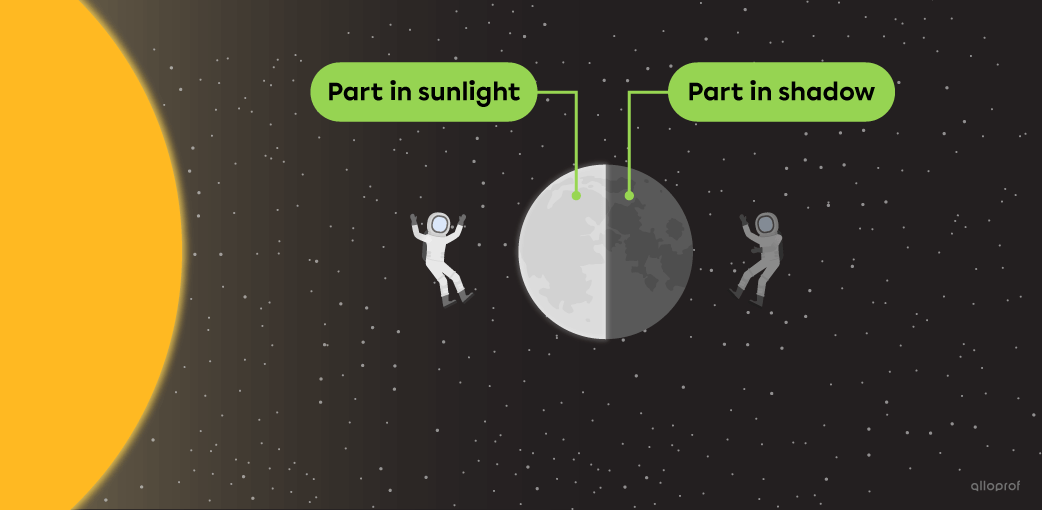
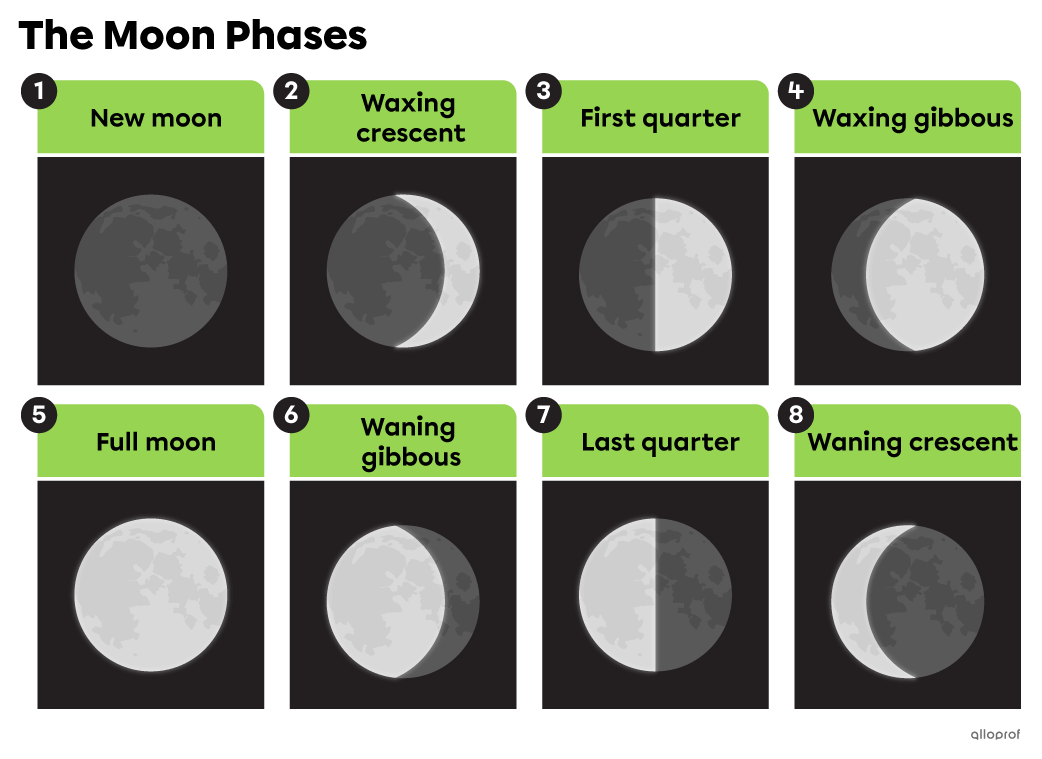
The Moon phases are the different appearances of the Moon as seen from Earth.
There are 8 Moon phases.

From new moon to full moon, the Moon is more visible in the sky with the illuminated part appearing to grow larger.
From full moon to new moon, the Moon is less visible in the sky with the illuminated part appearing to become smaller.
A few days after the waning crescent phase, the lunar cycle comes to an end. A new cycle begins with the new moon.
Even though it doesn’t look like it, the Moon always stays the same shape. Certain parts of the Moon even seem to light up at night but they are actually just reflecting sunlight.
From Earth, the Moon’s appearance changes depending on where it is in relation to the Earth and the Sun; it’s all a matter of point of view.
In the following image, you can see 2 astronauts. They are positioned differently with respect to the Moon. Since they don’t have the same point of view, they don’t see the same thing.
The astronaut to the left of the Moon sees only the part illuminated by the Sun. The astronaut to the right of the Moon sees only the part in shadow. In both cases, the Moon stays the same. It’s just the point of view that changes.
This image is not to scale. Real astronauts are much smaller than the Moon.
As the Moon orbits the Earth, your point of view changes. This is the reason why you can see the different phases of the Moon.