Natural Disasters Vocabulary

Fiche | Anglais

Vocabulary on the theme of natural disasters.

Basic Natural Disasters Vocabulary

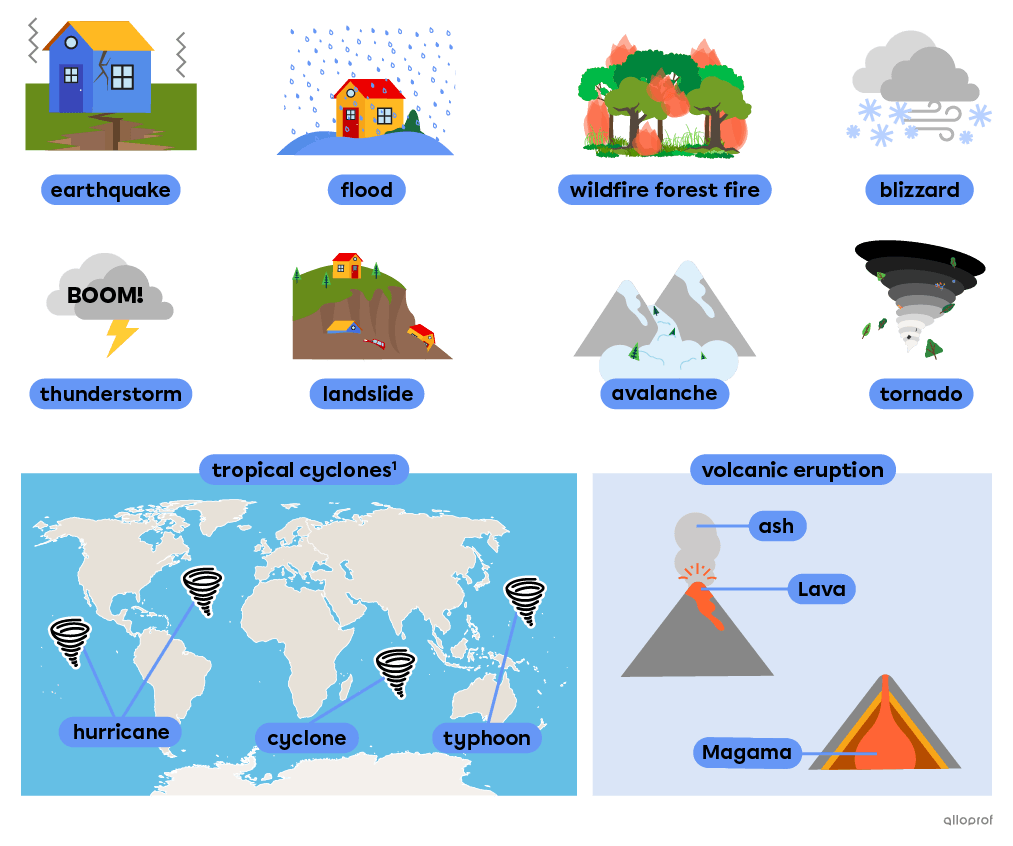
Basic natural disasters vocabulary such as earthquake, avalanche and volcanic eruption. Titre :

*Tropical cyclones are generally referred to by regional names.

  • When they form in the Atlantic Ocean or in the North-East Pacific Ocean, they are hurricanes.
  • When they form in the Indian Ocean, they are tropical cyclones.
  • When they form in the Western Pacific Ocean, they are typhoons.

Click to listen to the Basic Natural Disasters vocabulary.

Damage & Effects Vocabulary

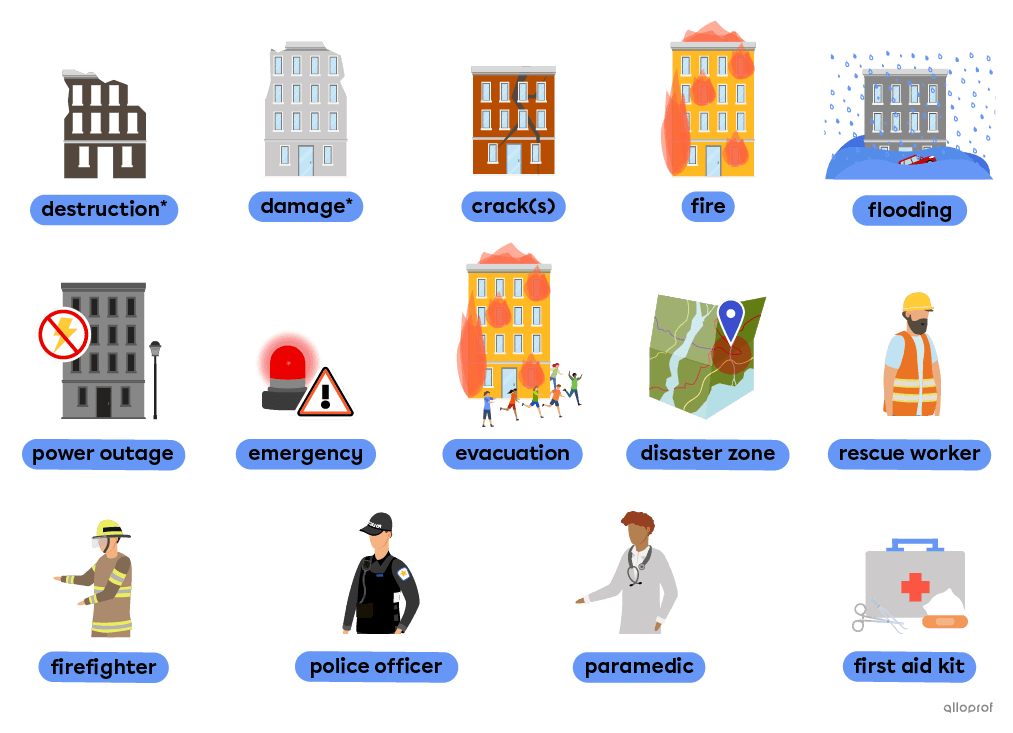
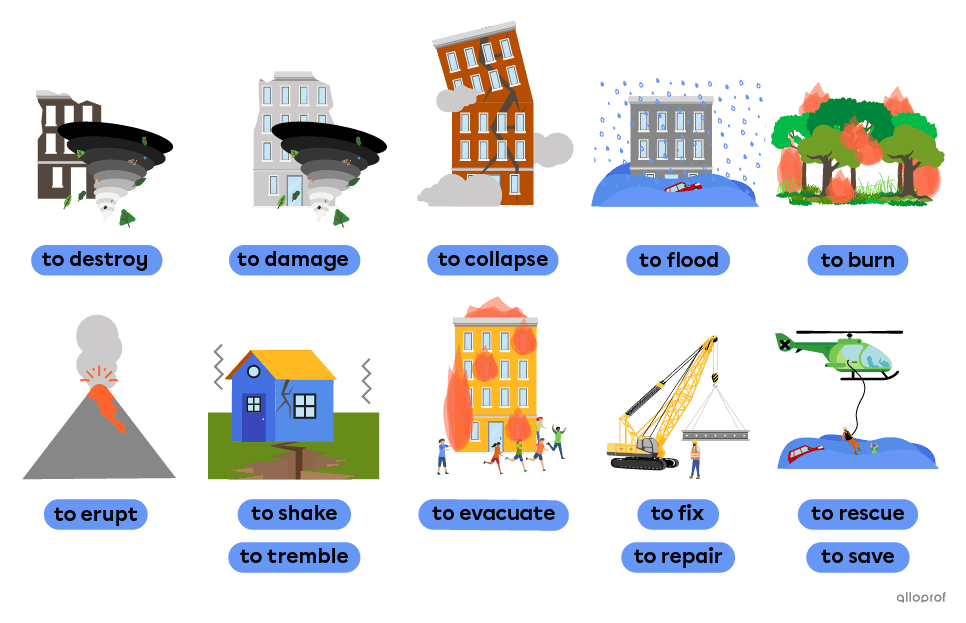
Damage and effects vocabulary related to natural disasters such as destruction, evacuation and first aid kit.

*Destruction vs. damage

The words destruction and damage are often used as synonyms, but they have slightly different meanings.

  • Destruction implies total loss, that it can’t be fixed: it will have to be rebuilt.
  • Damage implies partial loss, that it can probably be fixed or repaired.
     

Click to listen to the Damage & Effects vocabulary.

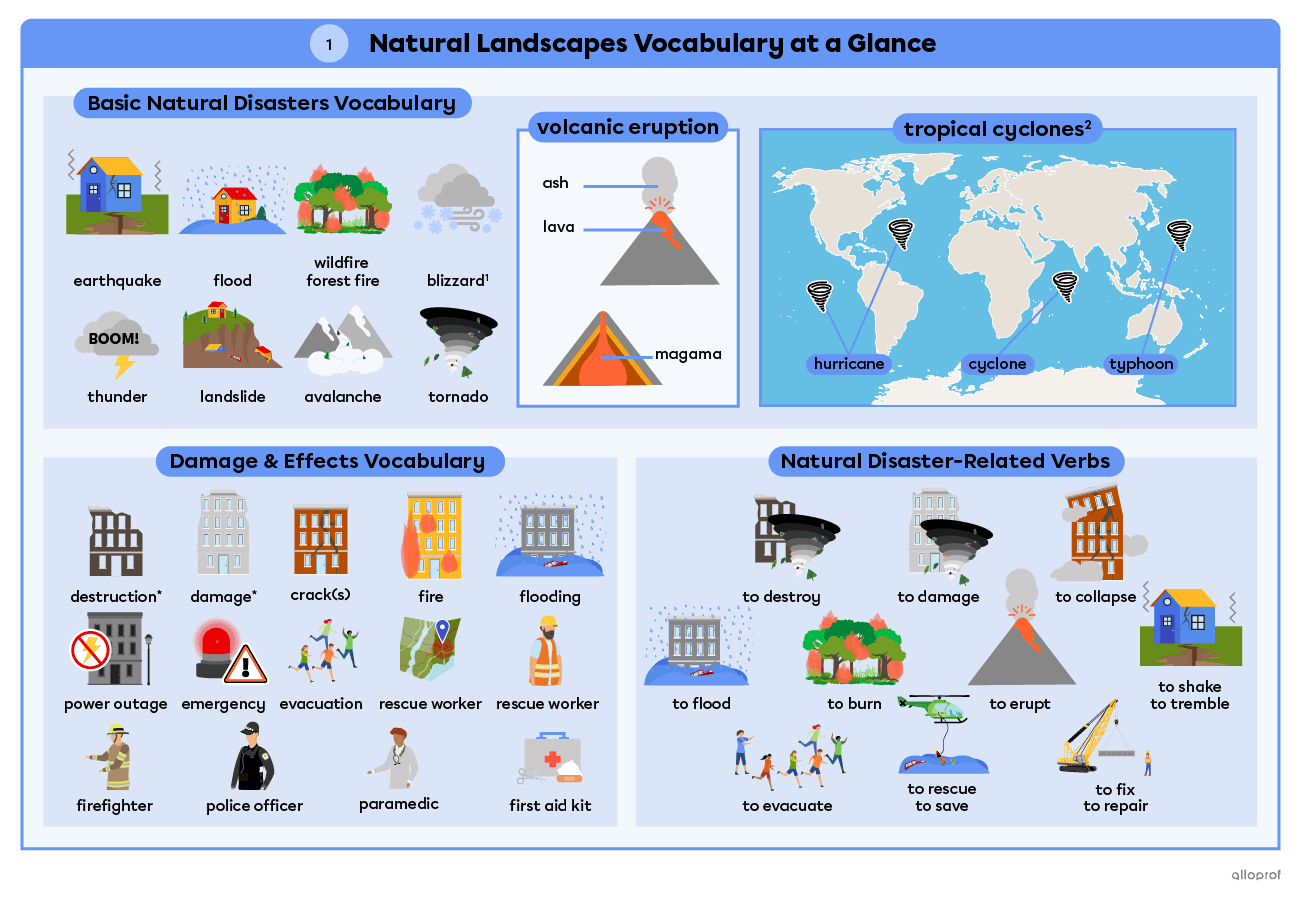
Natural Disasters Vocabulary at a Glance

Summary for natural disasters vocabulary.

Natural Disasters Vocabulary Exercise

(Coming soon)

Advanced Natural Disasters Vocabulary

Advanced Natural Disasters

  • storm surge
    A fast rise in sea level caused by a powerful storm.
  • flash flood
    A sudden and very fast flood that happens in a short time.
  • tidal wave*
    A wave caused by the effects of gravity, the daily movement of the tides. They generally do not cause damage.
  • tsunami*
    A series of huge waves triggered in the ocean. Underwater earthquakes and underwater volcanic eruptions are its main causes.
  • hailstorm
    A storm where solid balls of ice, called “hail,” fall from the sky.
  • sandstorm
    A strong windstorm that carries huge clouds of sand and dust through the air. It happens in dry areas like deserts.
  • mudslide
    A fast-moving landslide consisting mostly of wet mud and water.
  • sinkhole
    A large, sudden hole in the ground. It happens when water washes away the material under the surface, causing the ground above to collapse.
  • heatwave
    A period of extremely hot weather that lasts for many days or weeks. It is much hotter than usual for that specific area.
  • drought
    A long period with very little or no rain, affecting plants, animals and people.
  • famine
    An extreme shortage of food for a large number of people.
  • epidemic
    A sudden increase in a disease in a specific community or region.
  • pandemic
    An epidemic that has spread over several countries or continents.

*Until not so long ago, the expressions tidal wave and tsunami were used interchangeably. Many people and sources still do. However, since tsunamis are not connected to tides as tidal waves are, they are considered as two different phenomena with different causes and characteristics.

 Caused byCharacteristics
tidal waveGravity (tides)Predictable
Generally non-destructive
tsunamiUnderwater earthquakes and volcanoesUnpredictable
Huge waves
Very destructive

Advanced Damage & Effects Vocabulary

  • debris
    Scattered pieces of things that are destroyed or broken after a disaster.
  • rubble
    Pieces of broken stones, bricks, and concrete.
  • devastation
    Severe destruction and ruin caused by a natural disaster.
  • shortage
    When there isn’t enough of something people need, like water, food, medicine or electricity, for example.
  • homelessness
    When a person doesn’t have a home.
  • extinction
    When every single member of a group of animals or plants dies.
  • victim
    A person who is affected by a disaster.
  • casualties
    The total number of people who are either killed or injured in a disaster.
  • fatalities
    The number of people who die due to a disaster.
  • refugee
    A person who is forced to leave their home for safety or shortage reasons.
  • survivor
    People who have survived a disaster.
  • volunteer
    People who provide help and do work without being paid.
  • shelter
    A temporary safe place or structure to protect people.
  • rescue mission
    A planned operation to find and save people who are in danger after a disaster.
  • emergency services
    Trained people that respond to emergencies such as police, firefighters and paramedics.
  • state of emergency
    An official declaration by the government during a disaster. It gives the police and government officials additional temporary powers to resolve dangerous situations quickly.
  • evacuation centre
    A safe, temporary place—like a school gym or a community centre—where people go for safety after being evacuated.
  • relief
    Help for disaster victims in the form of food, clothes, money and medicine. Also called “aid.”
  • aid
    Help for disaster victims in the form of food, clothes, money and medicine. Also called “aid.”
  • tremor
    The shaking or vibrating movements of the ground during an earthquake.
  • aftershock
    A smaller earthquake that happens after a larger one. Sort of like an echo of the earthquake.
  • epicentre
    The point on the surface of the Earth directly above where an earthquake starts.
  • magnitude
    A measurement that tells us the size or the total energy of an earthquake. It is measured with the Richter Scale.
  • Richter Scale
    A scale from 1 to 10 used to measure the magnitude of an earthquake.
  • seismic
    Describes anything related to earthquakes, the vibrations of the Earth and its crust.
  • seismograph
    An instrument that detects and records vibrations in the ground. It can measure how long and how strong an earthquake is.
  • fault line
    A fracture on the Earth’s surface caused by tectonic plate movements.
  • tectonic plate
    Large pieces of the Earth’s crust that float on a layer of molten rocks and move very slowly.
  • to strike
    To hit or happen suddenly and with great force.
  • to hit
    To reach a place and cause damage or a strong effect.
  • to overflow
    When water gets too high and spreads on dry land.
  • to quake
    To shake or tremble violently.
  • to warn
    To give a "heads-up" so people can prepare or leave.
  • to alert
    To give a signal to make someone aware of an immediate danger.
  • to predict
    To say that something will happen in the future based on information or scientific data.
  • to survive
    To continue to live or exist after a dangerous event or a difficult situation.
  • to rebuild
    To build something again after it has been damaged or destroyed.
  • to recover
    To get better or go back to normal after something bad happens.

Natural Disasters Description Vocabulary

  • sudden
    That happened very fast and without warning.
  • unexpected
    That happened as a surprise, that was not expected.
  • unpredictable
    Not possible to know before it happened, not predictable.
  • strong
    That has a lot of power, force or energy.
  • intense
    That is very strong, deep or extreme.
  • severe
    That is very serious, dangerous or causes a lot of damage.
  • violent
    That has very high physical force and causes destruction.
  • huge
    That is very large in size, amount or area.
  • massive
    That is exceptionally large, often to describe the scale of the disaster.
  • gigantic
    That is unusually large, like a giant.
  • destructive
    That caused a lot of destruction.
  • devastating
    That caused total destruction.
  • dangerous
    That can cause serious trouble or harm.
  • risky
    That might result in danger, loss or injury.
  • hazardous
    That is a threat to your safety or health.
  • deadly
    That is very dangerous and may cause death.
  • fatal
    That can cause serious injury or death.
  • molten
    Solid materials (like rock or metal) turned into hot liquid by very high temperatures.
  • active (volcano)
    Volcano that is erupting or has recently erupted (in the last 10 000 years).
  • dormant (volcano)
    Volcano that hasn’t erupted in the last 10 000 years, but that may erupt again.
  • extinct (volcano)
    Volcano that is not expected to erupt again.

Exercise – Advanced Natural Disasters Vocabulary

'