Subjects
Grades
The War of the Conquest is a conflict between New France and the Thirteen Colonies. The British conquest led to the British Military Regime while awaiting the Royal Proclamation of 1763.
 100%
100%
 100%
100%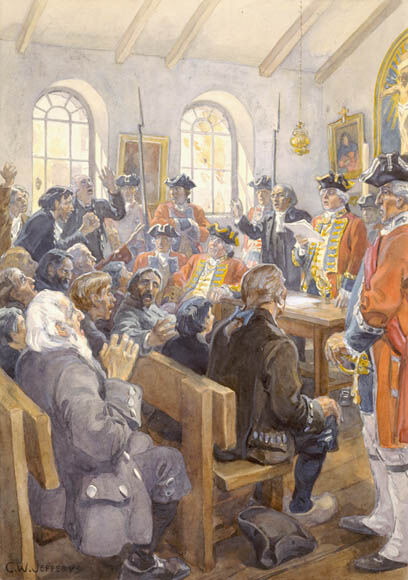 100%
100%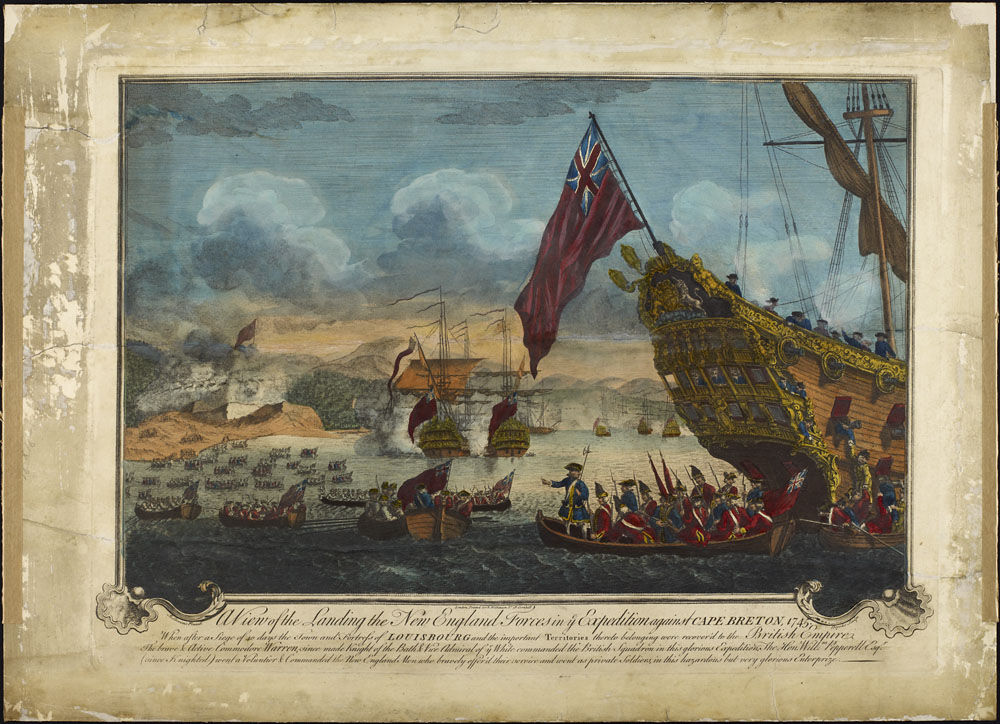 100%
100%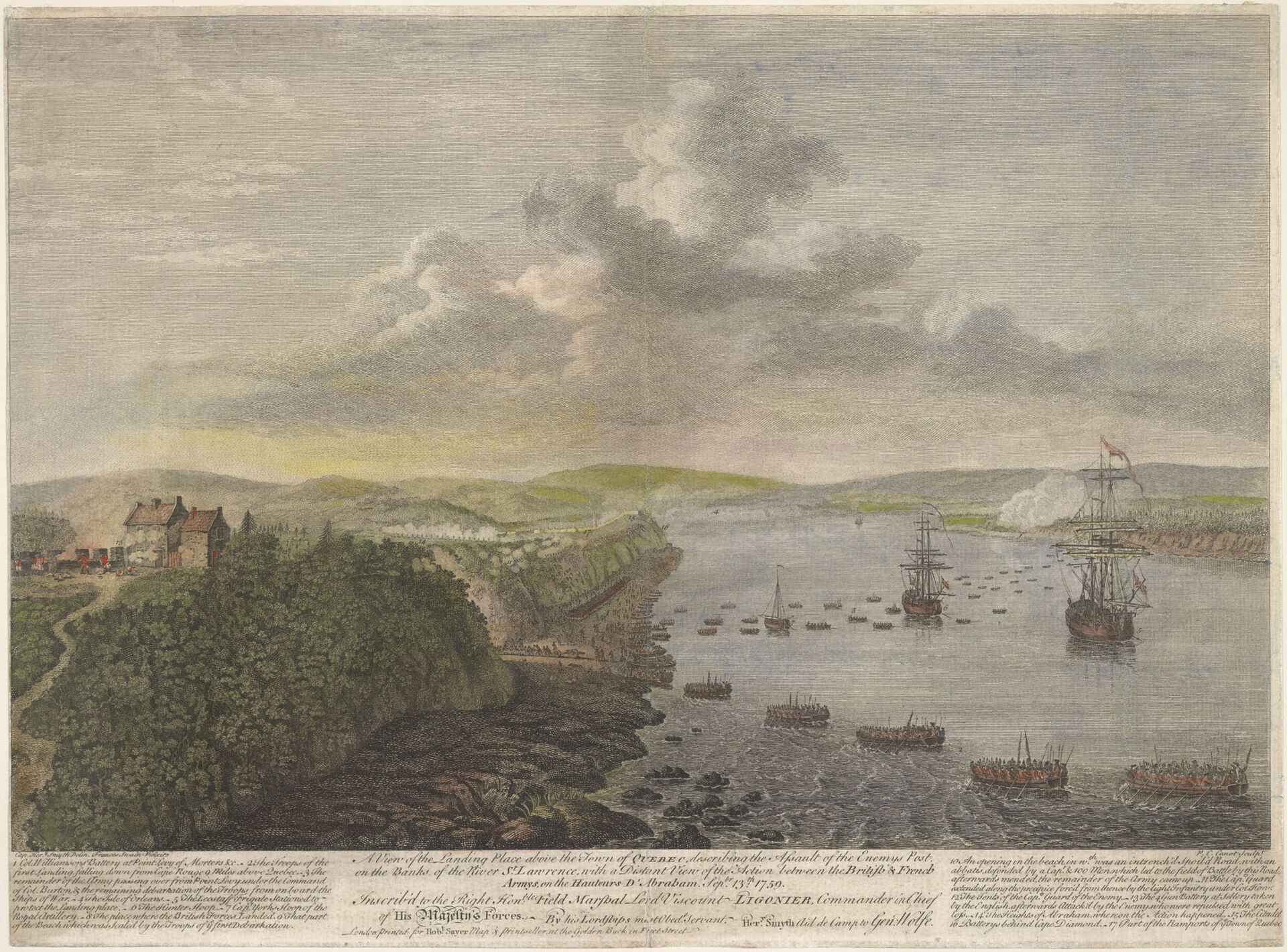 100%
100%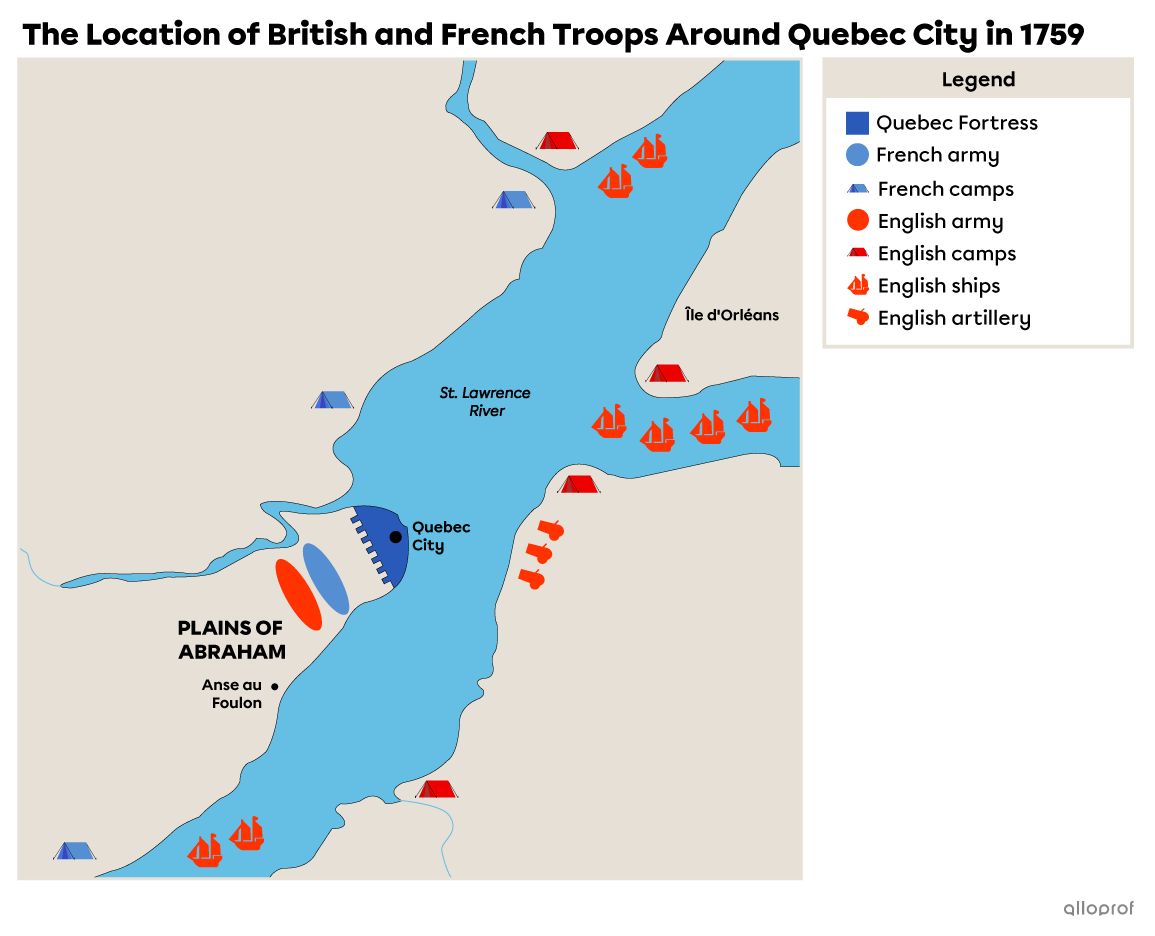 100%
100%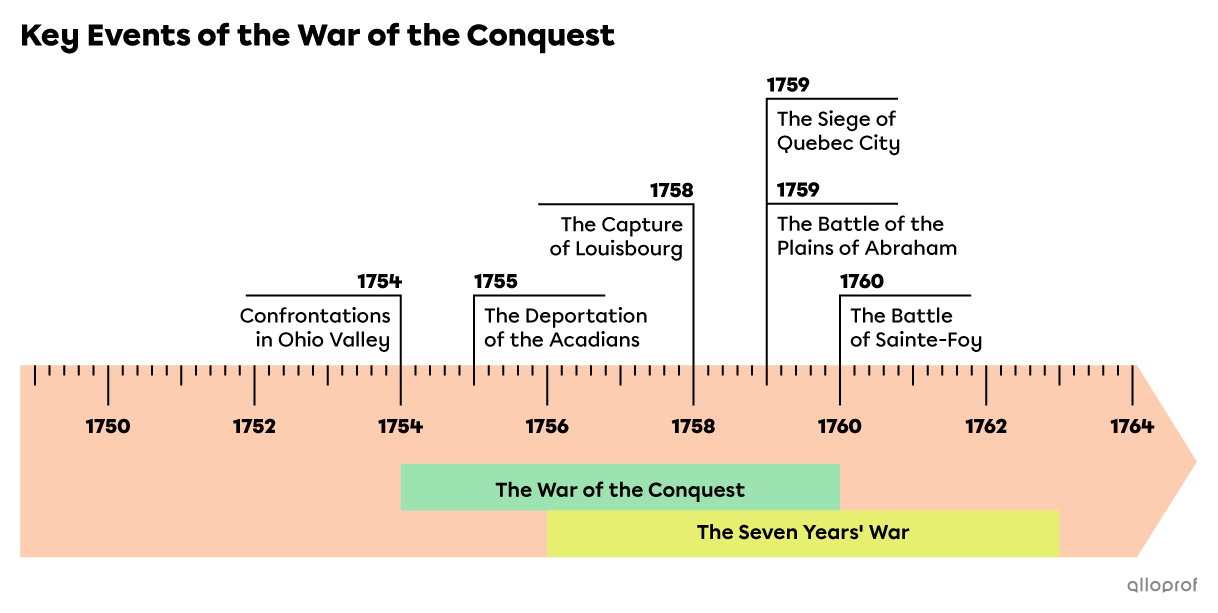
The War of the Conquest (1754–1760), between New France and the British, was part of the broader context of the Seven Years’ War (1756-1763). As its name implies, this war ended with the British conquest of New France.
At the start of the War of the Conquest, the balance of power between New France and the Thirteen Colonies was very uneven.
New France had a vast territory that was sparsely populated, making it hard to defend. France had also been weakened by previous conflicts and chose to focus its military efforts in Europe rather than in New France.
The opposite was true for Great Britain, which invested heavily in its military forces in North America to take possession of New France and its resources.
| Territory | New France (Canada, Acadia, Louisiana) | Thirteen Colonies (New Hampshire, Massachusetts, Rhode Island, Connecticut, New Jersey, New York, Pennsylvania, Delaware, Maryland, Virginia, North Carolina, South Carolina, Georgia) |
| Approximate Population | 82 000 | 1 600 000 |
| Political structure | A united political system: rapid decision-making | 13 political systems: slow decision-making |
| Military forces | Around 21 000 men:
| Around 90 000 men:
|

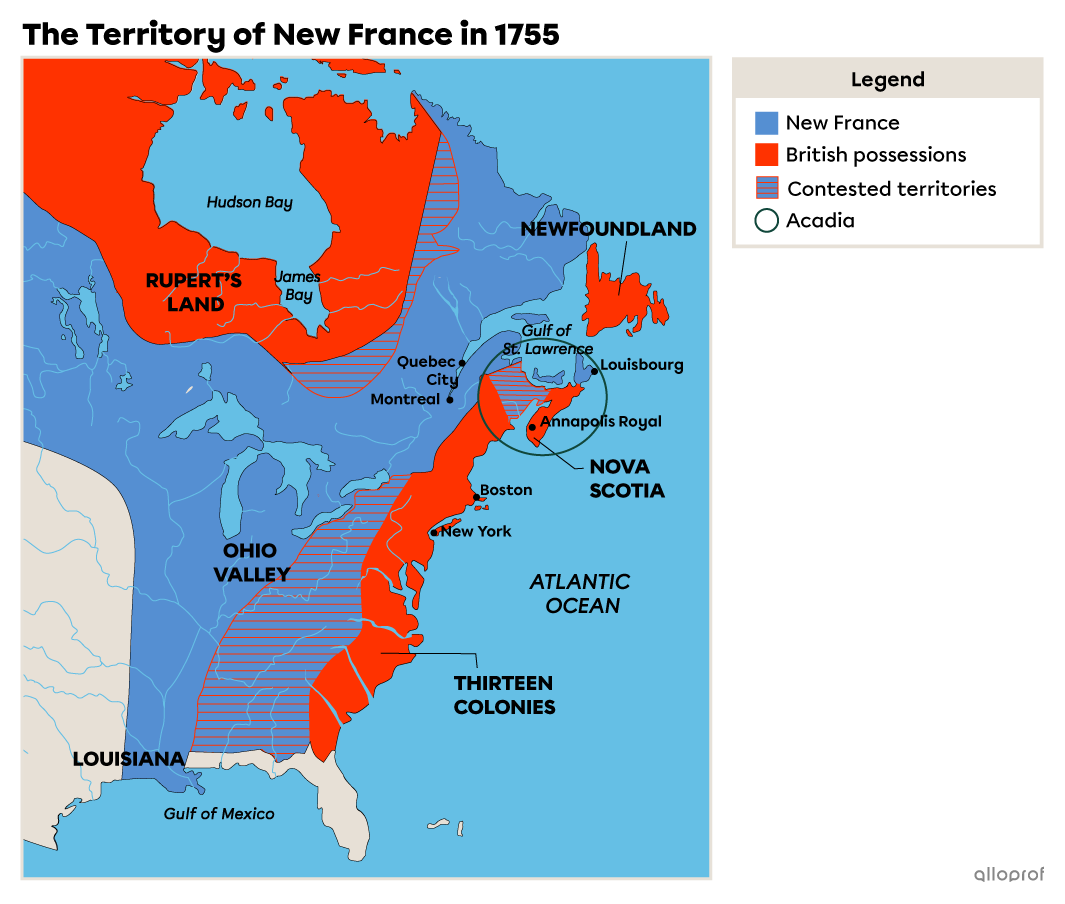
The War of the Conquest began with fighting in the Ohio Valley. Both France and Great Britain laid claim to this territory, which was very important for the fur trade.
In 1754, the British tried to seize control of the Ohio Valley and were met by opposition from the French. Despite being outnumbered, the French won several of these early battles. Their success was due in large part to the military support from their Indigenous allies.
Enlisting most of the able-bodied Canadian men and adolescents into the militia played a major role in the French victories. There were twice as many militiamen as regular soldiers on the French side during the War of the Conquest.
The militia is made up of groups of inhabitants who take up arms as needed, at the governor's call. Militiamen assist professional soldiers.
The Indigenous peoples used guerrilla warfare, which consisted of short surprise attacks. These attacks do not need much manpower as they are carried out by small groups.
After the Treaty of Utrecht in 1713, Great Britain held part of Acadia, now Nova Scotia. However, the British immigrants in Nova Scotia were greatly outnumbered by the Acadians, the original French settlers, who occupied the territory before they arrived.
Fearing that the Acadians would side with the French, in 1755, the British authorities decided to deport them to other British colonies and to Great Britain. This also meant that the rich farmland held by the Acadians could then be offered to British immigrants. Although several hundred of them managed to flee to New France, approximately 10 000 of the 13 000 Acadians were deported.
Reading of the deportation order
In 1758, luck turned for the French, who until then had won many victories. The British received better support from the mother country than the French and deployed their attacks on three fronts (the Ohio Valley and the Great Lakes, the Lake Champlain Valley, the Gulf of Saint-Lawrence) and started winning battles.
One of the most important victories was the capture of the Fortress of Louisbourg, in Acadia. Taking Louisbourg, gave the British control over access to the St. Lawrence River, due to its strategic position. This meant that they could stop supplies from France from reaching Quebec City and Montreal.
A mother country is a state that owns and administers its colonies, which involves exploiting territories outside its own country.
The Attack on the Fortress of Louisbourg by British Troops
In 1759, the British worked their way up the St. Lawrence River with the aim of conquering Quebec City and Montreal, the two political and economic centres of New France.
In June 1759, under the command of British General James Wolfe, British troops bombarded and laid siege to Quebec City for several months. Wolfe also attempted an attack near the French defense line, not far from Montmorency Falls, but it was a failure.
A city is under siege when an opposing armed force completely surrounds it with the aim of cutting it off from the rest of the world and attacking it. This is known as laying siege to a city.
During the siege, General Wolfe ordered the burning and looting of villages, fields, and crops around Quebec City. The goal of this strategy was to intimidate the inhabitants of Quebec and to cut off their access to food.
British Troops Heading Toward Quebec City
In September 1759, the siege of Quebec was still underway, but the city continued to resist. British troops knew they had to succeed in taking the city before the arrival of winter, as the ice forming on the river during the winter months would trap their ships. For this reason, during the night of September 12 to 13, 1759, Wolfe and his troops landed at Anse au Foulon to scale the cliffs up to the Plains of Abraham.
In the morning, the French Lieutenant General, Louis-Joseph de Montcalm, decided to confront the British troops on the Plains of Abraham without waiting for reinforcements.
The battle was over quickly, and the British were victorious. The City of Quebec surrendered 4 days later.
To surrender (capitulate) means to give up to the enemy and abandoning the fight.
In spring 1760, the French attempted to take Quebec City back from the British. Militiamen made up half of the French troops led by Chevalier de Lévis. They marched to Quebec City to fight the British at Sainte-Foy and emerged victorious, but could not win back Quebec City, where the British had taken refuge.
Both sides needed supplies from their mother country to put an end to the fighting. Supplies finally arrived from Great Britain on May 9, 1760, forcing the French troops to fall back.
Montreal capitulated in September 1760 without a fight to avoid more victims. This event marked the end of the War of the Conquest.