Subjects
Grades
Constructing a rhombus or a parallelogram requires the use of geometry tools such as a ruler, set square, protractor, or compass. Since the two figures have different properties, their respective construction methods will also differ.
A rhombus is a quadrilateral that has 4 congruent sides. Its opposite sides are parallel and its opposite angles are congruent.
Follow these steps to draw a rhombus using a set square and ruler:
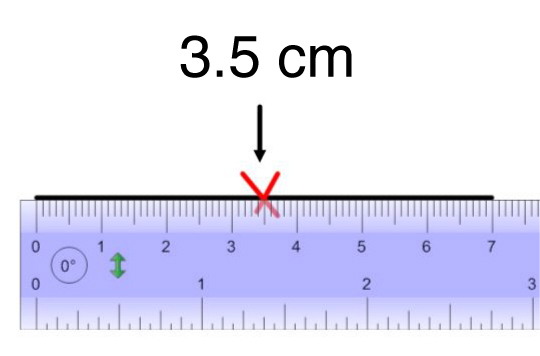
Using a ruler, draw a line segment corresponding to the length of the long diagonal.
Using the ruler, mark the midpoint of the line segment. (To locate this point, divide the measurement of the line segment by 2).
Using the set square, draw a perpendicular line from the midpoint of the line segment. The line must be longer than half of the short diagonal.
Perform the same procedure as in step 3 on the other side of the large diagonal.
Using the ruler, mark the location corresponding to half of the short diagonal on each line drawn in steps 3 and 4.
Using the ruler, connect the marks at each end of the long diagonal with line segments.
Here is a concrete example.
To represent a rhombus with a long diagonal measurement of |7\ \text{cm}| and a small diagonal of |4\ \text{cm}|, follow these steps:
 |
 |
 |
 |
 |
 |
A rhombus can be drawn using a ruler and protractor when the side and angle measurements are given.
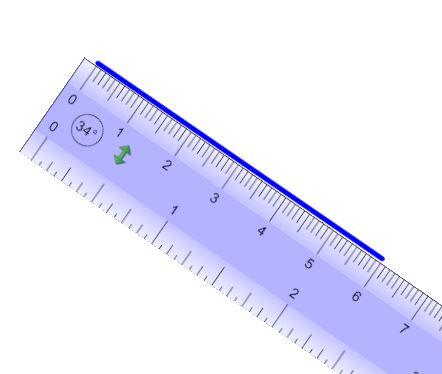
Using a ruler, draw a line segment corresponding to the length of one side of the rhombus.
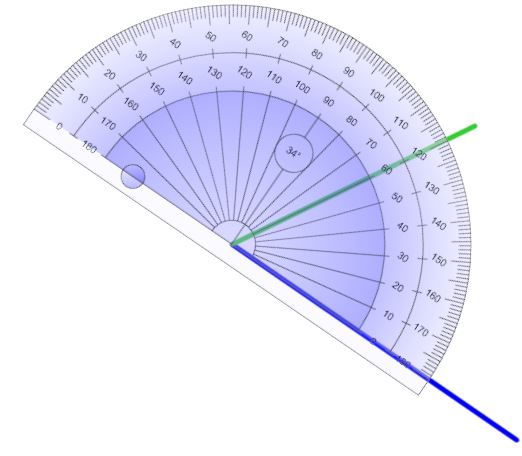
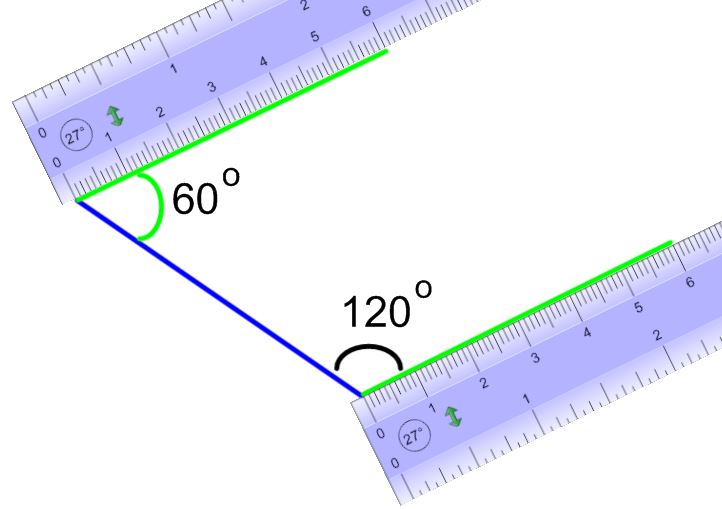
Place the protractor at one end of the line segment and construct the angle according to the specified measurement.
Place the protractor at the other end of the line segment and draw the other angle according to the specified measurement.
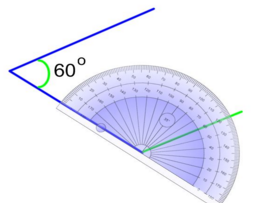
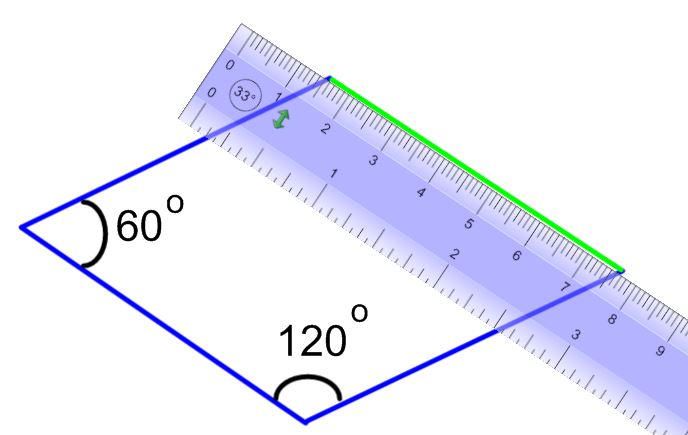
Extend the angle lines constructed in step 3 so that they correspond to the length of the rhombus’ sides.
Using the ruler, connect the ends of the line drawn in step 4.
Here is a concrete example.
Draw a rhombus with sides measuring |6\ \text{cm}| and angles measuring |60^o| and |120^o| respectively.
 |
 |
 |
 |
 |
A parallelogram is a quadrilateral that has two pairs of parallel sides. Opposite sides and opposite angles are congruent.
A parallelogram can be constructed with a compass and a ruler when the measurements of the sides are known.
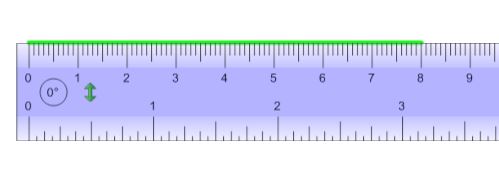
Using a ruler, draw a horizontal line segment that corresponds to the length of the long side of the parallelogram.
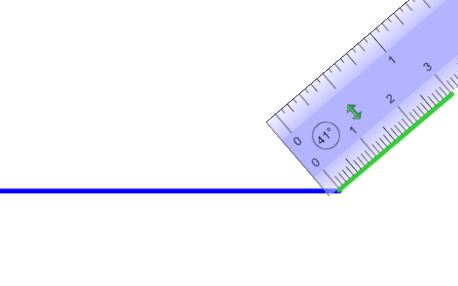
At one end of the line segment, draw a line segment that corresponds to the length of the parallelogram’s short side. This line must be oblique.
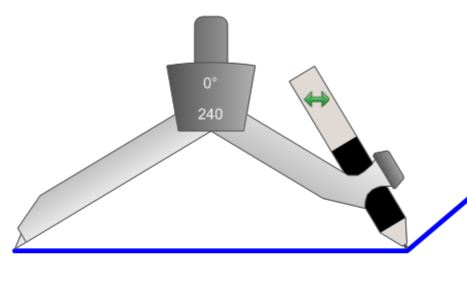
Open the compass to the size of the longer line segment. Place the compass anchor (sharp point) on the end of the oblique line segment.
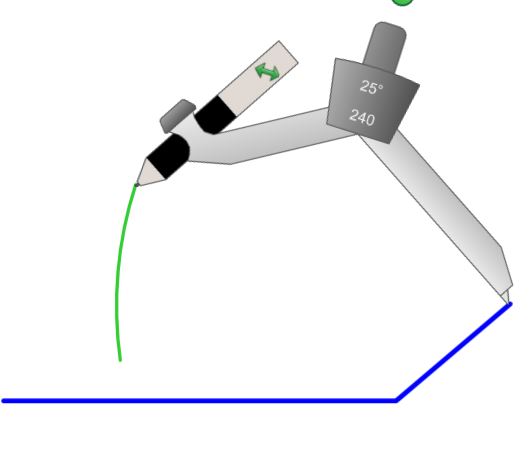
Draw an arc in the direction of the adjacent line segment.
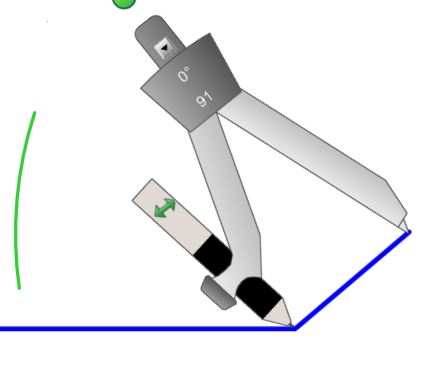
Open the compass to the size of the oblique line segment.
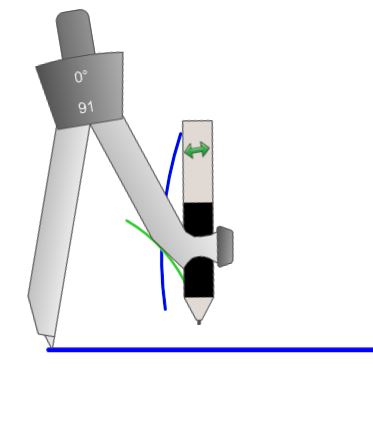
Place the compass anchor (sharp point) on the other end of the long line segment. Draw an arc in the direction of the adjacent line segment, crossing the first arc.
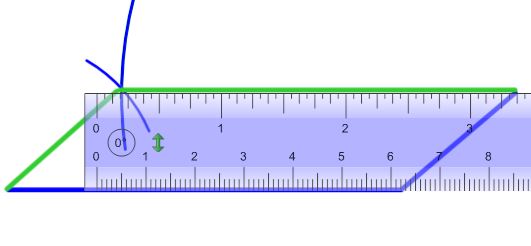
Using the ruler, connect the ends of the two line segments at the point where the two arcs intersect.
Here is a concrete example.
Draw a parallelogram whose long sides measure |8\ \text{cm}| and whose small sides measure |3\ \text{cm}|.
 |
 |
 |
 |
 |
 |
 |
|
Despite the precision of the parallelism between the opposite sides, this method does not take into account two fairly important measurements.
If the measurement of an angle is given, a protractor must be used to ensure the accuracy of the opening of each angle.
If the measurement of the height and one angle measurement are given, then a little more advanced geometry is needed; i.e., trigonometric ratios in a right triangle.
A parallelogram can be constructed using a protractor and a ruler when the measurements of the sides and angles are given.
Using a ruler, draw a horizontal line segment that corresponds to the length of the long side of the parallelogram.
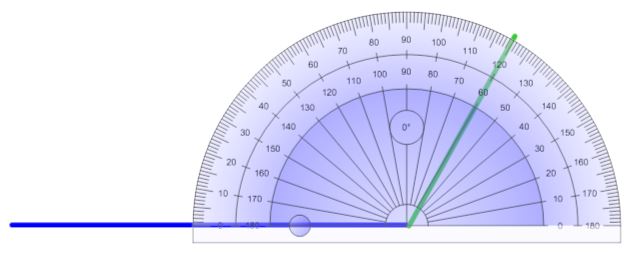
Using a protractor, construct the parallelogram’s obtuse angle at one end of the line segment.
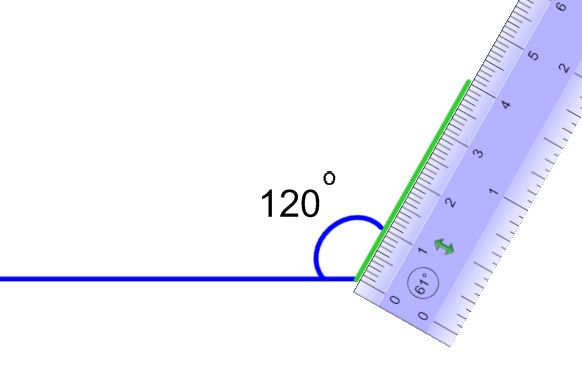
Using the ruler, extend the angle’s line so that it is equal to the measurement of the parallelogram’s short side.
Using the protractor, construct the parallelogram’s acute angle at the other end of the initial line segment.
Using the ruler, extend this angle’s line so that it is equal to the measurement of the parallelogram’s short side.
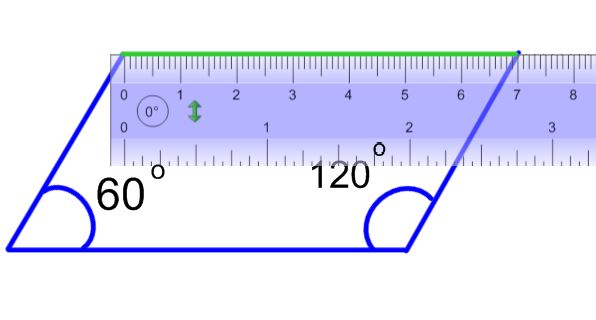
Using the ruler, connect the ends of the oblique line segments.
Here is a concrete example
Draw a parallelogram with bases measuring |7\ \text{cm}|, whose oblique line segments measure |4\ \text{cm}|, and whose obtuse and acute angles measure |120^o| and |60^o|, respectively.
|
 |
 |
 |
 |
 |