Dividing Numbers With a Remainder - Cycle 2

| Mathematics

What is the remainder of a division?

Definition

A remainder is the amount left over after dividing a number into equal groups.

Example:

14 ÷ 3 =?
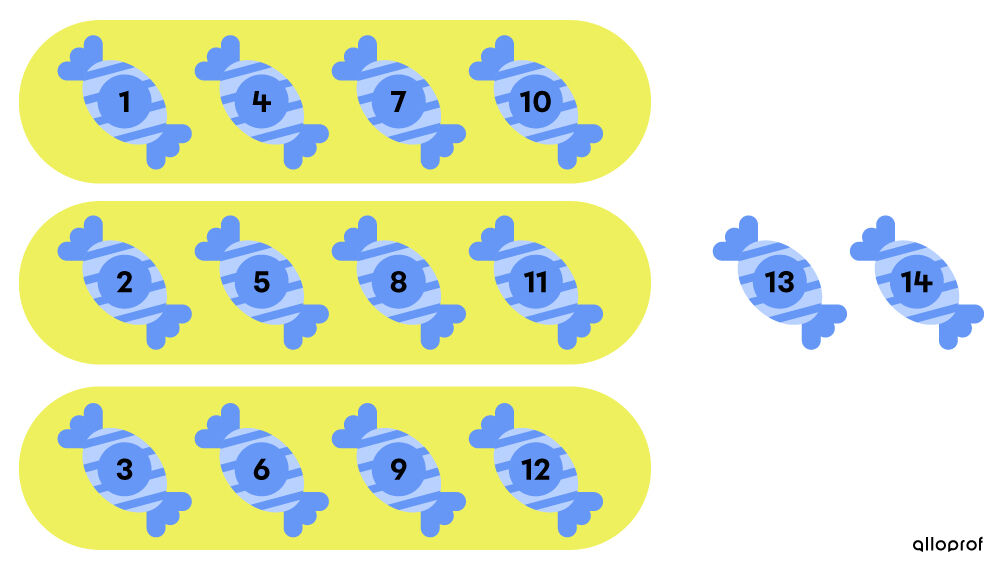
Exemple d’une division avec reste - 1

14 ÷ 3 = 4 remainder 2

How do you perform a division with a remainder using the long division method?

To perform a division with a remainder requires knowing how to use long division. To review long division, see the Dividing Numbers concept sheet.

Example

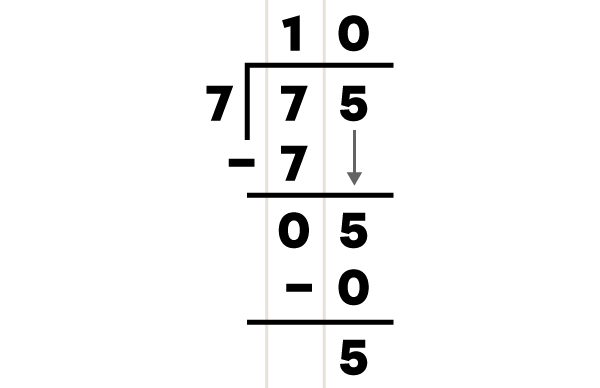
75 ÷ 7 = ?

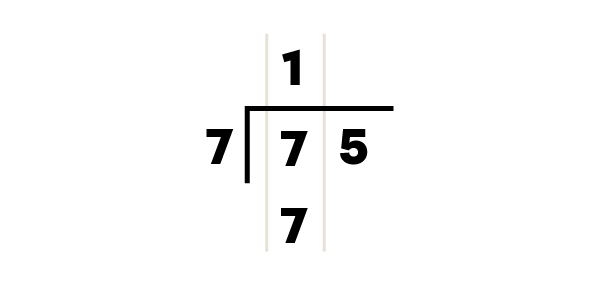
  1. I start by dividing the first digit on the left of the dividend. 

    I ask myself how many times 7 goes into 7.
    7 goes into 7 once.

    Next, I place 1 above the division bracket.
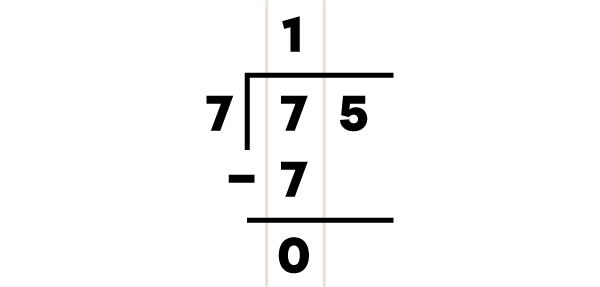
    I write 7 under the 7 and then perform a subtraction.
    7 - 7 = 0

image
image


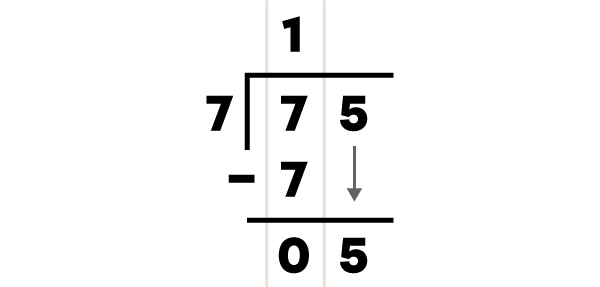
  1. I bring down the next number of the dividend and place it to the right of the answer in the subtraction.
image
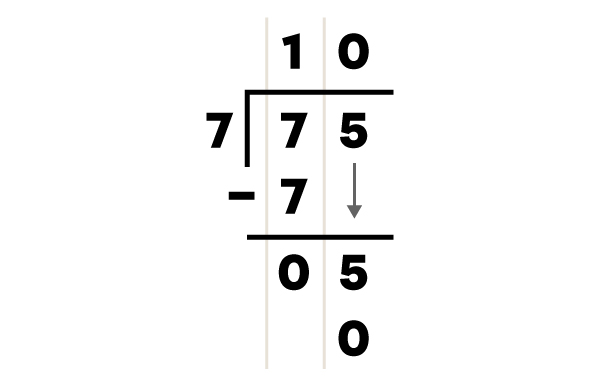
  1. I ask myself how many times 7 goes into 5.
    7 does not fit into 5, since it is greater than 5.

    So, I place a 0 in the answer above the division symbol and a 0 under the 5. Then, I subtract.
    5 - 0 = 5

    There is no longer a number to bring down. 5 is the remainder of the division.

image
image

75 ÷ 7 = 10 remainder 5

How do you write the remainder of a division as a fraction?

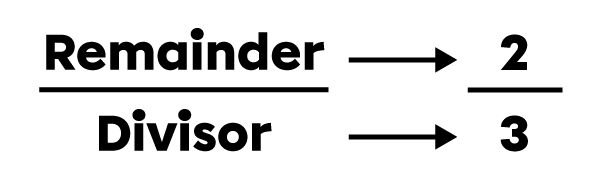
To write the remainder of a division as a fraction, write the remainder as the numerator and the divisor as the denominator.

Example

|14\div3=4\ \text{remainder}\ 2|

Example of a division with a remainder written as a fraction

In the form of a fraction, the quotient of |14\div3| is written |4\ \dfrac{2}{3}|.

Dividing Numbers with a Remainder (Grades 3-4)

Dividing Numbers with a Remainder (Grades 3-4)

Moments in the video:

  • 00:00-Introduction
  • 00:16-Example 1
  • 01:52-Example 2
  • 03:11-Conclusion