Subjects
Grades
 100%
100%
 100%
100%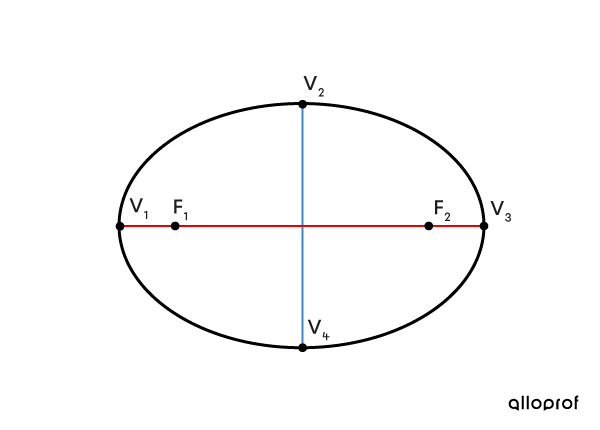 100%
100%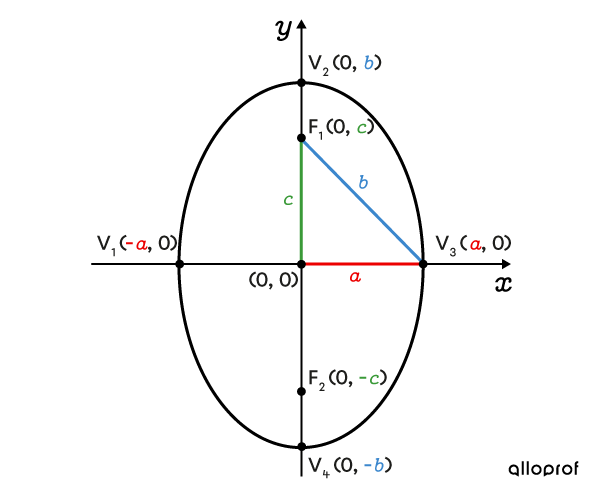 100%
100%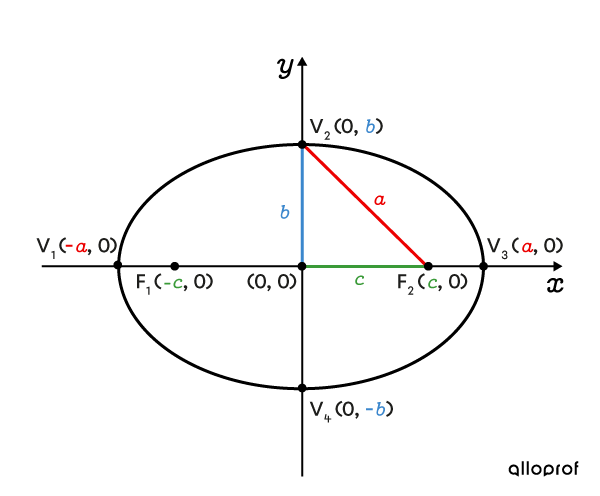 100%
100%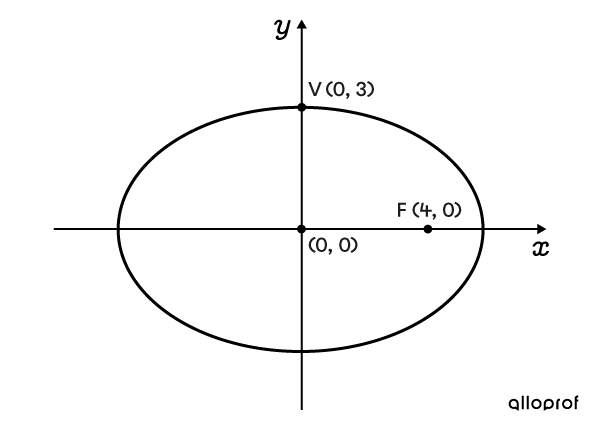 100%
100%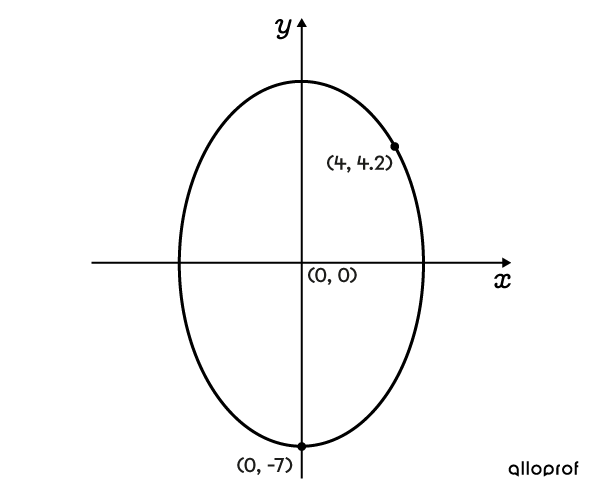 100%
100%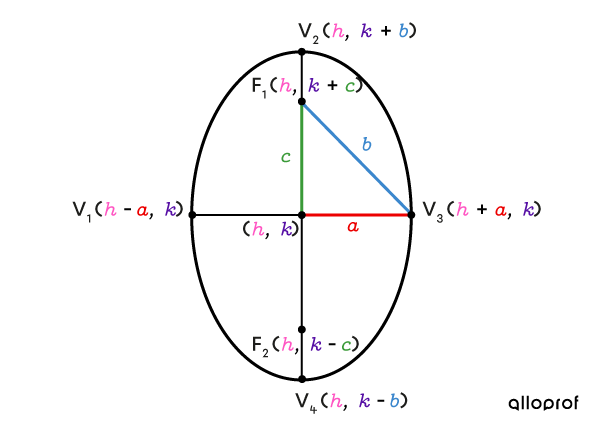 100%
100%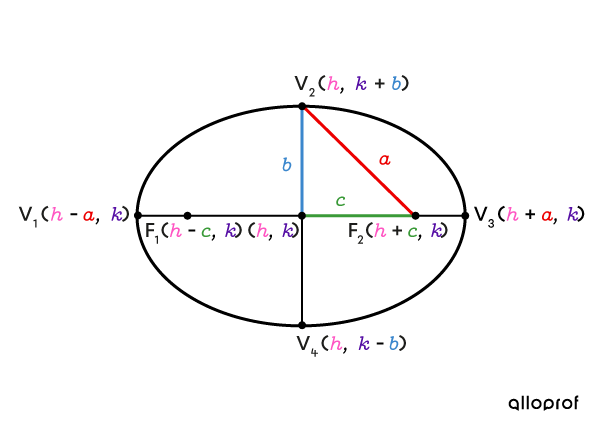 100%
100%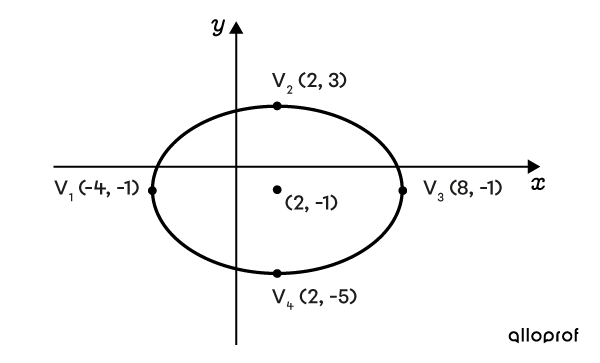 100%
100%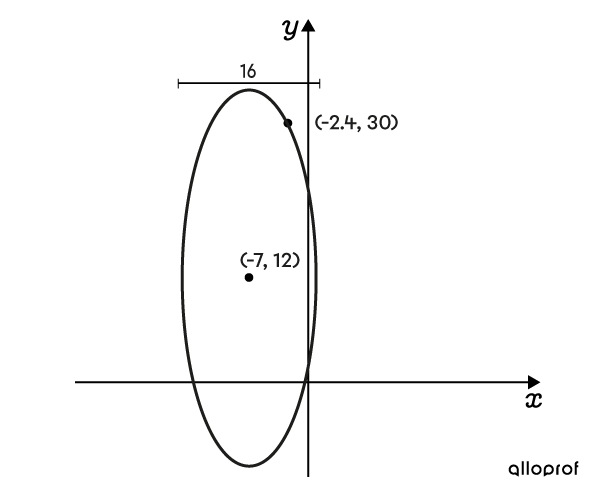
|
Sector of the Cartesian Plane |
Graphical Representation |
Corresponding Inequality |
|---|---|---|
|
The exterior, excluding the curve |
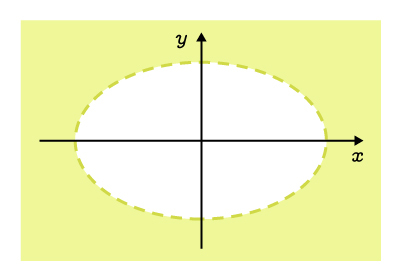 |
||\begin{align}\dfrac{x^2}{a^2}&+\dfrac{y^2}{b^2}>1\\\\ |
|
The interior, excluding the curve |
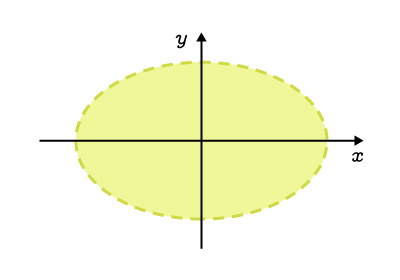 |
||\begin{align}\dfrac{x^2}{a^2}&+\dfrac{y^2}{b^2}<1\\\\ |
|
The exterior, including the curve |
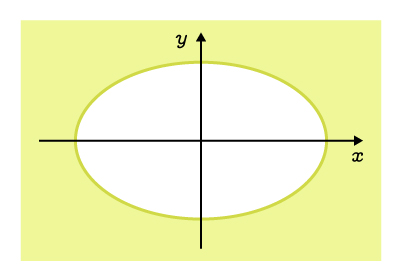 |
||\begin{align}\dfrac{x^2}{a^2}&+\dfrac{y^2}{b^2}\geq1\\\\ |
|
The interior, including the curve |
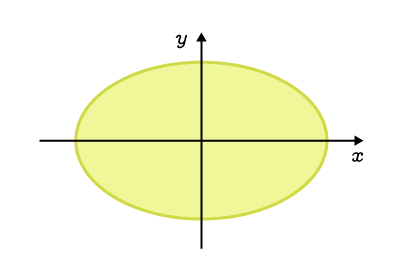 |
||\begin{align}\dfrac{x^2}{a^2}&+\dfrac{y^2}{b^2}\leq1\\\\ |
The ellipse is one of the conics. It is obtained by the intersection of a cone and a plane.
An ellipse is the geometric locus of all points whose sum of the distances to 2 fixed points, called foci, is constant.
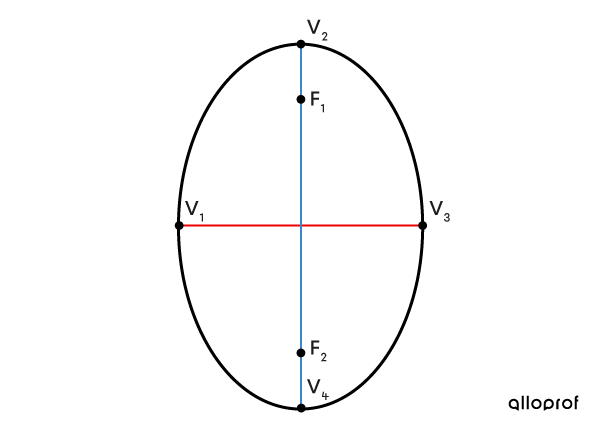
An ellipse has two axes of symmetry. The longest is called the major axis, and the shortest, the minor axis.
An ellipse has two foci, |F_1| and |F_2.|
An ellipse has four vertices, |V_1,| |V_2,| |V_3,| and |V_4.|
An ellipse can be vertical or horizontal.

Vertical Ellipse
Horizontal Ellipse
The equation that defines an ellipse centred at the origin uses parameters |a| and |b.|
||\dfrac{x^2}{a^2}+\dfrac{y^2}{b^2}=1|| where ||\begin{align} a &:\text{Half the length of the major axis }\\ b &: \text{Half the length of the minor axis } \end{align}||
If |\color{#ec0000}a < \color{#3b87cd}b,| the ellipse is vertical.
If |\color{#ec0000}a > \color{#3b87cd}b,| the ellipse is horizontal.
Here are the graphic representations of the two types of ellipses on which the important points are placed. The coordinates of these points in relation to the parameters of the ellipse are also given.
The sum of the distances between a point on a vertical ellipse and its two foci is |2\color{#3b87cd}b.|
The relationship between parameters |\color{#ec0000}a,| |\color{#3b87cd}b,| and |\color{#3a9a38}c| can be expressed using the Pythagorean Theorem.
||\color{#3a9a38}c^2=\color{#3b87cd}b^2-\color{#ec0000}a^2||
The sum of the distances between a point on a horizontal ellipse and its two foci is |2\color{#ec0000}a.|
The relationship between parameters |\color{#ec0000}a,| |\color{#3b87cd}b,| and |\color{#3a9a38}c| can be expressed using the Pythagorean Theorem.
||\color{#3a9a38}c^2=\color{#ec0000}a^2-\color{#3b87cd}b^2||
Find the value of the parameters |a| and |b| to determine the equation of an ellipse centred at the origin.
Generally, the procedure below is used.
Determine the value of parameter |\color{#ec0000}a,| which corresponds to half of the ellipse’s horizontal axis, and/or that of parameter |\color{#3B87CD}b,| which corresponds to half of the vertical axis.
If one of the two parameters is missing, find it using one of the following strategies:
a) If parameter |\color{#3A9A38}c| (the distance between the centre and a focus) is given, use the Pythagorean Theorem to determine the value of the missing parameter. ||\begin{align}\text{Vertical ellipse :}&\ \color{#3a9a38}c^2=\color{#3b87cd}b^2-\color{#ec0000}a^2\\ \text{Horizontal ellipse :}&\ \color{#3a9a38}c^2=\color{#ec0000}a^2-\color{#3b87cd}b^2 \end{align}||
b) If a point on the ellipse |(x,y)| is provided, substitute these coordinates into the equation and determine the value of the missing parameter.
Write the ellipse’s equation.
Determine the equation of this ellipse.
Determine the equation of this ellipse.
Follow these steps to draw an ellipse centred at the origin using its equation.
Mark the centre of the ellipse.
Use the value of parameter |\color{#EC0000}a| to mark the two vertices located on the horizontal axis. Here are the coordinates of the vertices: ||\begin{align}V_1&=(\color{#EC0000}{-a},0)\\ V_3&=(\color{#EC0000}a,0)\end{align}||
Use the value of parameter |\color{#3B87CD}b| to mark the two vertices located on the vertical axis. Here are the vertices’ coordinates: ||\begin{align}V_2&=(0,\color{#3B87CD}b)\\ V_4&=(0,\color{#3B87CD}{-b})\end{align}||
Connect the four vertices to draw the ellipse.
Draw the ellipse represented by the following equation. ||\dfrac{x^{2}}{289}+\dfrac{y^{2}}{196}=1||
The equation that defines an uncentered ellipse uses parameters |a,| |b,| |h,| and |k.|
||\dfrac{(x-h)^2}{a^2}+\dfrac{(y-k)^2}{b^2}=1|| or ||\begin{align} a &:\text{Half the length of the horizontal axis }\\ b &: \text{Half the length of the vertical axis }\\ (h,k) &: \text{Coordinates of the ellipse’s centre }\end{align}||
If |\color{#ec0000}a < \color{#3b87cd}b,| the ellipse is vertical.
If |\color{#ec0000}a > \color{#3b87cd}b,| the ellipse is horizontal.
The sum of the distances between a point on a vertical ellipse and its two foci is |2\color{#3b87cd}b.|
The relationship between the parameters |\color{#ec0000}a,| |\color{#3b87cd}b| and |\color{#3a9a38}c| can be expressed using the Pythagorean Theorem.
||\color{#3a9a38}c^2=\color{#3b87cd}b^2-\color{#ec0000}a^2||
The sum of the distances between a point on a horizontal ellipse and its two foci is |2\color{#ec0000}a.|
The relationship between parameters |\color{#ec0000}a,| |\color{#3b87cd}b,| and |\color{#3a9a38}c| can be expressed using the Pythagorean Theorem.
||\color{#3a9a38}c^2=\color{#ec0000}a^2-\color{#3b87cd}b^2||
To use a graph to determine the equation of an ellipse not centred at the origin, find the value of parameters |a,| |b,| |h,| and |k.|
Generally, the process looks like this.
Determine the values of parameters |\color{#FF55C3}h| and |\color{#560FA5}k| from the coordinates of the ellipse’s centre.
Determine the value of parameter |\color{#ec0000}a,| which corresponds to half of the ellipse’s horizontal axis, and/or that of parameter |\color{#3B87CD}b,| which corresponds to half of the vertical axis.
If either parameter |a| or |b| is missing find it using one of the following strategies:
a) If parameter |\color{#3A9A38}c| (the distance between the centre and a focus) is provided, use the Pythagorean Theorem to determine the missing parameter’s value. ||\begin{align}\text{Vertical ellipse :}&\ \color{#3a9a38}c^2=\color{#3b87cd}b^2-\color{#ec0000}a^2\\ \text{Horizontal ellipse :}&\ \color{#3a9a38}c^2=\color{#ec0000}a^2-\color{#3b87cd}b^2 \end{align}||
b) If a point on ellipse |(x,y)| is provided, substitute its coordinates into the equation and determine the value of the missing parameter.
Write the ellipse’s equation.
Determine the equation of this ellipse.
Determine the equation of this ellipse, knowing that its horizontal axis measures |16| units.
Follow these steps to draw an ellipse using its equation.
Identify parameters |\color{#FF55C3}h| and |\color{#560FA5}k| in the equation and mark the ellipse’s centre.
Use the value of parameter |\color{#EC0000}a| to mark the two vertices located on the horizontal axis. Here are the vertices’ coordinates. ||\begin{align}V_1:(\color{#FF55C3}h\color{#EC0000}{-a},\color{#560FA5}k)\\ V_3:(\color{#FF55C3}h\color{#EC0000}{+a},\color{#560FA5}k)\end{align}||
Use the value of parameter |\color{#3B87CD}b| to place the two vertices on the vertical axis. Here are the vertices’ coordinates. ||\begin{align}V_2:(\color{#FF55C3}h,\color{#560FA5}k\color{#3B87CD}{+b})\\ V_4:(\color{#FF55C3}h,\color{#560FA5}k\color{#3B87CD}{-b})\end{align}||
Connect the four vertices to draw the ellipse.
Draw the ellipse represented by the following equation. ||\dfrac{(x-5)^{2}}{64}+\frac{(y+4)^{2}}{100}=1||
Apply the following relations to represent a region bounded by an ellipse
|
Sector of the Cartesian Plane |
Graphical Representation |
Corresponding Inequality |
|---|---|---|
|
The exterior, excluding the curve |
|
||\begin{align}\dfrac{x^2}{a^2}&+\dfrac{y^2}{b^2}>1\\\\ |
|
The interior, excluding the curve |
|
||\begin{align}\dfrac{x^2}{a^2}&+\dfrac{y^2}{b^2}<1\\\\ |
|
The exterior, including the curve |
|
||\begin{align}\dfrac{x^2}{a^2}&+\dfrac{y^2}{b^2}\geq1\\\\ |
|
The interior, including the curve |
|
||\begin{align}\dfrac{x^2}{a^2}&+\dfrac{y^2}{b^2}\leq1\\\\ |
The general form of the equation of all conics, including the ellipse, for which the horizontal axis is parallel to the x-axis and the vertical axis is parallel to the y-axis is: || Ax^2+ By^2+Cx+Dy+E=0||
It can be helpful to switch from general form to standard form when solving some problems concerning the ellipse.