Subjects
Grades
A fraction is equivalent to another fraction when it represents the same part of a whole or set.
To fully understand what an equivalent fraction is, first you need to understand the role of the numerator and the denominator. To learn what a numerator and a denominator are, see The Representation of a Fraction.
To be equivalent, fractions must meet two criteria:
It is important for the wholes to be identical - that is to say, they are the same size, as in the following image.
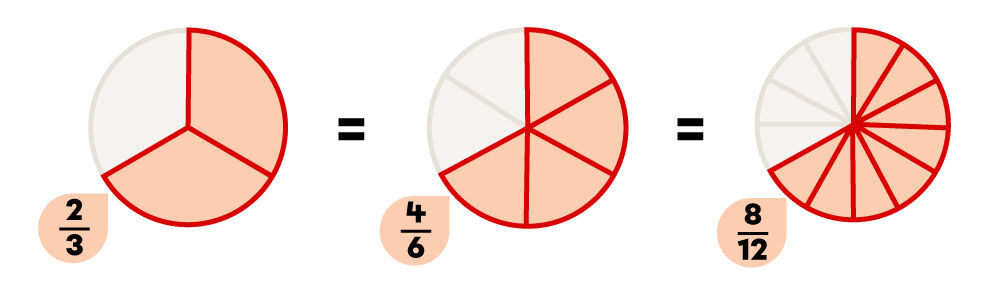
To verify that fractions are equivalent, I need to complete the following steps:
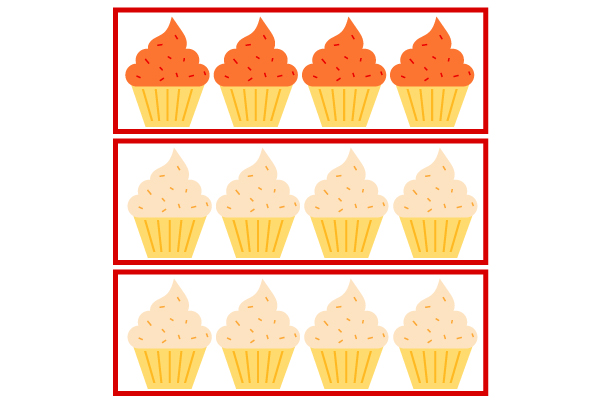
Alicia baked |12| cupcakes. |\dfrac{1}{3}| of her cupcakes have red frosting and |\dfrac{3}{12}| have blue frosting. All of the remaining cupcakes are white.
Did Alicia bake the same number of red cupcakes as blue cupcakes?
|  |
|  |
|  |
The amount of red cupcakes is not equivalent to the amount of blue cupcakes, because Alicia frosted |4| cupcakes red and only |3| cupcakes blue.
Therefore, |\dfrac{3}{12}| is not equivalent to |\dfrac{1}{3}.|