Subjects
Grades
 100%
100%
A cosine equation or inequality contains a cosine ratio, where the unknown |(x)| is found in the argument.
Since the cosine function is periodic, this type of equation may have no solution, one solution, several solutions or an infinite number of solutions.
Also, we need to use the angles in radians.
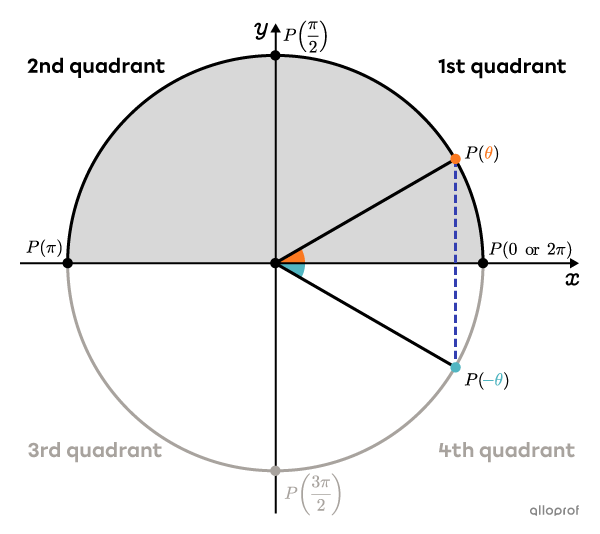
In the unit circle, the cosine of an angle corresponds to the x-coordinate of the point on the circle. When solving a cosine equation, we look for angles that have a certain x-coordinate. To do so, we can use the main points of the unit circle or the inverse function |\boldsymbol{\arccos}.|
When we use the unit circle, we generally choose angles located between |0| and |2\pi.|
When using the reciprocal function |\arccos,| the result obtained is always an angle in the 1st quadrant or the 2nd quadrant of the unit circle. In other words, the angle is between |0| and |\pi.|
However, there are always 2 different trigonometric angles with the same x-coordinate. This is why, from the angle obtained |\boldsymbol{\color{#fa7921}{(\theta)}},| we find the 2nd angle by calculating |\boldsymbol{\color{#51b6c2}{-\theta}}.|

The inverse function |\arccos| is sometimes denoted |\cos^{-1},| especially on calculators.
The procedure for solving a cosine equation is as follows:
Isolate the cosine ratio.
Find the trigonometric angles.
- If the cosine ratio is equal to the x-coordinate of one of the main points, use the unit circle.
- If not, use the inverse function |\boldsymbol{\arccos}.|
Solve the equations obtained with the trigonometric angles.
Calculate the period of the cosine function.
Give the solutions of the equation.
Here's an example using the main points of the unit circle to solve the equation.
Solve the following equation:||2\cos(5x)+\sqrt{3}=0||
Here's an example that uses the inverse function arccosine to solve the equation.
Solve the following equation for the interval |[-\pi,\pi].|||\dfrac{1}{2}\cos\left(\dfrac{3(x+1)}{2}\right)+\dfrac{9}{10}=1||
Here's an example of solving a 2nd degree cosine equation.
Solve the following equation:||2\cos^2\left(\dfrac{x}{4}\right)-3\cos\left(\dfrac{x}{4}\right)+1=0||
The procedure for solving a cosine inequality is as follows:
Change the inequality symbol to an equal symbol.
Isolate the cosine ratio.
Determine the trigonometric angles.
- If the cosine ratio is equal to an x-coordinate of one of the main points, use the unit circle.
- If not, use the inverse function |\boldsymbol{\arccos}.|
Solve the equations obtained with the trigonometric angles.
Calculate the period of the cosine function.
Give the solution set of the inequality.
Here's an example using the main points of the unit circle to solve the inequality.
Solve the following inequality:||2\cos(x−3)>1||
Here's an example of how to use the inverse function arccosine to solve the inequality.
Solve the following inequality:||-\dfrac{1}{4}\cos\!\big(3(x+7)\big)-2\ge-\dfrac{29}{16}||
Here's an example of solving a 2nd degree cosine inequality.
Solve the following inequality:||\cos^2(x)<\dfrac{1}{4}||