Subjects
Grades
Solving a system of equations that are linear consists of finding, if possible, the coordinates of the intersection point of 2 first-degree functions.
A system of equations is a set of two or more equations that can be solved using various strategies.
Solving a system of linear equations consists of determining the coordinates of the intersection point(s) between the straight lines given by the equations.
Solving a system of two-variable equations involves finding the point where the equations meet. When the intersection point exists, it is a point |(x,y).|
This is possible when the two lines intersect. When the lines are parallel and coincident there are an infinite number of solutions, and when they are parallel and distinct there is no solution.
A system of linear equations can be solved in several ways. A graph or a table of values can be used to determine the intersection point. It is also possible to solve the system of equations algebraically using different methods.
To confirm that you understand solving systems of linear equations, see the following interactive Crash Course:

When solving a system of linear equations, it is necessary to find a point |(x, y)| which verifies all the system’s equations. Therefore, the point found corresponds to the coordinates of the two lines’ intersection point.
There are three possible situations:
The system of equations can have a unique solution. In this case, the lines meet graphically at a single point. Therefore, the slopes of the equations are different, which characterizes intersecting lines.
The system of equations may have no solution. In this case, the lines never meet. Therefore, the slopes of the equations are the same but their initial values are different, which characterizes distinct parallel lines.
The system of equations can have an infinite number of solutions. In this case, the lines meet at all points. Therefore, the slopes and the |y|-intercept of the lines are the same, which characterizes coincident lines.
Therefore, the number of possible solutions of a system of equations can be determined using the equations of the lines and their graphs.
Consider the following system of equations.||\begin{cases}y=a_1x+b_1\\y=a_2x+b_2\end{cases}||The possible cases are summarized in the table below.
|
Unique solution |
No solution |
Infinite solutions |
|---|---|---|
|
Intersecting lines  Their slope and y-intercept are different.||a_1\neq a_2||and||b_1\neq b_2|| |
Distinct parallel lines 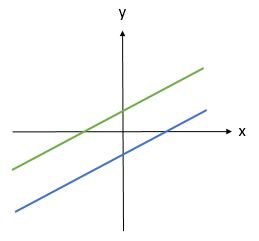 Their slope are the same, but their y-intercept are different.||a_1= a_2||and||b_1\neq b_2|| |
Coincident lines 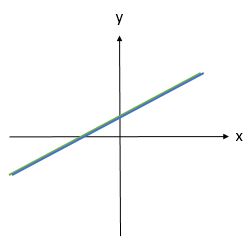 Their slope and y-intercept are the same.||a_1= a_2||and||b_1=b_2|| |