Subjects
Grades
Before you can subtract two fractions, you must find a common denominator.
Once equivalent fractions and common denominators have been found, the fractions can be subtracted.
We look for a common denominator.
For each fraction, we create an equivalent fraction.
We subtract only the numerators.
When a denominator is a multiple of the other, we can quickly find a common denominator.
Subtract the following: ||\frac{1}{2}-\frac{1}{4}||
We look for a common denominator.
Multiples of |2=\{2,\underbrace{\color{red}{4}}_{\color{blue}{2^{nd} \ \text{multiple}}},6,8,...\}|
Multiples of |4=\{\underbrace{\color{red}{4}}_{\color{green}{1^{st} \ \text{multiple}}}, 8, 12, 16,...\}|
Thus, the common denominator is |\color{red}{4}.|
For each fraction, we create an equivalent fraction. ||\frac{1}{2}^{\color{blue}{\times 2}}_{\color{blue}{\times 2}}=\frac{2}{\color{red}{4}} \\\\ \frac{1}{4}^{\color{green}{\times 1}}_{\color{green}{\times 1}}=\frac{1}{\color{red}{4}}||
We subtract only the numerators.||\begin{align} \frac{1}{2}-\frac{1}{4} &= \frac{2}{\color{red}{4}}-\frac{1}{\color{red}{4}}\\\\ &=\frac{2-1}{\color{red}{4}}\\\\ &=\frac{1}{\color{red}{4}}\end{align}||
When one denominator is not a multiple of the other, we can multiply the two denominators to find the common denominator.
Subtract the following: ||\frac{5}{\color{blue}{6}}-\frac{4}{\color{green}{5}}||
We look for a common denominator.
By multiplying the denominators, we find the common denominator: ||\color{blue}{6} \times \color{green}{5} = \color{red}{30}||
For each fraction, we create an equivalent fraction. ||\frac{5}{\color{blue}{6}}^{\color{green}{\times 5}}_{\color{green}{\times 5}} =\frac{25}{\color{red}{30}} \\\\ \frac{4}{\color{green}{5}}^{\color{blue}{\times 6}}_{\color{blue}{\times 6}} = \frac{24}{\color{red}{30}}||
We subtract only the numerators. ||\begin{align} \frac{5}{\color{blue}{6}} - \frac{4}{\color{green}{5}} &= \frac{25}{\color{red}{30}} - \frac{24}{\color{red}{30}} \\\\ &= \frac{25-24}{\color{red}{30}} \\\\ &= \frac{1}{\color{red}{30}} \end{align}||
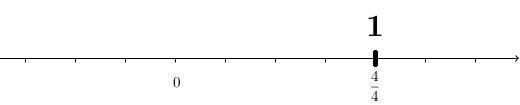
First, we must separate each whole on the number line into as many parts as the value of the denominator (the bottom number in the fraction).
For example, take the fraction |\dfrac{3}{4}.| The 4th line from |0| represents a whole, or the fraction |\dfrac{4}{4}.|
To subtract fractions using a number line, follow these steps:
We look for the common denominator of the fractions.
For each fraction, create an equivalent fraction.
We segment each whole on the number line into as many parts as the value of the common denominator.
We place the 1st fraction on the number line according to its numerator.
We subtract the 2nd fraction from the 1st.
Find the difference between: ||\frac{3}{8}-\frac{1}{4}||
We find the common denominator of the two fractions.
Multiples of |8=\{\underbrace{\color{red}{8}}_{\color{blue}{1^{st} \ \text{multiple}}}, 16, 24, 32, ... \}|
Multiples of |4=\{4, \underbrace{\color{red}{8}}_{\color{green}{2^{nd} \ \text{multiple}}}, 12, 16, ...\}|
Thus, the common denominator is |\color{red}{8}.|
For each fraction, we create an equivalent fraction. ||\frac{3}{8}^{\color{blue}{\times 1}}_{\color{blue}{\times 1}} =\frac{3}{\color{red}{8}} \ \ \text{and} \ \ \frac{1}{4}^{\color{green}{\times 2}}_{\color{green}{\times 2}} =\frac{2}{\color{red}{8}}||
We segment each whole on the number line into as many parts as the value of the common denominator.

Place the 1st fraction according to its numerator.

Subtract the 2nd fraction from the 1st.

Therefore, |\dfrac{3}{8} - \dfrac{1}{4} = \dfrac{3}{8} - \dfrac{2}{8} = \dfrac{1}{8}.|
If the equation is made up of mixed numbers, there are several methods that can be used. The simplest method however, is to convert the mixed numbers into fractions and then apply the same method used for the subtraction of fractions.
Find the difference between the following: ||5 \dfrac{1}{3} - 2 \dfrac{2}{5}||
We convert mixed numbers into fractions. ||\begin{align} &5 \dfrac{1}{3} && \text{and} && \quad \ \ 2 \dfrac{2}{5} \\ =\ &\dfrac{5 \times 3 + 1}{3} && \text{and} && =\dfrac{2 \times 5 + 2}{5} \\ = \ &\dfrac{16}{\color{blue}{3}} && \text{and} && =\dfrac{12}{\color{green}{5}} \end{align}||
We look for a common denominator.
Multiply the denominators to find the common denominator |\color{blue}{3} \times \color{green}{5} = \color{red}{15}.|
For each fraction, we create an equivalent fraction. ||\dfrac{16}{\color{blue}{3}}^{\color{green}{\times 5}}_{\color{green}{\times 5}} =\dfrac{80}{\color{red}{15}}\ \ \text{and} \ \ \dfrac{12}{\color{green}{5}}^{\color{blue}{\times 3}}_{\color{blue}{\times 3}} = \dfrac{36}{\color{red}{15}}||
We subtract only the numerators. ||\begin{align} \dfrac{16}{\color{blue}{3}} - \dfrac{12}{\color{green}{5}} &= \dfrac{80}{\color{red}{15}} - \dfrac{36}{\color{red}{15}} \\[3pt] &= \dfrac{80-36}{\color{red}{15}} \\[3pt] &= \dfrac{44}{\color{red}{15}} \\[3pt] &=2\dfrac{14}{15}\end{align}||
It is always a good idea to write an answer as a fraction in its simplest form at the end of a calculation when possible.