Subjects
Grades
 100%
100%
 100%
100%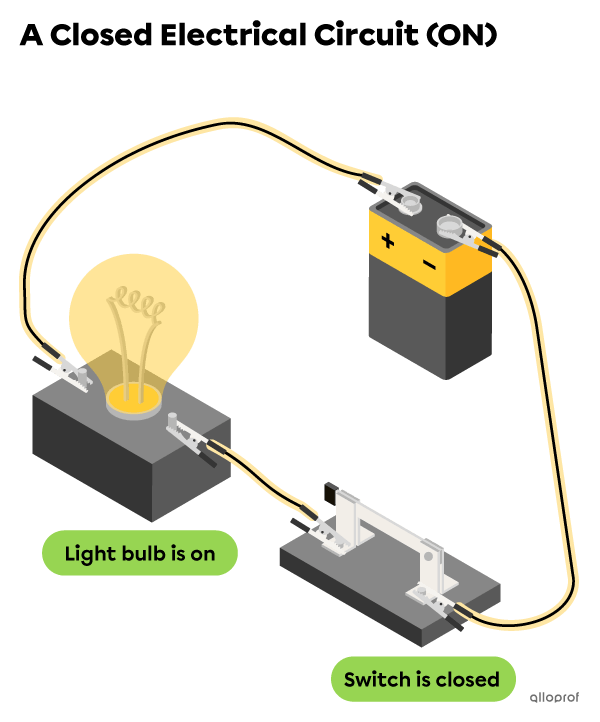 100%
100%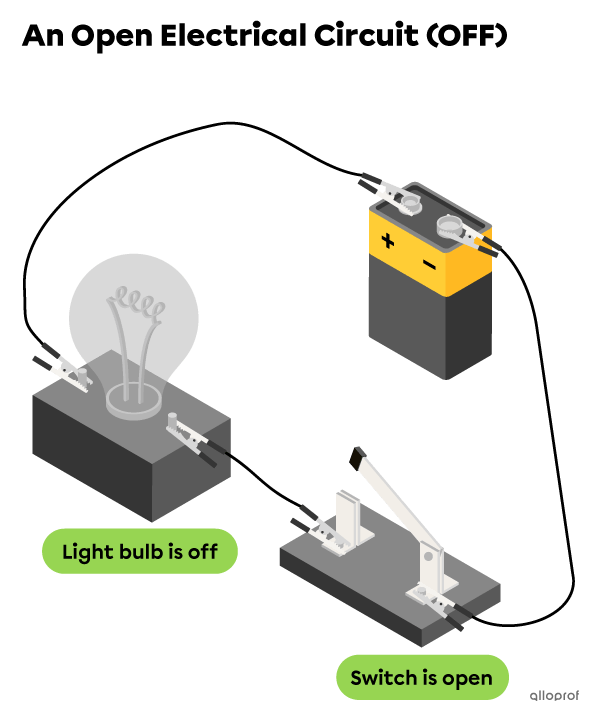
Electricity is the energy produced by the movement of electrons in a material.
Electrons are very small particles of matter.
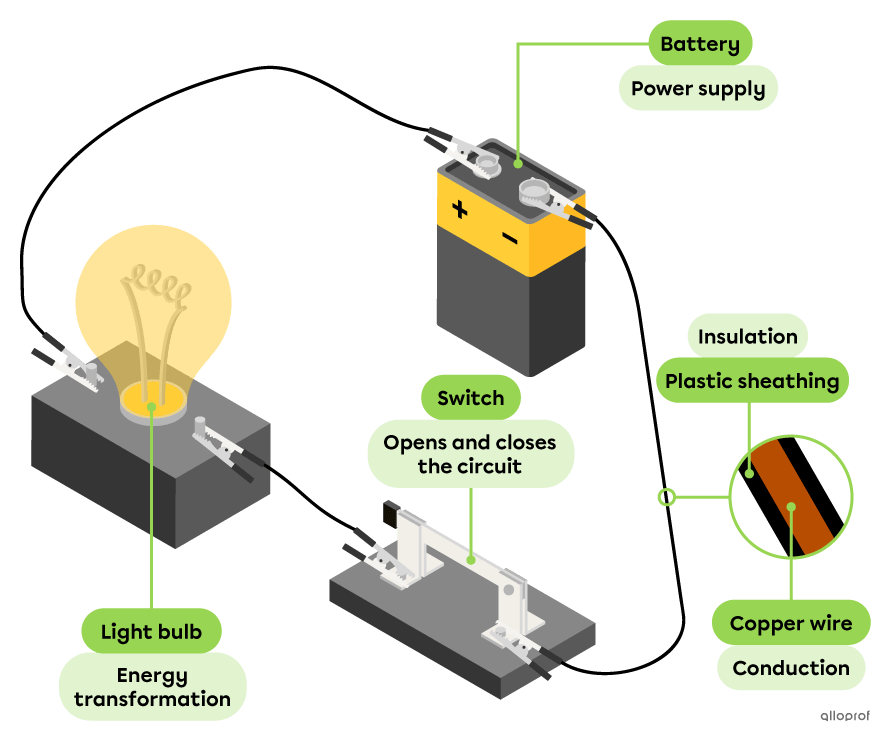
An electrical circuit is an assembly of connected electrical components.
Here is an example of an electrical circuit where each component is associated with its function.

An electrical circuit forms a loop.
If the loop is closed, electrons use it as a path to move through the circuit. In this case, the circuit is said to be closed or on.
If there’s an opening in the loop, the electrons no longer have a path to travel along, so no electricity can flow through the circuit. In this case, the circuit is said to be open or off.
A switch can be used to open and close an electrical circuit.
When the switch is closed, it is in contact with a conductive part of the circuit.
The circuit is closed.
Electrons flow through the circuit.
The light bulb is on.
When the switch is open, it is not in contact with any conductive part of the circuit.
The circuit is open.
Electrons do not flow through the circuit.
The light bulb is off.