Subjects
Grades
 100%
100%
 100%
100%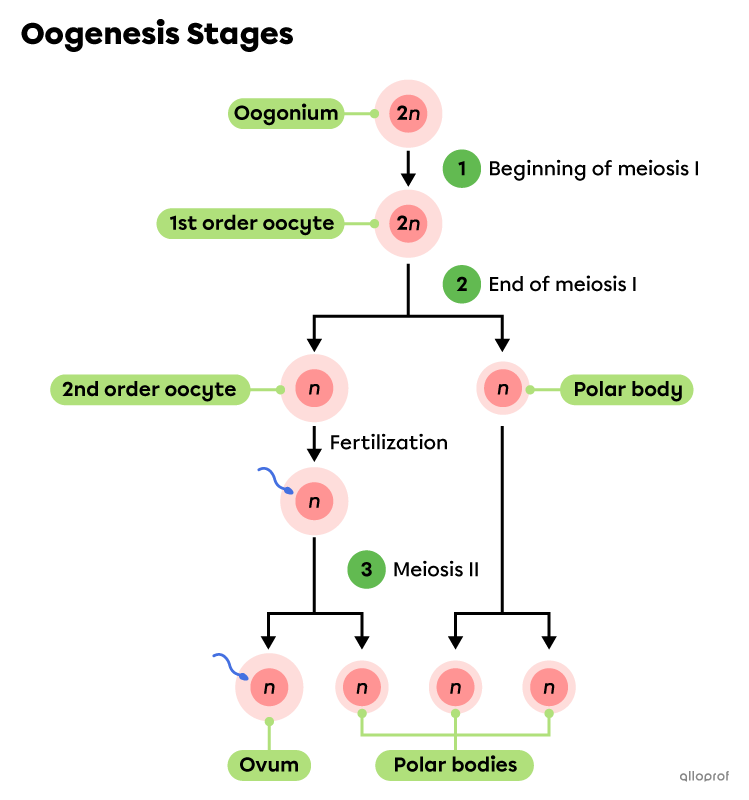
Oogenesis is the process through which a female gamete (an ovum) is produced.
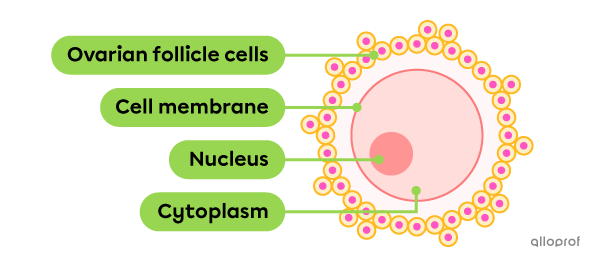
Before becoming an ovum, the female gamete is contained in an envelope, called an ovarian follicle. This follicle is made up of small cells that nourish the future ovum so that it can reach maturity.

An oocyte inside an ovarian follicle
The hormones responsible for the maturation of the ovarian follicle are luteinizing hormone (LH), follicle stimulating hormone (FSH), estrogen and progesterone.
The following diagram shows the different stages of oogenesis. In order to simplify this diagram, the follicle is not represented.
Before birth, the baby’s ovaries are already producing immature gametes: ovogonia. Ovogonia then begin the first cell division (meiosis I) and become first order oocytes. This cell division is then paused and will only resume at puberty.
From puberty onwards, hormone production increases and then fluctuates, which regulates the stages of the ovarian cycle. During the ovarian cycle, the first order oocyte finishes the cell division (meiosis I) that it started. This cell division generates 2 daughter cells of different sizes: 1 second order oocyte and 1 polar body.
The second order oocyte is much larger than the polar body because it receives most of the cytoplasm and organelles following cell division. In addition, each of these daughter cells now contains half the genetic material (symbolized as n) of their mother cell (symbolized as 2n).
As long as the oocyte is not fertilized by a spermatozoon, it remains at this stage.
If fertilization occurs, the second order oocyte undergoes a second cell division (meiosis II). 2 daughter cells are then obtained: 1 ovum and 1 polar body.
In addition, the first polar body also undergoes cell division, resulting in 2 new polar bodies.
At the end of the oogenesis process, a total of 4 daughter cells are obtained: an ovum and 3 polar bodies. The 3 polar bodies eventually degrade, while the ovum continues to develop.
In everyday language, the term ovum is often used incorrectly. For example, it is often said that an ovum is eliminated during each menstruation, when in fact it is the oocyte. During menstruation, the oocyte is not fertilized, so it is not a full-fledged ovum.