Subjects
Grades
 100%
100%
 100%
100% 100%
100%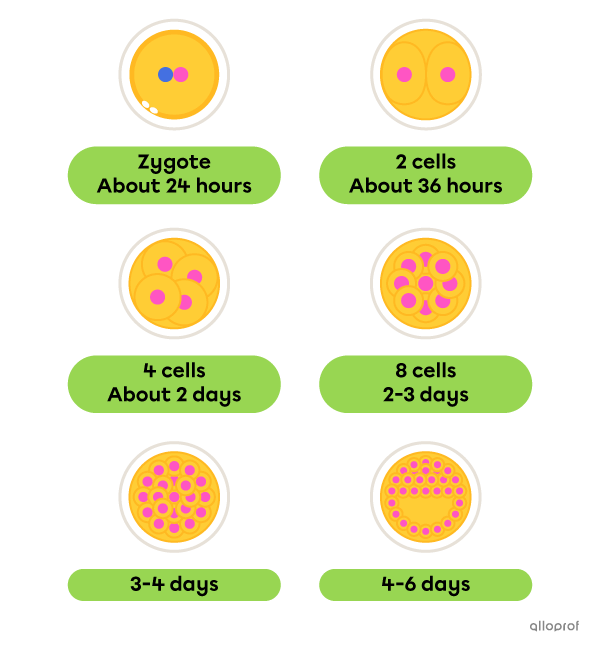 100%
100% 100%
100%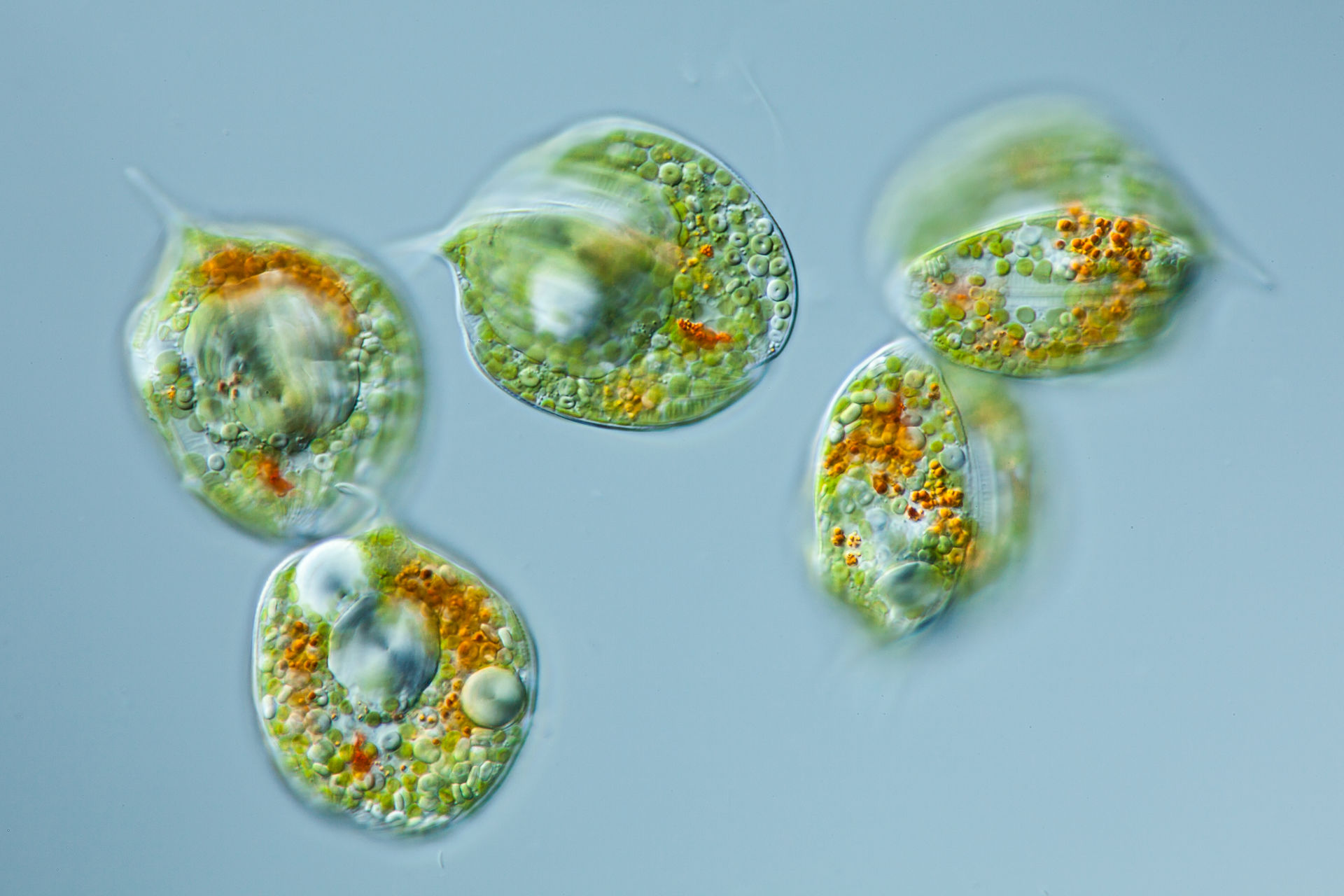 100%
100%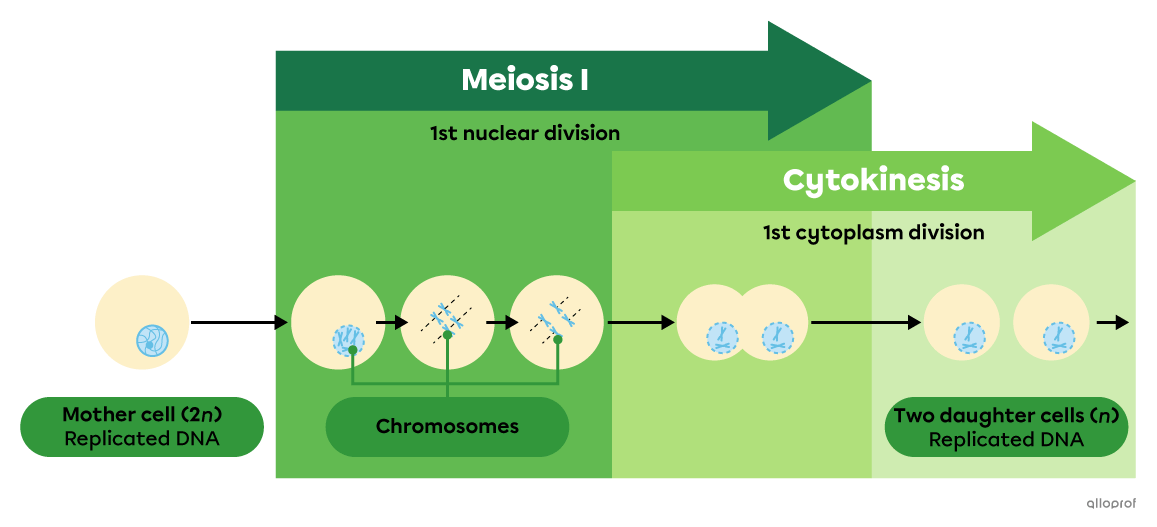 100%
100%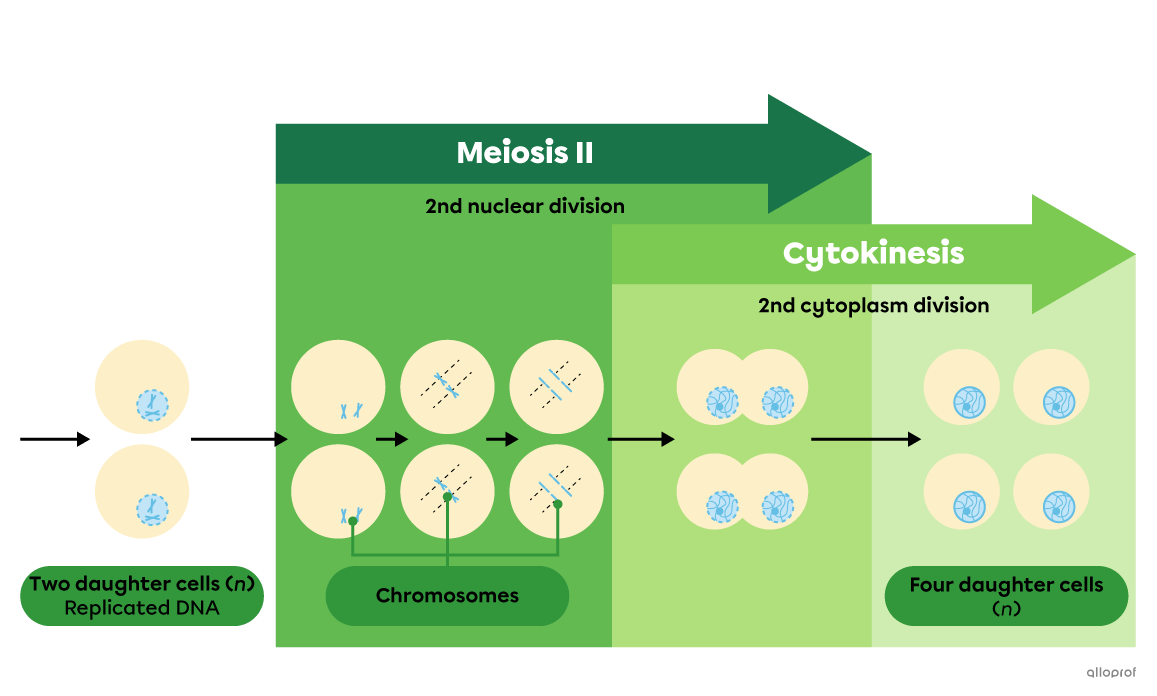
Mitosis and meiosis are cell division processes. They are distinguished by their function(s) and the type of cells obtained (|\text{2n}| or |\text{n}|.)
Mitosis results in two |\text{2n}| cells that are genetically identical to the mother cell.
Cell division by mitosis has the following functions.
Meiosis results in four |\text{n}| cells that are genetically different from the mother cell.
Cell division by meiosis has the following function.
A cell that initiates cell division is called a mother cell. The new cells generated by the division are called daughter cells.
The |\text{2n}| symbol refers to the entire genetic makeup of a cell or nucleus. For example, a somatic cell is represented by |\text{2n}.|
The |\text{n}| symbol refers to half of the genetic makeup of a cell or nucleus. For example, human gametes are represented by |\text{n}.|
A human somatic cell |(\text{2n})| has 46 chromosomes.
A human gamete |(\text{n})| has 23 chromosomes.
Cell division is the process by which a cell divides to produce new somatic cells or gametes.
Somatic cells make up the tissues of an organism, and their nucleus includes all the genetic makeup. A somatic cell is generally represented by |\text{2n}| and referred to as diploid.
Gametes are reproductive cells. Their nucleus contains half of the genetic makeup. A gamete is generally represented by |\text{n}| and referred to as haploid.
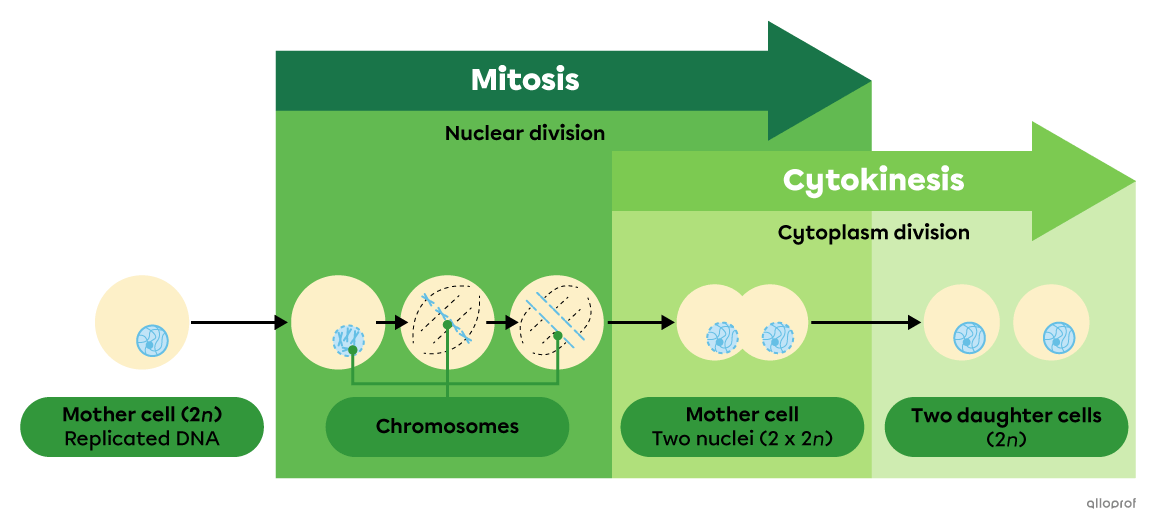
Mitosis is a cell division process that allows the nucleus of a cell to split into two identical nuclei.
Before the mitosis of its nucleus begins, the mother cell replicates its DNA. Mitosis then occurs in a series of complex phases where replicated DNA from the mother cell is condensed into chromosomes and then pulled to opposite poles of the cell. At this point, two new nuclei are formed. They contain the same genetic makeup as the mother cell.
Towards the end of mitosis, cell division is completed by the separation of the cytoplasm, called cytokinesis. Finally, two daughter cells genetically identical to the mother cell are formed.

Simplified diagram of cell division by mitosis
Mitosis results in two daughter |\text{2n}| cells genetically identical to the mother cell.
Cell division by mitosis performs the following functions.
The growth of a multicellular (multi- = many, cellular = cell) organism is achieved by increasing its total number of cells. Since mitosis produces two daughter cells from one mother cell, each cell division contributes to increasing the number of cells in the body.
In humans, growth begins at fertilization and continues until late adolescence. This means that an adult has more cells than a child.
A child and an adult
The tissues of an organism can be damaged. Also, some cells reach the end of their lifecycle and can no longer perform their functions. Cell division by mitosis ensures the replacement of cells that are too old or damaged.
Bones can regenerate after a fracture.
Depending on the degree of the fracture, the limb may be immobilized in a cast to facilitate recovery. However, it is the division of bone cells that allows the broken bone to be repaired.
A cast
Some unicellular organisms reproduce asexually using cell division by mitosis.
The Euglena genus includes unicellular organisms that reproduce asexually through mitosis.
Euglena organisms observed under a microscope
Meiosis is a cell division process that allows the formation of reproductive cells (gametes).
Meiosis is a reductive cell division, meaning that the genetic makeup of the daughter cells is reduced compared to that of the mother cell. The mother |\text{2n}| cell (diploid) produces four |\text{n}| daughter cells (haploid).
Meiosis consists of two consecutive divisions: meiosis I and meiosis II.
During meiosis I, the replicated DNA from the mother cell is condensed into chromosomes and then pulled to opposite poles of the cell. Then, there is a first round of cytoplasm separation called cytokinesis. At this point, two daughter cells are formed. These cells have half of the genetic makeup of the mother cell and are represented by |\text{n}.| Their genetic makeup is replicated, and is therefore present in duplicate.
Simplified diagram of meiosis I
During meiosis II, the genetic content of the two daughter cells is divided again and pulled to opposite poles of the cells. Finally, cytokinesis occurs again and a total of four new |\text{n}| daughter cells are formed. Each nucleus contains only half the genetic makeup of the mother cell.
Simplified diagram of meiosis II
Cell division by meiosis results in four |\text{n}| daughter cells that are genetically different from the mother cell.
The function of meiosis is the production of gametes.
Meiosis is an essential process of sexual reproduction and takes place mainly in the gonads (testicles and ovaries).
In the testicles, meiosis begins at puberty and continues throughout life. This process is called spermatogenesis, and the resulting gametes are spermatozoa.
In the ovaries, meiosis begins at birth and is halted until puberty. At this stage, the oocyte has only undergone meiosis I. Meiosis II occurs only if there is fertilization with a spermatozoon in the Fallopian tube. This process is called oogenesis, and the resulting gamete is an ovum.
Gametes obtained through meiosis are noted |\text{n},| because they contain only half the genetic makeup. At fertilization, gametes fuse and a |\text{2n}| zygote is formed, because |\text{n}+\text{n}=\text{2n}.| Together, the DNA of the two gametes forms the complete genetic makeup of the zygote.
If the gametes resulting from meiosis were already |\text{2n},| after fertilization a |\text{4n}| zygote would form, because |\text{2n}+\text{2n}=\text{4n}.| This means that the genetic makeup of zygotes would double with each generation, which is impossible.