Subjects
Grades
A gamete is a reproductive cell, which is a cell that allows reproduction.
In sexually reproducing species, each gamete contains half of the complete genetic makeup. During fertilization, a male gamete and a female gamete unite to form a new cell, called a zygote. The zygote contains the complete genetic makeup, which allows it to develop into a new individual.
The characteristics of human gametes are presented below.
An ovum (pl. ova) is a female gamete, or a female reproductive cell.
In humans, ova are produced by the ovaries in a process called oogenesis. When it is released from the ovary, the ovum is not yet mature. This immature ovum is then called an oocyte. The oocyte becomes a full-fledged ovum after being fertilized by a spermatozoon.
The release of oocytes by the ovaries begins at puberty and ends at menopause (last menstruation). Over the course of their lifespan, the ovaries can release a total of about 300 to 400 oocytes.
In humans, on average, an oocyte measures 80 micrometres |(\mu \text{m}),| or |0.08\ \text{mm}| in diameter. It is one of the largest cells in the body!
The oocyte is surrounded by an envelope which nourishes it. It is called an ovarian follicle.
The following image represents the ovarian follicle along with the cell membrane, cytoplasm and nucleus of the oocyte.
The nucleus of the oocyte contains half of a complete genetic makeup (23 chromosomes).
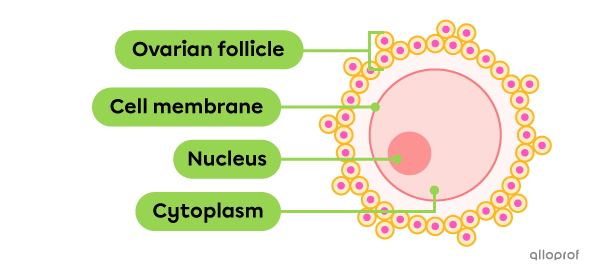
An oocyte inside an ovarian follicle
A spermatozoon (pl. spermatozoa) is a male gamete, or a male reproductive cell.
In humans, spermatozoa are produced by the testicles in a process called spermatogenesis.
The testicles start to release spermatozoa at puberty and can continue throughout a man’s life. Every day, the testicles produce a total of about 400 million spermatozoa.
In humans, on average, a spermatozoon is 50 micrometres |(\mu \text{m})| long, which is |0.05\ \text{mm}.|
The structure of spermatozoa is divided into 3 main parts: the head, the midpiece and the flagellum, which allows this cell to move. The nucleus of the cell is located in the head of the spermatozoon and contains half of a complete genetic makeup (23 chromosomes).
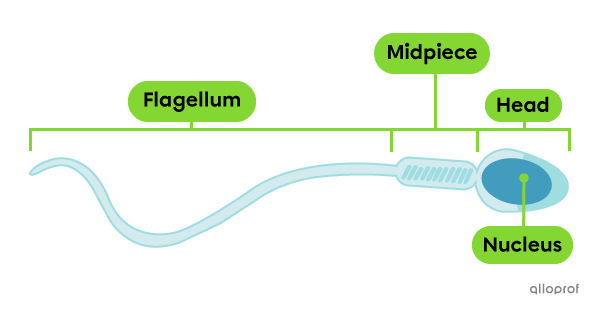
Structure of the spermatozoon