Best Of
Re: Question
Salut RubisFiable9468 😁
Merci pour ta question!
De manière théorique, il y a plusieurs facteurs qui augmentent la vitesse de réaction d'un réaction chimique.
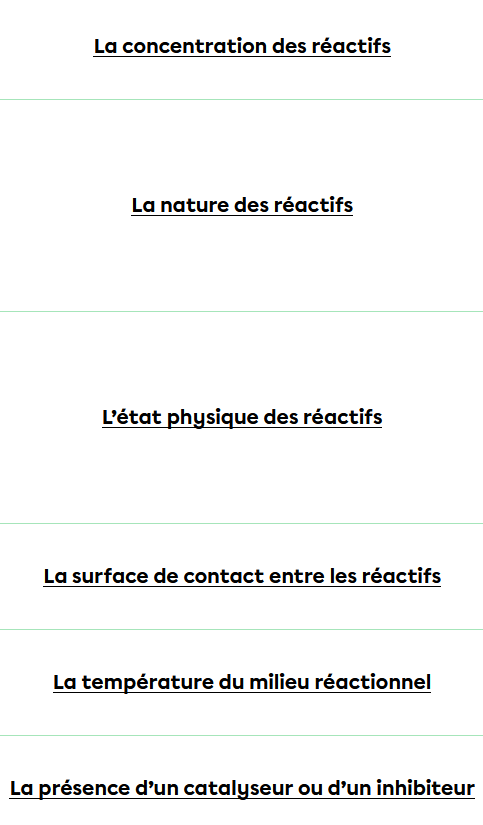

Tu peux consulter la fiche ici au besoin.
Dans ton expérience, tu augmentes la surface de contact avec les particules en réduisant la craie en poudre seulement.
Pour la dilution de la craie en solution aqueuse, tu contrôles plutôt l'état de ton réactif. Tu le fais passer de solide à liquide, ce qui est très efficace.
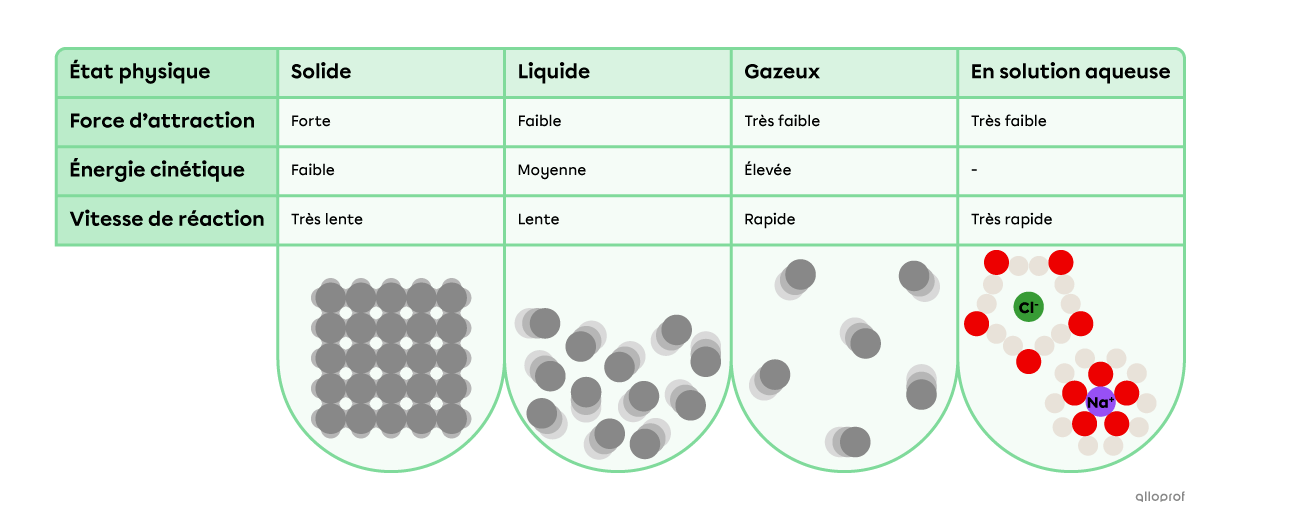
Par contre, si un des critères de ta réaction est de conserver les produits intacts, il pourrait être plus complexe de les récupérer de cette manière, en y ayant ajouté de l'eau. S'il n'y a pas de contraintes, oui, c'est une excellente idée!
Pour les variables dépendantes et indépendantes, tu les as bien déterminées également.
Écris-nous si tu as d'autres questions. 😊
À bientôt sur la Zone d'entraide! 😎 Et, bon rapport de lab!
Re: Question
Bonjour TitanAlpha5092,
Merci d'utiliser la Zone d'entraide d’Alloprof !
Pour faire de bons résumés, il faut rapporter les moments importants du chapitre en dégageant l'essentiel. Tu peux te demander quels sont les éléments clés de ce passage.
Voici quelques astuces qui pourraient t'aider :
- Lis bien le chapitre, puis ferme le livre et pense à l’histoire. Quelles sont les idées principales ou événements clés ? Que veux-tu retenir de ce chapitre ?
- Ne note pas tout, seulement les éléments importants : qui fait quoi, où, quand, pourquoi. Par exemple : qui est le personnage principal, qu'est-ce qu'il fait, pourquoi c'est important.
- Sois bref (brève) : essaie de réduire l’histoire à quelques phrases, sans donner ou répéter trop de détails.
- Utilise tes propres mots : n’écris pas exactement comme dans le livre, mais résume avec tes propres phrases.
- Vérifie : après avoir écrit, relis ton résumé et demande-toi si quelqu’un qui n’a pas lu le chapitre pourrait comprendre l’histoire avec ce que tu as écrit.
Tu trouveras d'autres informations utiles en cliquant sur ce lien :
N'hésite pas à nous écrire si tu as d'autres questions !

Re: Question
Salut Elferose1758,
Ta question a été répondue ici :
J'espère que ça t'aide et n'hésite pas à nous réécrire si tu as d'autres questions!
Anthony B.
Re: Question
Salut!
Pour simplifier une fraction rationnelle, il faut tout d'abord tenter de la factoriser.
Il y a 3 étapes primordiales à effectuer lors de la simplification de ces expressions algébriques :
1. On factorise les polynômes au numérateur et au dénominateur.
2. On établit les restrictions.
3. On simplifie les facteurs communs aux deux polynômes.
Voici un exemple :
Nous avons :
$$\frac{(x^2-9)}{x^2+6x+9}$$
1 - Factorisation
Comme nous pouvons le constater, nous pouvons faire une différence de carré au numérateur, et un trinôme carré parfait au dénominateur. Nous avons donc :
$$\frac{(x-3)(x+3)}{(x+3)^2}$$
2 - Restrictions
Avant de simplifier l'expression, il ne faut pas oublier de calculer les restrictions. Nous avons donc :
(x+3)=0 donc x=-3
Ainsi, x ne peut pas être égal à -3.
3 - Simplifier facteurs communs
Il ne nous reste plus qu'à simplifier les facteurs se retrouvant au numérateur et au dénominateur :
$$\frac{x-3}{x+3}$$
Voici des fiches sur cette notion qui pourraient t'être utiles :
- https://www.alloprof.qc.ca/fr/eleves/bv/mathematiques/la-simplification-des-fractions-rationnelles-m1078
- https://www.alloprof.qc.ca/fr/eleves/bv/mathematiques/la-factorisation-d-un-polynome-m1077
N'hésite pas si tu as d'autres questions :)
 Katia K
Re: Question
Salut!
Envoie-nous une photo de ce numéro, ça nous fera plaisir de t'aider!
Tu peux éditer cette publication à l'aide des trois petits points en haut à droite pour nous faire parvenir la photo.
J'attends de tes nouvelles :)
Katia K
Re: Question
Bonsoir à toi !
Tu peux utiliser la Zone d'entraide sur ton ordinateur si tu as des questions ; un enseignant Alloprof ou encore un autre élève te viendra alors en aide. :)
Tu peux poser une question ou encore envoyer une photo de ton exercice.
N'hésite surtout pas à nous réécrire si tu as des questions, il nous fera plaisir de t'aider !
Océane :)
Océane D
Re: Question
Bonjour ZincAdmirable6165 !
Merci d'utiliser la Zone d'entraide d’Alloprof !
Je crois que l'explication de la question suivante est en mesure de répondre à ta question présente. La voici :
N'hésite de nous contacter à nouveau si tu as d'autres questions !
Laura A
Re: Question
Bonsoir !
Merci de faire appel à nos services ! Tout est une question de suivre la logique et de savoir utiliser les proportions. Donc, on dit que le chemin parcouru a été de 5115 km avec une vitesse de 93 km/h. Tu dois alors calculer combien d'heures ont été utilisées pour parcourir le trajet de 5115 km avec cette vitesse. N'oublie pas que 1j = 5h et ils se sont déplacés 4 jours. Donc?
Je te laisse prendre connaissance du tout. Reviens nous voir si tu hésites encore !
Laura A
Question
Bonjour
merci pour votre réponse! Est ce que c’est possible que dans les examens ( surtout du ministère) il y a des grandes résolutions de problèmes ou on doit appliquer géométrie + algèbre+statistique etc tout dans la même résolution?
quels sont les type de combinaisons fréquentes?
merci beaucoup!