Spelling Rules (3rd cycle primary)
Article
Update : April 2, 2026
Learning Together : An Initiative of the Institut des troubles d’apprentissage
Learning Together : An Initiative of the Institut des troubles d’apprentissage
This activity presents five strategies make learning to spell more enjoyable and complements the methods learned at school. Using both oral and written strategies, the activity is designed to help your child memorize spelling words more effectively and retain new knowledge over the long term.
You will need:
Written by: Marie-Lou Laplante, Educational Specialist
Understanding that vowel sounds can be represented by combinations of two, three, or even four letters is a significant aspect of learning to read. These vowel groups can be daunting for children, as they differ from simpler single-letter vowels. This activity introduces four vital rules for reading to help your child decode these complex vowel graphemes, ultimately reducing guesswork by simplifying the reading of complex vowel combinations.
You will need :
Rédaction : Lise L’Heureux, Special Education Teacher, Director, Instructor, Consultant
This activity focuses on helping your child recognize and spell R-controlled vowels in words. When a vowel is followed by the letter "R," it changes sound, affecting how the mouth is positioned and altering the vowel's pronunciation. Understanding R-controlled vowels adds another layer of pronunciation for each vowel, enhancing reading and spelling skills.
You will need :
Rédaction : Lise L’Heureux, Special Education Teacher, Director, Instructor, Consultant
This activity focuses on teaching your child to read and spell diphthongs, which are composed of two consecutive vowel sounds within the same syllable. English has several diphthongs, influenced by local pronunciations, but this activity concentrates on two key examples: [oy] as in "boy" and [ow] as in "cow." By helping learners recognize the graphemes for diphthongs and apply probability rules, the activity aims to reduce reliance on memorization, enhancing reading and spelling skills for these complex vowel sounds.
You will need :
Rédaction : Lise L’Heureux, Special Education Teacher, Director, Instructor, Consultant
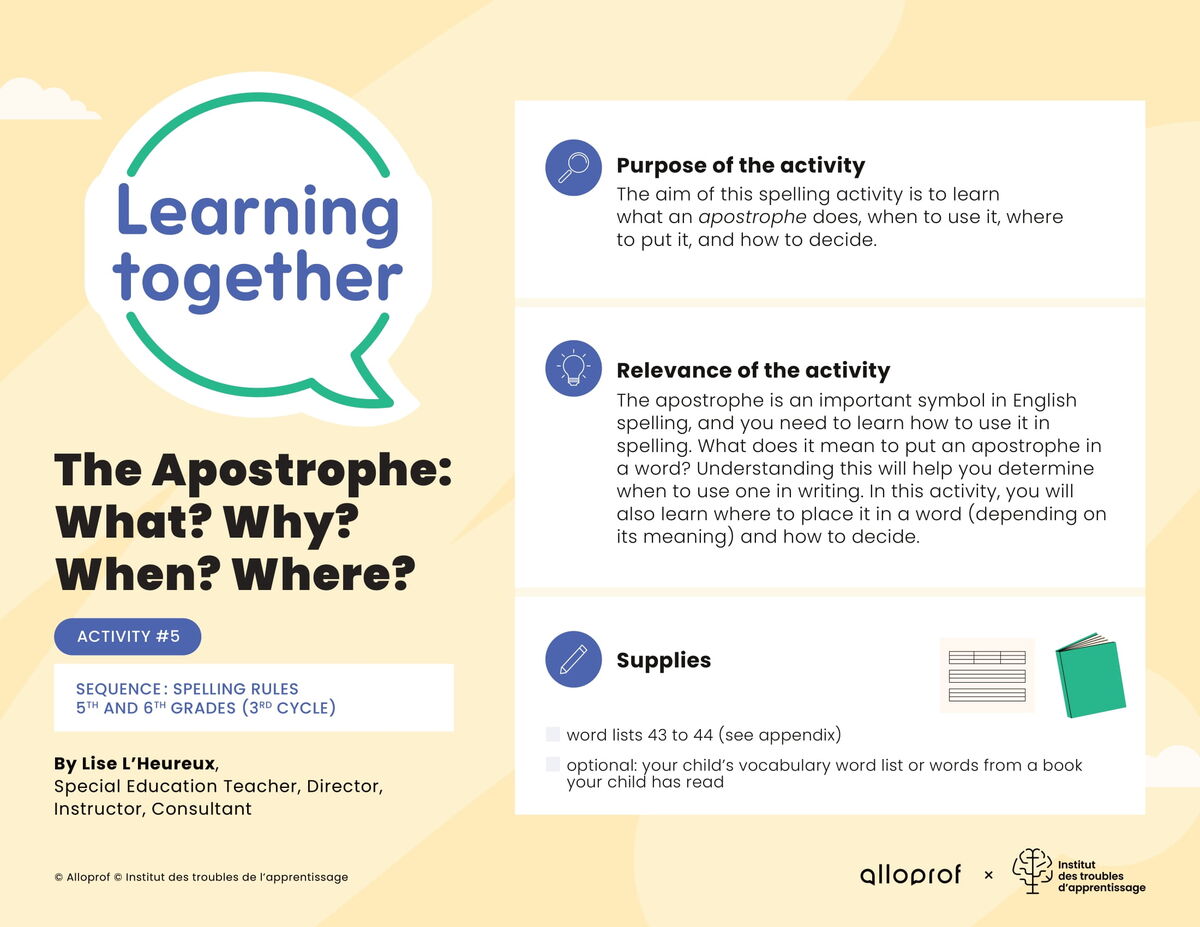
This activity is designed to teach your child the function and usage of the apostrophe in English spelling. Understanding what an apostrophe does, when to use it, and where to place it in a word is crucial for accurate writing. By clarifying its purpose and placement, the activity ensures that your child can confidently decide if and where an apostrophe is needed, improving their overall spelling proficiency.
You will need:
Rédaction : Lise L’Heureux, Special Education Teacher, Director, Instructor, Consultant
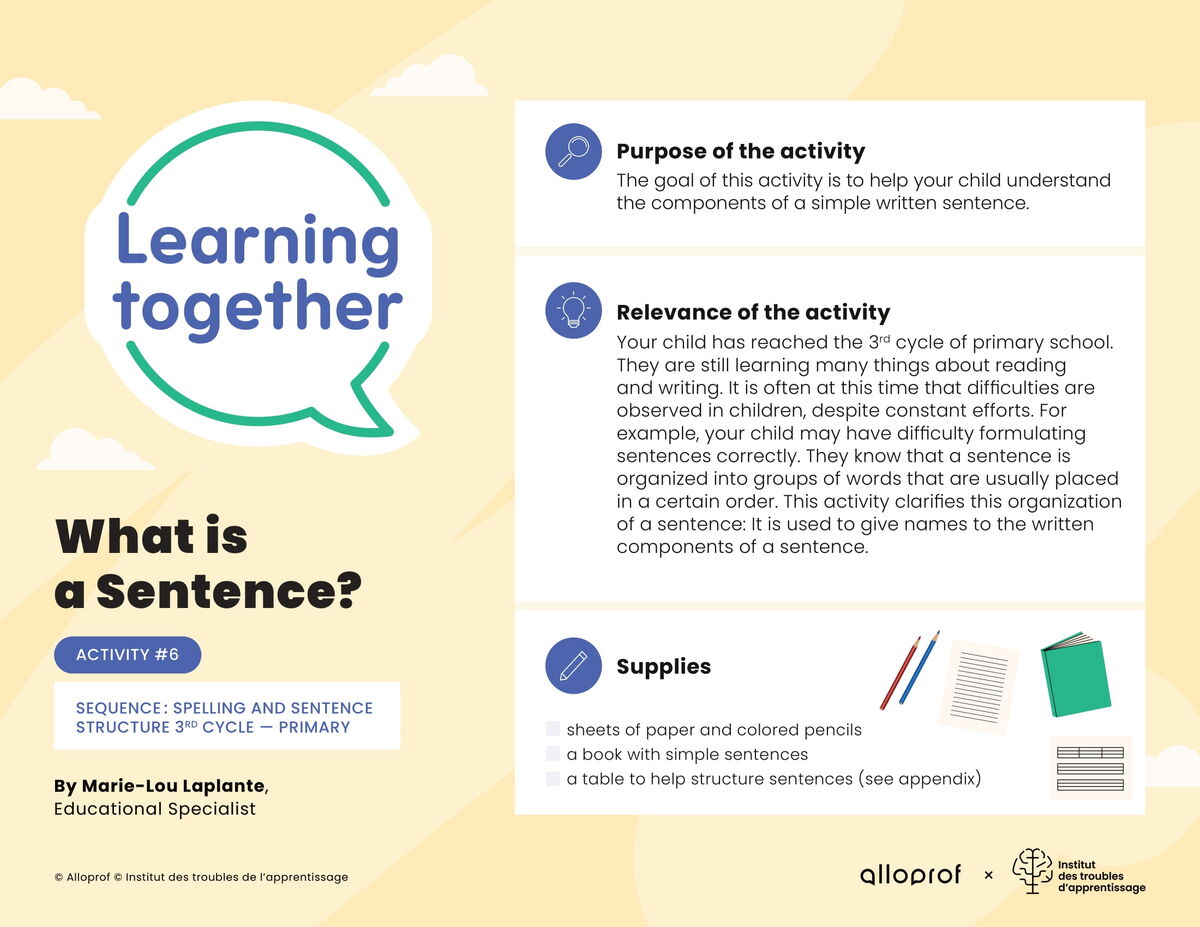
Some kids in Cycle 3 of elementary school still have trouble building coherent, meaningful sentences, even if they’re making good progress in reading and writing. The goal of this activity is to teach your child to understand and identify the structure of a simple sentence.
You will need:
Written by: Marie-Lou Laplante, Educational Specialist
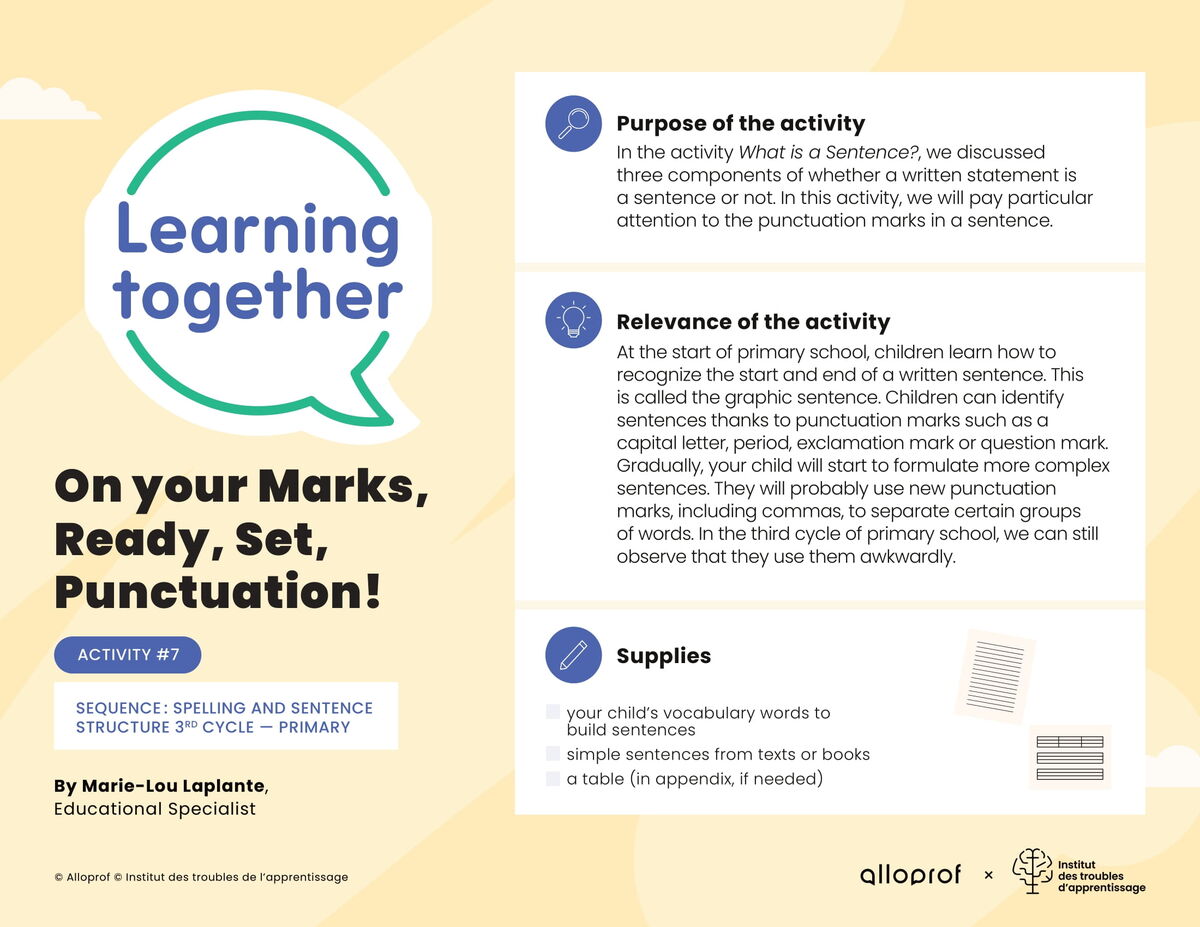
In elementary school, children learn to recognize the beginning and end of a sentence. As they get older and start writing longer sentences, they need to master other punctuation marks such as commas. Some Cycle 3 students still need to practice using punctuation. This activity focuses on learning punctuation marks once a child has mastered the three main parts of a sentence.
You will need:
Written by: Marie-Lou Laplante, Educational Specialist
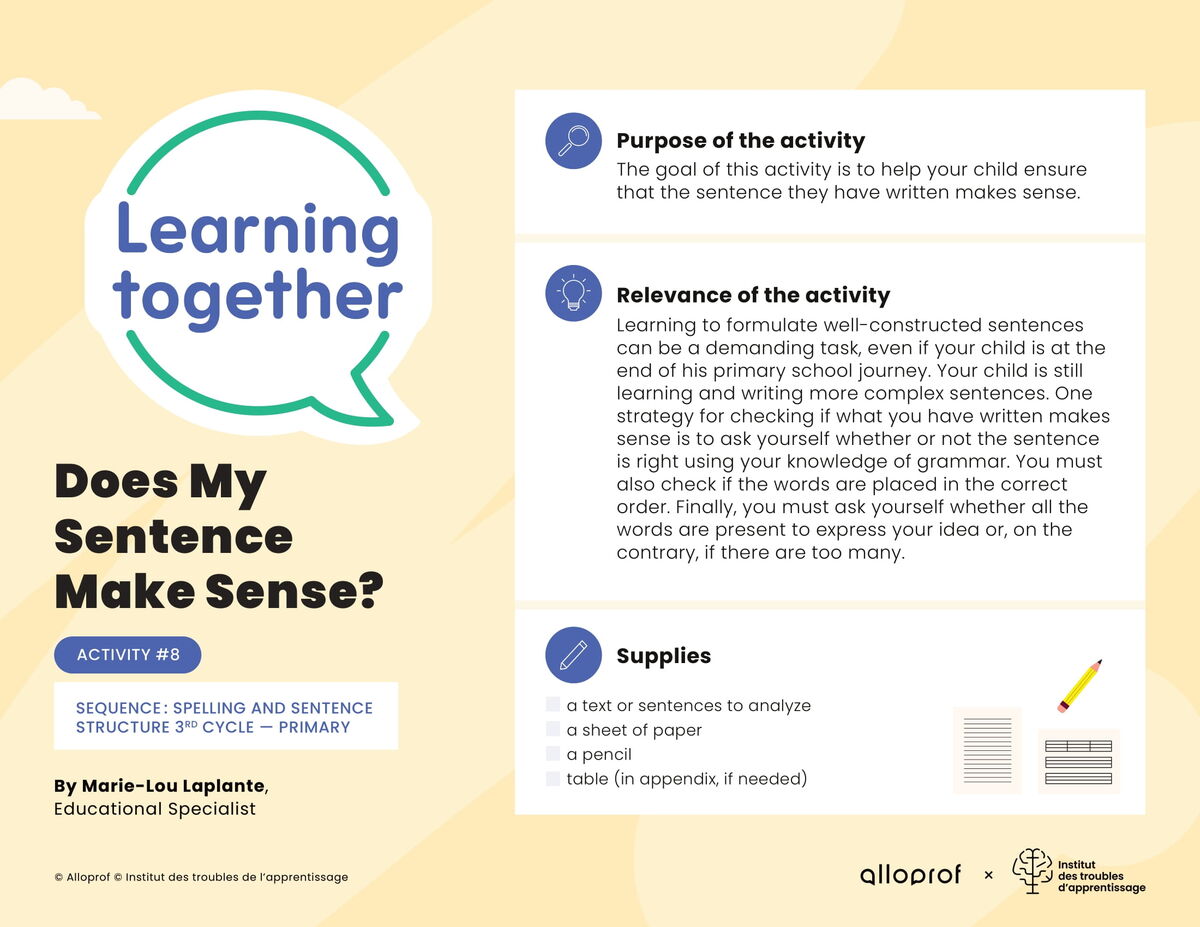
The goal of this activity is to teach your child strategies for making sure that their sentences are understandable and meaningful. Constructing well-structured sentences can be a challenge, even for students who are finishing elementary school. They need to make sure that every sentence clearly conveys their ideas, check that the words are in the right order, and make sure they don’t have too many or too few words.
You will need:
Written by: Marie-Lou Laplante, Educational Specialist
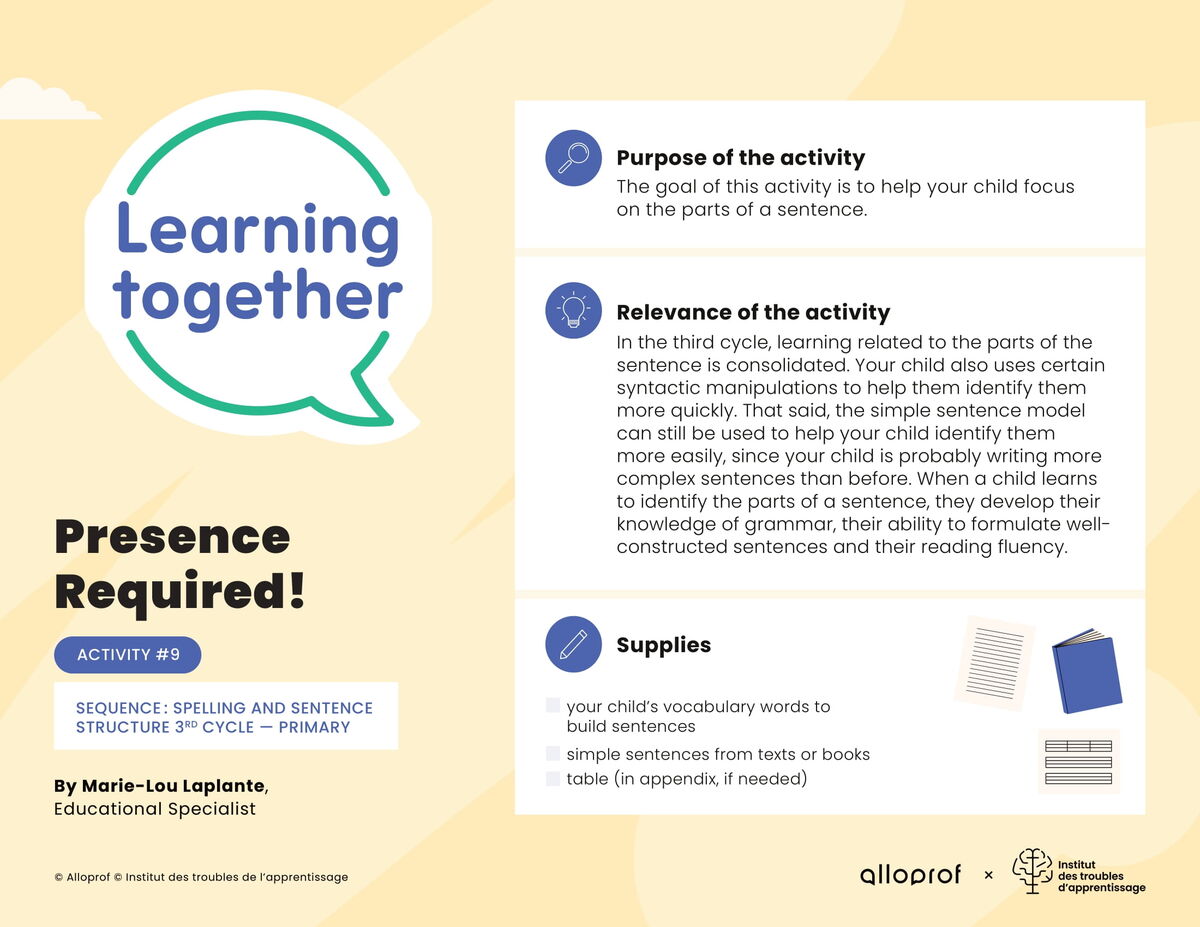
This activity is designed to encourage your child to focus on the components of a sentence. In Cycle 3, children start using syntactic manipulation to analyze sentences. Being able to identify the parts of a sentence helps students build grammatical skills, formulate sentences more easily, and read more fluently.
You will need:
Written by: Marie-Lou Laplante, Educational Specialist
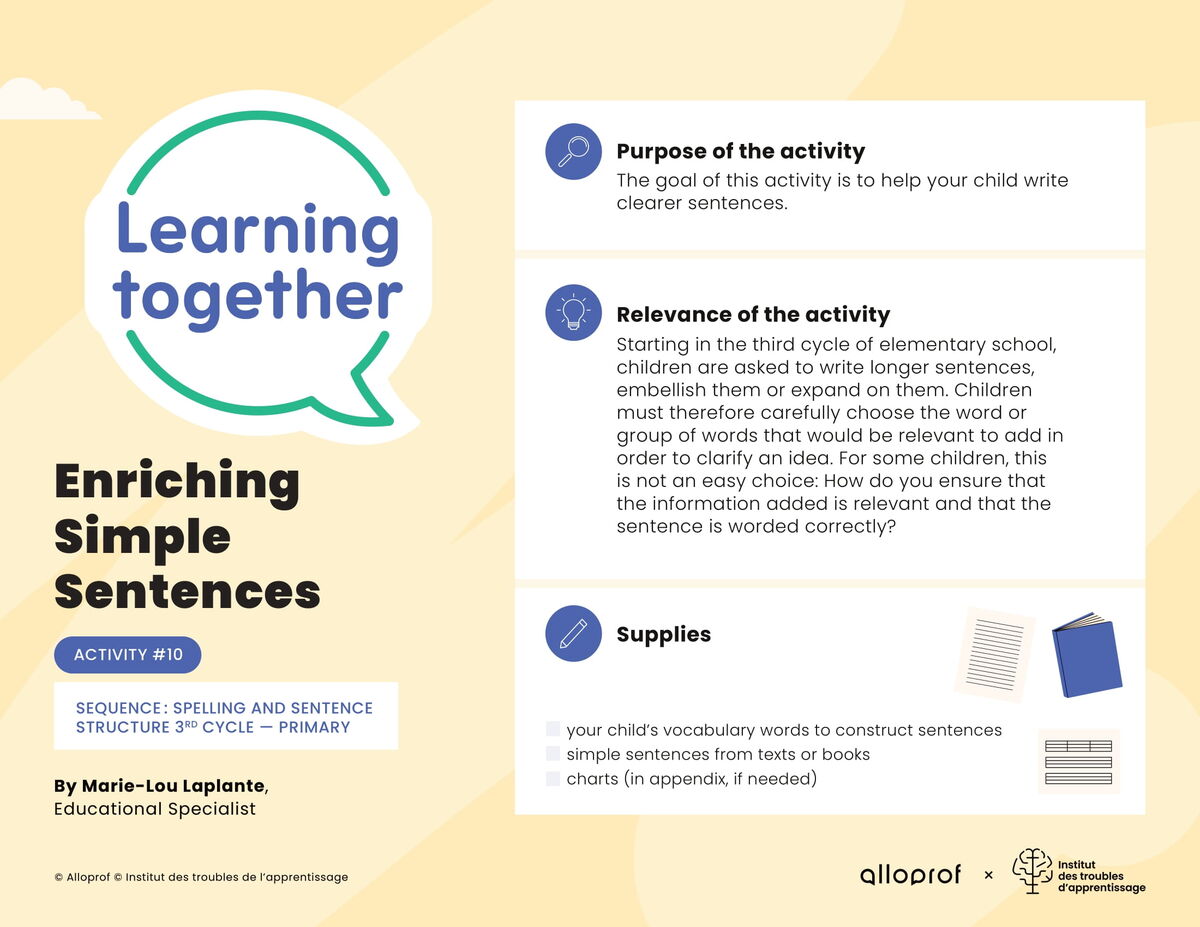
The goal of this activity is to help your child clarify their ideas in a sentence. In Cycle 3, students learn how to add relevant details to their sentences to make them more specific and better structure their ideas. This can be tricky for some students, as they have to determine whether the information they’re adding is relevant and make sure the sentence stays properly structured.
You will need:
Written by: Marie-Lou Laplante, Educational Specialist