Subjects
Grades
To access the other concept sheets in the Tourism unit, consult the See also section.
 100%
100%
 100%
100%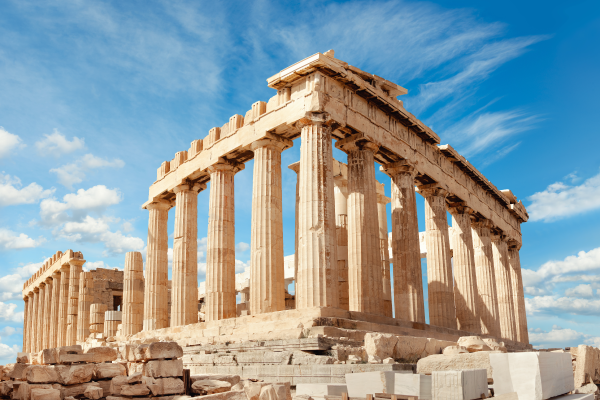 100%
100%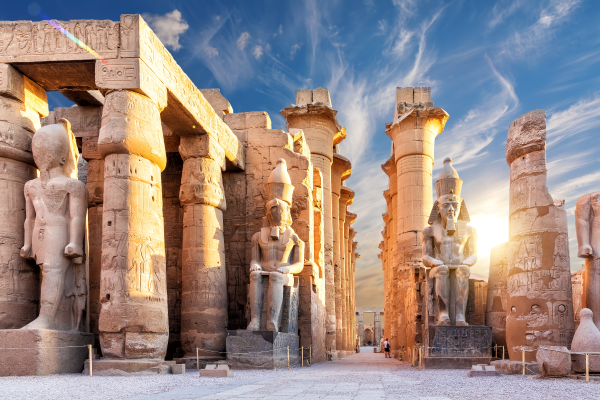 100%
100%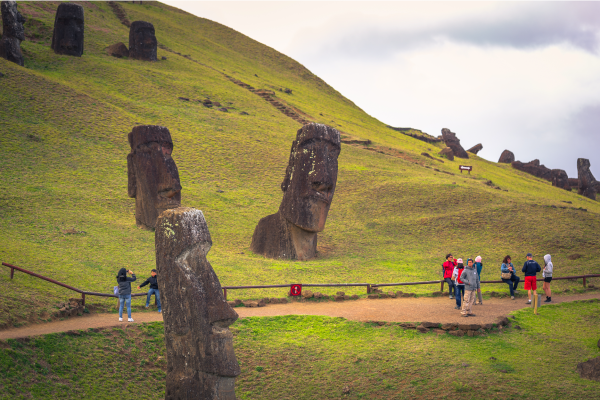
In geography, an issue is a problem related to the use and development of land. The issue may relate to environmental, economic, political or social aspects, etc.
Certain regions of the world receive a lot of tourists. The major tourist destinations help to identify these regions. Tourism has a number of impacts, some positive, some negative.
Tourism offers a number of economic and social advantages.
Tourism is a sector that creates many jobs in industries such as hotels and restaurants. Tourism can also generate revenue for certain countries, by taxing specific sectors of the tourism industry. Tourism can therefore be beneficial to the economic development of a region or country.
The presence of tourists in certain regions leads to the construction of new transportation or communication infrastructures. The local population also benefits from this.
The new infrastructures could be highways, airports or an internet network.
Tourism can help to protect ecosystems by creating national parks. These parks are protected areas that cannot be exploited or damaged. The revenue generated by a national park is used, among other things, to ensure its protection.
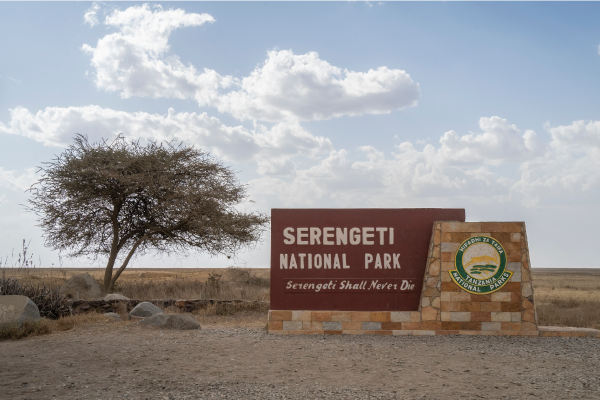
Serengeti National Park
This national park, located in Tanzania, is home to great biological diversity. Large herds of zebra, wildebeest and gazelle as well as endangered species such as the cheetah and the black rhinoceros also live in the park. It is part of UNESCO's World Heritage List.
While travelling, tourists meet people from different cultures. They have the opportunity, for example, to taste food that is new to them, discover traditional dances or songs, and to learn about artisan techniques. Exchanges between cultures help to reduce or eliminate certain prejudices.
Mass tourism allows many people to travel to the same places. This often leads to overcrowding in certain tourist areas.
In the 1950s and 1960s, tourism became increasingly popular due to a number of factors such as:
the introduction of paid holidays
lower air transportation costs
all-inclusive travel offers
the increasing ease of organizing and planning trips (thanks to the internet)
The result was the emergence of the phenomenon of mass tourism. Over the years, tourism has grown at an impressive rate.
|
Year |
Number of tourists worldwide |
|---|---|
|
1950 |
25 million |
|
1980 |
278 million |
|
1990 |
435 million |
|
2018 |
1.4 billion |
|
2030 |
1.8 billion (forecast) |
Source: Radio-Canada, 2019[1]. |
|
This massive increase in the number of tourists leads to over-visiting of certain tourist sites. Also known as overtourism, this phenomenon occurs when the number of tourists is so great that it threatens the territory and local populations.
Mass tourism has a number of negative consequences for the environment.
The tourism sector generates 8% of the world's greenhouse gas emissions, contributing to global warming [2]. Most of this air pollution is caused by tourism-related travel. Planes and cruise ships are two of the most popular means of transportation in the tourism industry and are also two of the biggest polluters.
The huge quantity of waste generated by tourism and the poor management of this waste contributes significantly to pollution. Wastewater and waste often end up in rivers and natural environments. Marine pollution in the Mediterranean Sea increases by 40% every year during the tourist season[3].
Mass tourism also creates a great deal of noise and visual pollution.
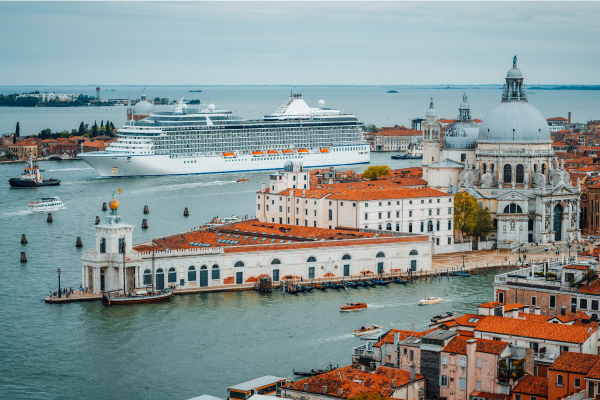
Venice is one of the most visited cities in the world. The negative impacts of mass tourism are most evident in the historic centre of Venice.
One major problem is the presence of huge cruise ships in the lagoon. The waves and pollution caused by these boats are eroding the foundations of the city and threatening the lagoon's ecosystem. What's more, these huge ships create a great deal of visual pollution, as well as noise pollution, due to their size and the noise of their engines running 24 hours a day.
On August 1st, 2021, a law was passed related to cruise ships that are over 180 metres in length or emit emissions containing more than 0.1% of sulphur. They will no longer be able to enter the Basin and Canal of San Marco, nor the Giudecca Canal[4].
To learn more about Venice, see the Tourism in the Venice Lagoon concept sheet.

A cruise ship in the Venice lagoon
A lagoon is a body of water separated from the sea by a strip of land or by a coral reef.
The tourism industry demands an enormous amount of natural resources, such as drinking water and food.
Water consumption can become a major issue for tourist regions, because large tourist infrastructures often monopolize drinking water to the detriment of the local population.
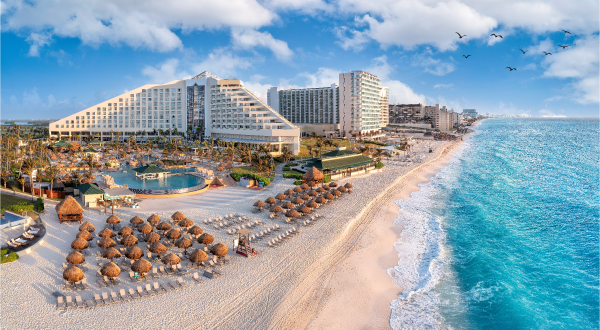
A hotel in Cancún, Mexico
Hotels use huge quantities of water to fill swimming pools, do laundry, water the grounds and so on.
The tourism industry requires many different types of infrastructure, such as hotels, parking lots, and so on. Often, forests have to be cleared, wetlands drained, etc. to build these amenities.
This damages or destroys local ecosystems. The habitat of plant and animal species disappears, threatening animals and plants.
Repeated tourist visits to the same area can also seriously damage the ecosystem.
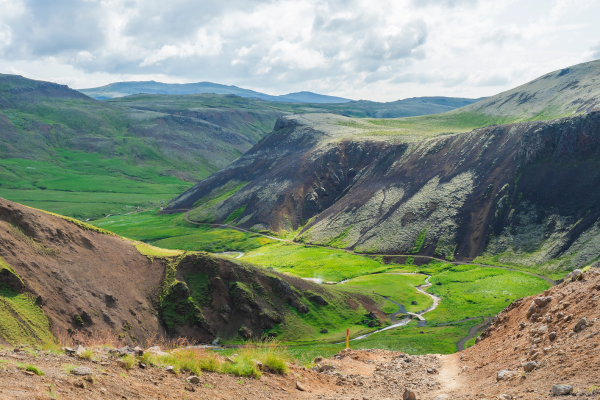
In Iceland, the Reykjadalur Valley had to be temporarily closed to visitors in 2019. Due to the large number of tourists, the valley's vegetation had been seriously damaged.
The mass traffic in certain places can lead to a deterioration (destruction) of the various attractions of a tourist area. This is often the case for cultural and historical attractions because:
these sites and monuments are not adapted to the very large number of visitors they receive
they are also more susceptible to the negative effects of atmospheric pollution, such as acid rain and rising sea levels
these places are also subject to acts of vandalism by some tourists, such as graffiti or engravings on ancient monuments
The Acropolis of Athens is a historic attraction that is deteriorating over time. Indeed, acid rain and pollution are degrading the marble of the monuments. Temple structures are also increasingly fragile due to drought and heavy rains.
The Parthenon temple at the Acropolis in Athens, Greece
In 2013, a teenager visiting Luxor Temple with his parents carved his name into one of the sculptures. The temple, built around 3400 years ago, is one of the most important archaeological sites in Egypt.
Luxor Temple in Egypt
The presence of tourists, especially in large numbers, poses a number of problems for local residents.
Housing for residents is becoming increasingly scarce and expensive, as spaces are used to accommodate tourists (construction of hotels, inns or youth hostels). As a result, local businesses (bakeries, hardware stores, etc.) are disappearing and being replaced by tourist-oriented businesses (souvenir stores, restaurants, etc.).
The presence of large numbers of tourists also causes other problems for people living in tourist areas, such as:
noise
traffic congestion
overcrowded public spaces
As a result of increased contact with tourists and visitors, local populations sometimes change elements of their own way of life to reflect aspects of foreign lifestyles. This phenomenon is called acculturation.
Acculturation refers to changes or adaptations in the culture, values and traditions of a population or individual as a result of encountering different populations.
The development of an area to welcome and appeal to tourists can slow local development, because sometimes foreign companies are favoured to the detriment of local businesses. Part of the money generated by tourism does not stay in the country or region, going instead to the foreign company's home country. The tourist region therefore loses part of the income generated by tourism.
Easter Island is a small island in the Pacific Ocean and is one of Chile’s provinces.
The island of Rapa Nui, also formerly known as Easter Island, attracts many tourists every year. Before 2020, more than 160 000 tourists visited each year. With the 7000 inhabitants on the island, that was a lot of people in one place[5]. This strong presence of foreign visitors, whether tourists or people from abroad who have come to settle on the island, causes many issues, among them:
Access to resources such as drinking water becomes difficult during peak tourist season.
The island's inhabitants have gradually abandoned their traditional activities to concentrate on economic activities linked to tourism.
Faced with so much foreign presence, the native population is increasingly concerned about the preservation of its culture.
Visitors on the island of Rapa Nui (Easter Island)
The statues, called moais, are one of the island's attractions.
In order to reduce the negative impact of large numbers of tourists, the Chilean government has passed a number of laws to:
limit the number of people who can visit the island
reduce the length of stays on the island
reserve the right to live on the island for certain people
These measures are designed to protect the island's environment, attractions and residents.
The issues surrounding tourism are numerous. Various solutions can be implemented in the short term to mitigate the negative effects of mass tourism such as:
Introduce visitor quotas
Pay a special tax to visit certain cities
Participate in the global plastics initiative in the tourism sector to reduce waste and pollution
Temporarily close certain areas to give the natural environment time to regenerate
Introduce a tax on air transport
However, in order to find long-term solutions, a different type of tourism must be encouraged: sustainable tourism. As such, action by several groups, such as governments, the public and businesses, is needed to implement solutions.
The verb regenerate means that something is renewed.
Sustainable tourism is a type of tourism in which development respects the population, economy and environment of each region.
Similar to sustainable development, sustainable tourism aims to strike a balance between environmental, social and economic aspects. It therefore becomes more sustainable, and its negative impacts are greatly reduced. Implementing sustainable tourism requires the collaboration of various groups, including governments, the general public and businesses. Some actions to help make tourism more sustainable are:
To create protected areas to preserve natural environments
To build infrastructures that respect the environment and the local population
To impose water consumption limits on tourism businesses
To limit over-consumption to avoid waste
To respect local culture
To support local businesses
To educate tourists about protecting natural environments and cultural attractions
Hawaii is a destination that suffers greatly from mass tourism. While this US state had a population of around 1,455,271, the islands had received over 10 million tourists[7] in 2020[6].
Mass tourism negatively affects the local population. Not only are locals often evicted from their homes in favour of tourist infrastructure, the real estate market is also one of the most expensive in the country. Some residents are forced to move to another state.
There are also many negative impacts on Hawaii's environment and natural habitats. The construction of tourist infrastructures causes environmental degradation that threatens many endangered species. Mass tourism also creates huge pollution problems that affect both natural environments and local residents. In addition, poor water management by hotels and restaurants has contaminated natural water bodies, leading to a water crisis.
Several measures linked to sustainable tourism are being implemented with the aim of reducing the negative impacts of tourism. These include:
the obligation to make a reservation to visit the most popular natural sites, which makes it possible to control the number of people visiting them;
the screening of instructions before accessing natural sites, to make tourists aware of good practices;
closing certain sites for a few days each week to allow them to regenerate;
the resumption of Hawaiian culture (food, clothing, music and dance) by the local population;
the use of local flowers to make necklaces offered to tourists.
In addition, the Hawaii Tourism Authority and the Hawaii Visitors and Convention Bureau have set up a program to reduce the negative impacts of tourism: the Mālama Hawaii program. Through this program, visitors are invited to get involved in taking care of the sites they visit. Several options are offered, depending on the location, such as cleaning up a beach or planting native species to support reforestation.
To access the rest of the unit, please consult the following concept sheets.
Baron, Yanik Dumont. (2019, September 5). Y a-t-il trop de touristes sur la planète?. Radio-Canada. https://ici.radio-canada.ca/nouvelle/1286566/tourisme-masse-planete-europe
Hood, Marlowe et Catherine Hours. (2018, May 7). Le tourisme cause près de 10% des émissions de gaz à effet de serre. La Presse. https://www.lapresse.ca/environnement/climat/201805/07/01-5174472-le-tourisme-cause-pres-de-10-des-emissions-de-gaz-a-effet-de-serre.php
Alessi, Eva et Giuseppe Di Carlo. (June 2018). Pollution plastique en méditerranée : Sortons du piège!. WWF - Fond Mondial pour la Nature. https://www.wwf.fr/sites/default/files/doc-2018-06/180608_rapport_plastiques_mediterranee.pdf
Branchereau, Gaël. (2021, July 13). Les grands navires de croisière bannis du centre historique. La Presse. https://www.lapresse.ca/voyage/europe/2021-07-13/venise/les-grands-navires-de-croisiere-bannis-du-centre-historique.php
Geo. (2022, August 10). Île de Pâques : le tourisme d'avant, c'est terminé. https://www.geo.fr/voyage/ile-de-paques-le-tourisme-davant-cest-termine-211278
United States Census Bureau. (n.d.) QuickFacts - Hawaii. https://www.census.gov/quickfacts/fact/table/HI/POP010220#POP010220
Hawai‘i Tourism. (n.d.). 2019 Annual Visitor Research report. https://www.hawaiitourismauthority.org/media/5062/2019-annual-report-final-for-posting.pdf