Subjects
Grades
The inverses of logarithmic functions are exponential functions. From the graph of a logarithmic function, we can graph its inverse. It is also possible to determine the rule of this inverse through algebraic manipulations.
 100%
100%
 100%
100%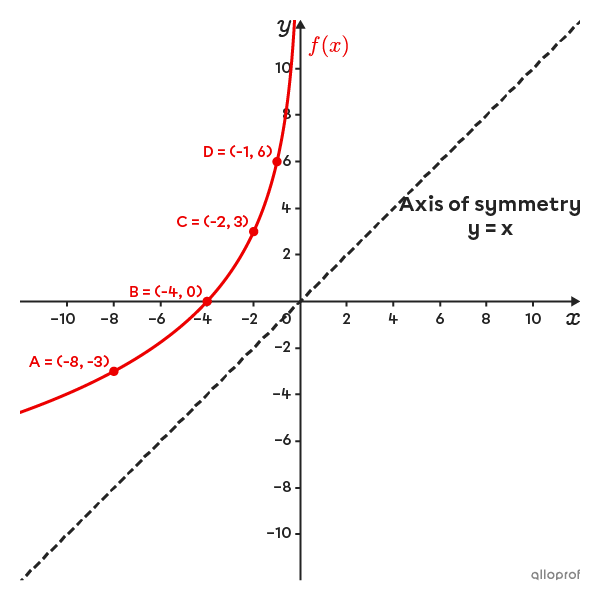 100%
100%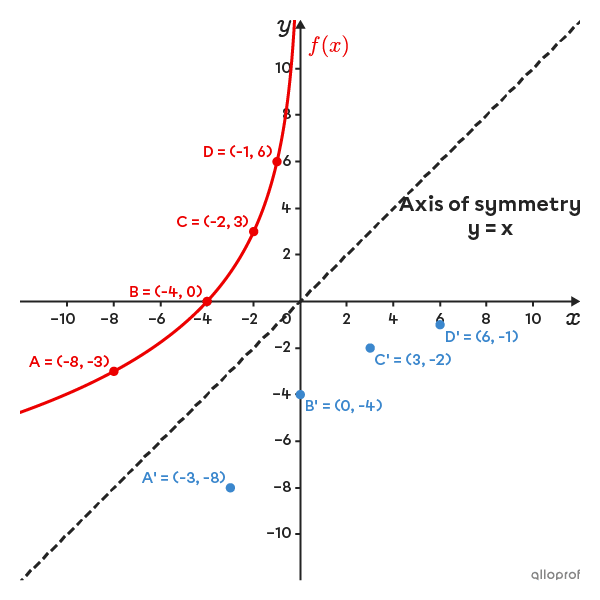 100%
100%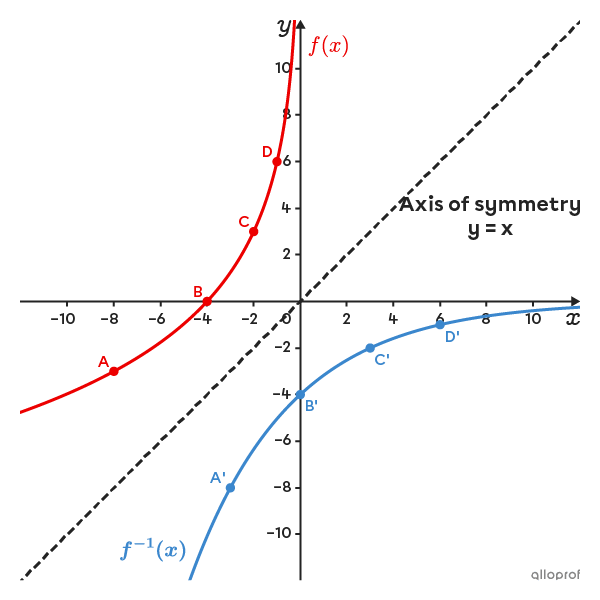 100%
100%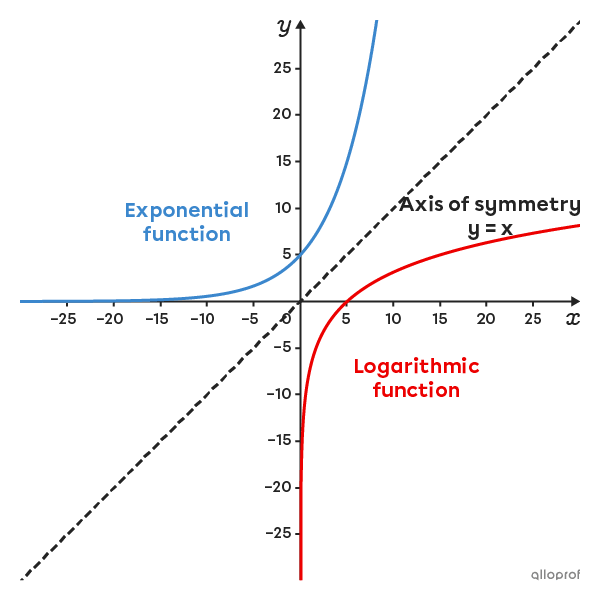 100%
100%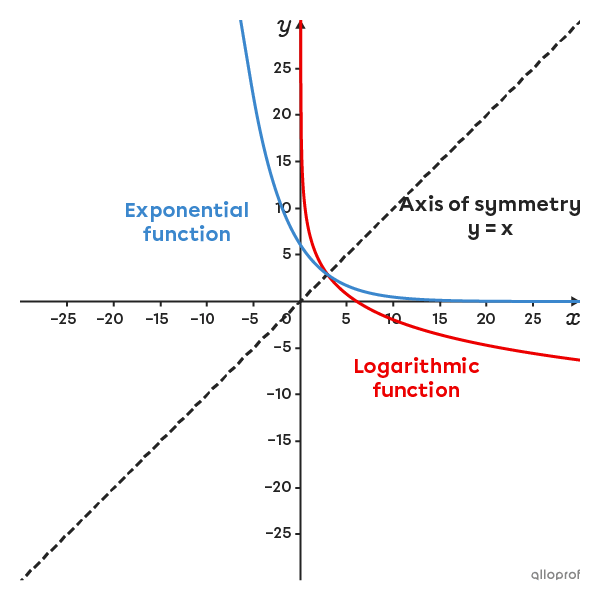
Here are two ways to find the inverse of a logarithmic function:
To determine the inverse of a logarithmic function graphically, you can proceed as follows:
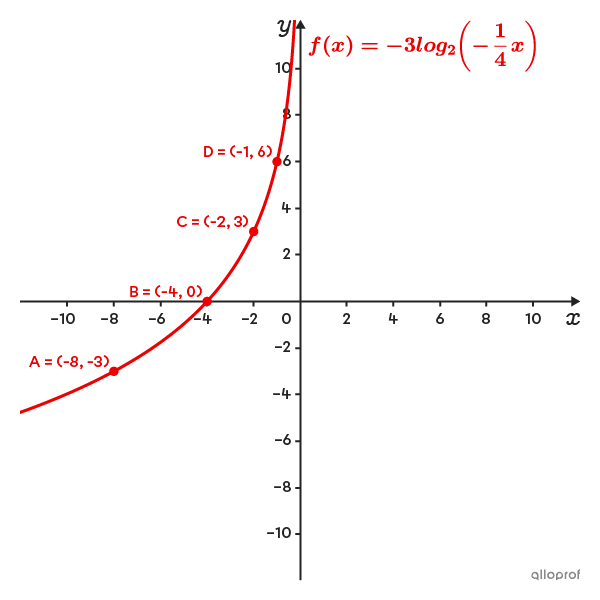
Graph the inverse of the following logarithmic function: ||y = -3\log_2\left(-\dfrac{1}{4}x\right)||
Since there are no given points or table of values, we must use the rule and substitute |x| with any value.
If |x = -8|, we get: ||\begin{align}f(-8) &= -3\log_2\left(-\dfrac{1}{4}\times-8\right)\\
&= -3\log_2\left(2\right)\\
&= -3\times1\\
&= -3\end{align}||
The graph of the logarithmic function therefore passes through point |(-8, -3).| We repeat this for other values of |x| to find other points.

We interchange the |x| and |y| coordinates of the points, then plot them on the graph.
Therefore, we get the inverse of the initial logarithmic function. We can use the points of the inverse to find the rule of this exponential function.
A logarithmic function and its inverse always have the same variation.
To determine the inverse of a logarithmic function algebraically, you can proceed as follows:
Determine algebraically the rule of the inverse of the following logarithmic function.
||f(x)=-4\log_7\left(3(x-6)\right)+8||
||\begin{gather}\boldsymbol{y}=-4\log_7\left(3(\boldsymbol{x}-6)\right)+8
\\\Downarrow\\
\boldsymbol{x}=-4\log_7\left(3(\boldsymbol{y}-6)\right)+8\end{gather}||
||\begin{align}x &= -4\log_7\left(3(y-6)\right)+8\\
x-8 &= -4\log_7\left(3(y-6)\right)\\
-\dfrac{1}{4}(x-8) &= \log_7\left(3(y-6)\right)\end{align}||
||\begin{align}7^{\frac{-1}{4}(x\,-\,8)} &= 3(y-6)\\ \dfrac{7^{\frac{-1}{4}(x\,-\,8)}}{3} &= y-6\\ \dfrac{7^{\frac{-1}{4}(x\,-\,8)}}{3}+6 &= y\\
\dfrac{1}{3}(7)^{\frac{-1}{4}(x\,-\,8)}+6 &= y\end{align}||
Therefore, the rule of the inverse is |f^{-1}(x)=\dfrac{1}{3}(7)^{\frac{-1}{4}(x\,-\,8)}+6.|
If we carefully observe the initial function |\left(f(x)\right)| and its inverse |\left(f^{-1}(x)\right),| this is what we notice:
||f(x)=\boldsymbol{\color{#3A9A38}{a}}\log_\boldsymbol{\color{#FF55C3}{c}}\left(\boldsymbol{\color{#EC0000}{b}}(x-\boldsymbol{\color{#3B87CD}{h}})\right)+\boldsymbol{\color{#FA7921}{k}}\\[5pt]
\Updownarrow\\[5pt]
f^{-1}(x)=\boldsymbol{\color{#3A9A38}{\dfrac{1}{b}}}(\boldsymbol{\color{#FF55C3}{c}})^{\boldsymbol{\color{#EC0000}{\frac{1}{a}}}(x\,-\,\boldsymbol{\color{#3B87CD}{k}})}+\boldsymbol{\color{#FA7921}{h}}||
Find the rule of the inverse of the following logarithmic function:
||f(x)=0.25\log_{10}\left(-\dfrac{2}{7}(x+9)\right)-6||
We can directly find the inverse as follows.
||\begin{gather}f(x)=\boldsymbol{\color{#3A9A38}{0.25}}\log_\boldsymbol{\color{#FF55C3}{10}} \left(\boldsymbol{\color{#EC0000}{-\dfrac{2}{7}}}(x-\boldsymbol{\color{#3B87CD}{-9}})\right)+\boldsymbol{\color{#FA7921}{-6}}\\[3pt]
\Updownarrow \\[3pt]
\begin{aligned}f^{-1}(x)&=\boldsymbol{\color{#3A9A38}{\dfrac{1}{-\frac{2}{7}}}}(\boldsymbol{\color{#FF55C3}{10}})^{\boldsymbol{\color{#EC0000}{\frac{1}{0.25}}}(x\,-\,\boldsymbol{\color{#3B87CD}{-6})}}+\boldsymbol{\color{#FA7921}{-9}}
\\[5pt] &= -\dfrac{7}{2}(10)^{4(x\,+\,6)}-9\end{aligned}\end{gather}||