Subjects
Grades
When two plane figures are similar, there is a ratio of similarity between their corresponding sides (k) and their area (k²). When two solids are similar, there is a similarity ratio between their corresponding edges (k), their corresponding faces (k²) and their volume (k³).
Each of these ratios can be used to find a missing measurement in a figure or a missing measurement in a solid.
The ratios of similarity, area, and volume indicate either an enlargement or a reduction of the image figure with respect to the initial figure.
If the image figure is larger then the initial figure, then:||k=\dfrac{\color{#333fb1}{\text{Image Figure}}}{\color{#3a9a38}{\text{Initial Figure}}}=\dfrac{\color{#333fb1}{\text{Large Figure}}}{\color{#3a9a38}{\text{Small Figure}}}||where |k>1|
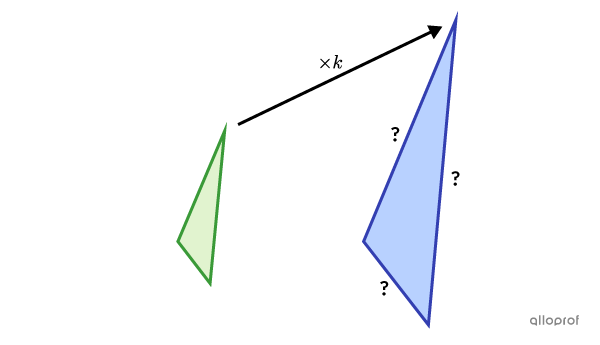
In this case, |k| is an enlargement ratio.
If the image figure is smaller then the initial figure, then:||k=\dfrac{\color{#333fb1}{\text{Image Figure}}}{\color{#3a9a38}{\text{Initial Figure}}}=\dfrac{\color{#333fb1}{\text{Small Figure}}}{\color{#3a9a38}{\text{Large Figure}}}||where |0<k<1|
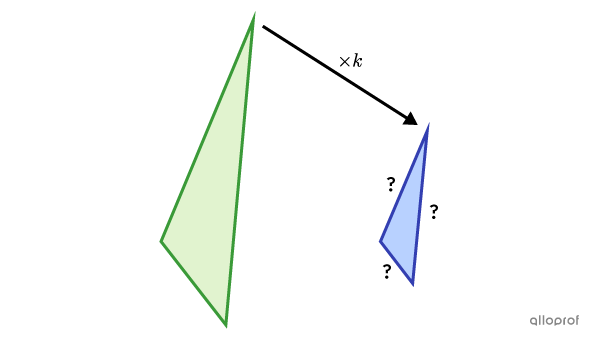
In this case, |k| is a reduction ratio.
Similarity, area, and volume ratios are only valid when comparing corresponding lengths, areas, or volumes. For example, the height of one pyramid with the apothem of another pyramid cannot be compared, because they are not corresponding segments.
The similarity ratio (or scale factor) |\boldsymbol{(k)}| is the relationship between the corresponding lengths (i.e., sides, perimeters, radii, circumference, etc.) of two similar figures.
||k=\dfrac{\text{Length on the image figure}}{\text{Corresponding length on the initial figure}}||or||k=\dfrac{\text{Length on the image solid}}{\text{Corresponding length on the initial solid}}||
The ratio of areas |\boldsymbol{(k^2)}| is a ratio of the corresponding surfaces (areas of plane figures, bases of prisms, side faces of pyramids, etc.) of two similar figures.
||k^2=\dfrac{\text{Area of the image figure}}{\text{Area of the initial figure}}||or||k^2=\dfrac{\text{Face on the image solid}}{\text{Corresponding face on the initial solid}}||
The ratio of volumes |\boldsymbol{(k^3)}| is a ratio of the volumes of two similar solids.
||k^3=\dfrac{\text{Volume of the image solid}}{\text{Volume of the initial solid}}||
The following interactive tool illustrates what happens to lengths, areas, and volumes when changing the value of |k.|
How many times does the green length fit into the blue length?
How many times does the green square fit into the blue square?
How many times does the green cube fit into the blue cube?
When the value of one of the 3 ratios is known, it is possible to find the value of the other 2 using the properties of exponents and roots. The following diagram summarizes the operations necessary to change from one ratio to the other.
To correctly use the diagram, it is essential to follow the direction of the arrows. For example, to go from |k^3| to |k^2,| follow the path |k^3\rightarrow k\rightarrow k^2.|

Here is how to proceed when looking for missing measurements using |k,| |k^2| and |k^3.|
Identify the ratio required to find the missing measure
Calculate the ratio required to find the missing measure using the relationships between the ratios.
Calculate the missing measure.
The following similar solids are regular polyhedra called octahedra.
Find the measure of the edges and the volume of the orange octahedron and the light blue octahedron.
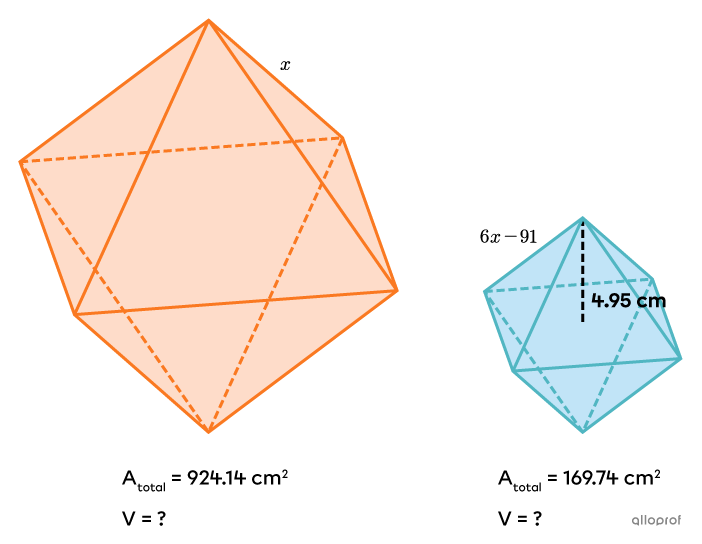
In the last example, the value of |k^3| used to calculate the volume of the orange octahedron is a reduction ratio |\left(0<\dfrac{27}{343}<1\right).| Since the orange octahedron is larger than the pale blue octahedron, we can also use the reciprocal of |\dfrac{27}{343}| to use an enlargement ratio. The approach would have been the following.
||\begin{align}\dfrac{1}{k^3}&=\dfrac{\color{#fa7921}{\text{Volume of the Initial Octahedron}}}{\color{#51b6c2}{\text{Volume of the Image Octahedron}}}\\\dfrac{343}{27}&=\dfrac{\color{#fa7921}V}{\color{#51b6c2}{161.7}}\\343\times161{,}7&=V\times27\\\color{#ec0000}{\dfrac{\color{black}{343\times161.7}}{27}}&=\color{#ec0000}{\dfrac{\color{black}{V\times27}}{27}}\\2\ 054.19\ \text{cm}^3&\approx V\end{align}||