Subjects
Grades
 100%
100%
 100%
100%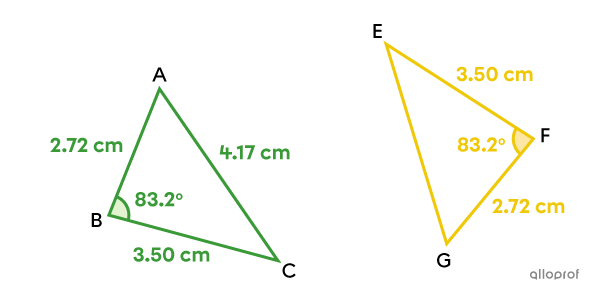 100%
100%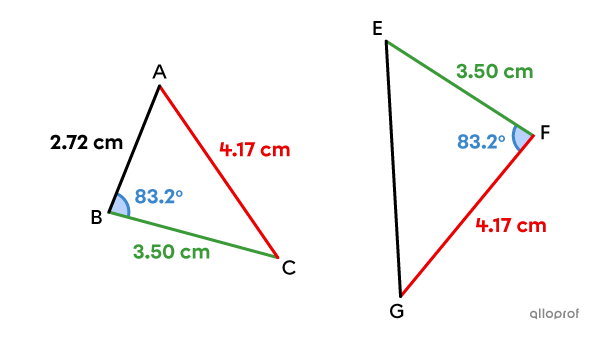 100%
100%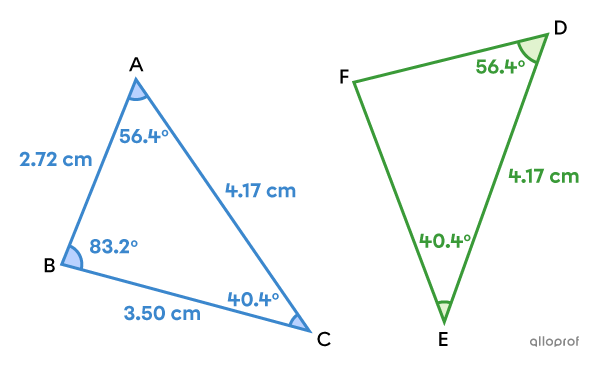 100%
100%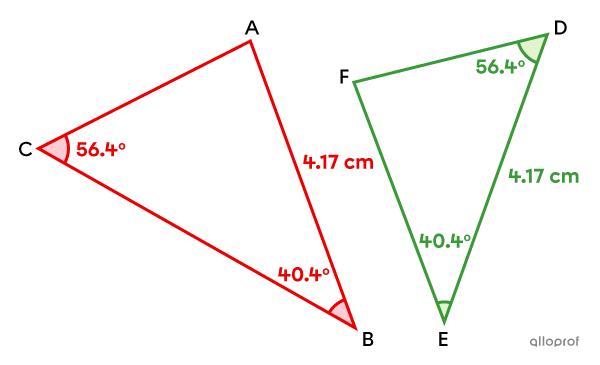 100%
100% 100%
100% 100%
100%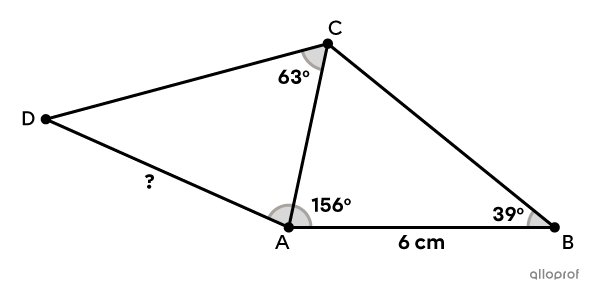 100%
100%
When comparing polygons, we can determine if they are congruent (isometric) figures by checking if they have congruent corresponding angles and sides. The same is true for triangles. Fortunately, to prove that two triangles are congruent, it is not necessary to know the measure of all the sides and angles. It is enough to check that certain minimal conditions are met. These are called the minimum conditions for congruent triangles.
The minimal conditions for congruent triangles allow us to prove that triangles are congruent using the fewest possible pieces of information.
There are 3 minimal conditions to prove the congruence of triangles. There are also minimal conditions for proving the similarity of triangles. We use the most appropriate condition depending on the information provided in the problem and we organize our argument in a table of statements and justifications.
We can explain why the minimal conditions are sufficient to assert that triangles are congruent (isometric) by examining the construction of the triangles in question.
Triangles are congruent (isometric) if and only if their corresponding sides are congruent.
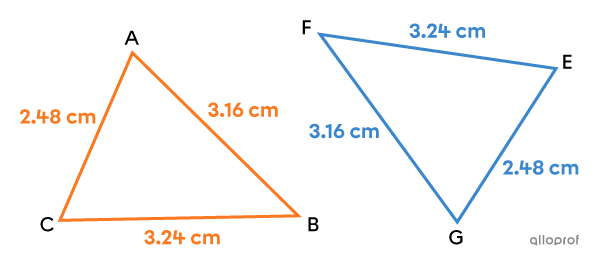
The condition SSS (Side-Side-Side) does not involve any angle measure. In fact, it is enough to know that the 3 pairs of corresponding sides have the same measure to conclude that the triangles are congruent.
Prove that the following triangles |ABC| and |GFE| are congruent.

| Statement | Justification | ||
|---|---|---|---|
|
1 |
Segments |\overline{AC}| and |\overline{EG}| are congruent. |
S |
By hypothesis. |
|
2 |
Segments |\overline{AB}| and |\overline{FG}| are congruent. |
S |
By hypothesis. |
|
3 |
Segments |\overline{BC}| and |\overline{EF}| are congruent. |
S |
By hypothesis. |
|
4 |
Triangles |ABC| and |GFE| are congruent. |
They satisfy the minimal condition SSS: triangles are congruent if and only if their corresponding sides are congruent. |
|
Before starting a proof of congruence (isometry), it is important to identify the pairs of corresponding sides. In the previous example, the 2 triangles are associated by a rotation. The segments |\overline{AC}| and |\overline{GE}| are corresponding, because each segment is the smallest side of its triangle. We apply the same reasoning for the 2 other pairs of corresponding sides.
Triangles are congruent (isometric) if and only if they have a pair of congruent angles located between 2 pairs of corresponding congruent sides.
Prove that the following triangles |ABC| and |GFE| are congruent.
| Statement | Justification | ||
|---|---|---|---|
|
1 |
Segments |\overline{AB}| and |\overline{FG}| are congruent. |
S |
By hypothesis. |
|
2 |
Angles |ABC| and |GFE| are congruent. |
A |
By hypothesis. |
|
3 |
Segments |\overline{BC}| and |\overline{EF}| are congruent. |
S |
By hypothesis. |
|
4 |
Triangles |ABC| and |GFE| are congruent |
They satisfy the minimal condition SAS: triangles are congruent if and only if they have a pair of congruent angles located between 2 pairs of corresponding congruent sides. |
|
The chosen angle must be formed by the corresponding pairs of congruent sides. If the angle is not in the right place, the 2 triangles are not necessarily congruent.
For example, in the image above, |\angle{ABC}| and |\angle{EFG}| have the same measure. However, angle |ABC| is located between the sides measuring |2.72| and |3.50\ \text{cm},| whereas angle |EFG| is located between the sides measuring |4.17| and |3.50\ \text{cm}.| Therefore, the 2 triangles are not congruent.
||\triangle ABC\color{#ec0000}\not\cong\triangle EFG||
Triangles are congruent (isometric) if and only if they have a pair of congruent sides located between 2 pairs of corresponding congruent angles.
Prove that the following triangles |ABC| and |DFE| are congruent.
| Statement | Justification | ||
|---|---|---|---|
|
1 |
Angles |BAC| and |EDF| are congruent. |
A |
By hypothesis. |
|
2 |
Segments |\overline{AC}| and |\overline{DE}| are congruent. |
S |
By hypothesis. |
|
3 |
Angles |ACB| and |DEF| are congruent. |
A |
By hypothesis. |
|
4 |
Triangles |ABC| and |DEF| are congruent. |
They satisfy the minimal condition ASA: triangles are congruent if and only if they have one pair of congruent sides located between 2 pairs of corresponding congruent angles. |
|
The location of the pairs of corresponding sides and angles in the triangles is critical. If the pair of corresponding sides is not located between the 2 pairs of corresponding angles, then the 2 triangles are not necessarily congruent (isometric).
For example, in triangle |ABC,| the side that measures |4.17\ \text{cm}| is not located between the angles of |40.4^\circ| and |56.4^\circ,| while it is in triangle |DEF.| The triangles |ABC| and |DEF| are therefore not congruent.
||\triangle ABC\color{#ec0000}\not\cong\triangle DEF||
It is possible to use the minimal conditions for congruence of triangles as well as the properties of quadrilaterals to construct proofs.
The following quadrilateral |ABCD| is a rectangle.
Prove that the triangles |ABC| and |CDA| are congruent.
The following quadrilateral |ABCD| is a parallelogram. |M| is the intersection point of the 2 diagonals |\overline{BD}| and |\overline{AC}.|
Prove that the triangles |BCM| and |DAM| are congruent.
After having proved that triangles are congruent, we can find missing measurements of either of the triangles. Here is an example where we use the minimal conditions to find a missing measurement.
We must first prove that the triangles are congruent using the information provided in the problem before calculating missing measurements.
Find the measure of |\overline{AD}| given that |\overline{AC}| is the bisector of angle |DAB.|
Here is an example where we use the minimal conditions of congruence to complete a proof.
In the following figure |ABCD,| |\overline{AD}| and |\overline{BC}| are parallel and |E| is the midpoint of |\overline{AC}.|
Prove that the quadrilateral |ABCD| is a parallelogram.