Subjects
Grades
 100%

 100%

It was Antoine Laurent de Lavoisier who formulated the law conservation of matter:
During a transformation, matter is neither created nor destroyed, but is transformed from its initial state to a final state.
“Nothing is lost, nothing is created, all is transformed.”
This law indicates that the number of atoms of each type is the same before and after a transformation. The same is true for mass. The mass of the reactants before a transformation is the same as the mass of the products at the end of the transformation.
In a physical change, the mass of the reactants and the products remains the same, because they contain the same substances at the beginning as at the end of the reaction.
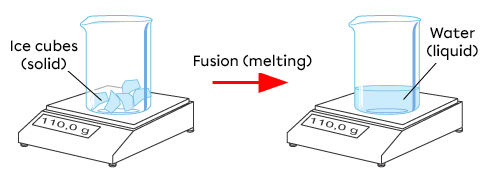
This principle can be easily observed by weighing a closed beaker filled with ice and weighing it again after the ice melts. The total mass before and after the physical change is the same.
During a chemical change, mass is also conserved. Just as in a physical change, the mass of the reactants before the reaction is the same as the mass of the products at the end of the reaction. This is because the same atoms are present at the beginning and at the end of the reaction. However, during a chemical change, the atoms rearrange themselves to form new substances.
A sodium sulfate solution |(\text{Na}_2\text{SO}_{4_\text{(aq)}})| reacts with a calcium chloride solution |(\text{Ca}\text{Cl}_{2_\text{(aq)}})|. The reaction produces a white precipitate of calcium sulfate |(\text{Ca}\text{SO}_{4_\text{(s)}})| as well as sodium chloride in solution |(\text{Na}\text{Cl}_\text{(aq)})|.

Before the reaction, the scale shows a mass of |455.13\ \text{g}.| Once the reaction is complete, the mass is still |455.13\ \text{g}.| Indeed, mass is conserved.

Moments in the video :