Subjects
Grades
Fission and fusion are two types of nuclear transformations, which means they involve the nucleus of atoms.
Nuclear fission involves splitting of the nucleus of an atom into several lighter nuclei. The transformation can also generate other subatomic particles.
In nature, radium |(\text{Ra})| is present in soil and rocks and decays into radon |(\text{Rn}),| a natural radioactive gas. The transformation can be expressed as follows.
||^{226}_{88}\text{Ra}\rightarrow\ ^{222}_{86}\text{Rn}+\ ^{4}_{2}\text{He}||
The decay generates alpha radiation |(\alpha).|
Radon is found in varying concentrations in the soil and it can infiltrate and accumulate in homes, mainly in basements without adequate ventilation.
Prolonged exposure to radon is the leading cause of lung cancer in non-smokers.
The artificial nuclear fission of uranium is used to generate electricity, because it releases a lot of energy from a relatively small amount of uranium.
Uranium isotopes decay in several different ways. Here is one example from uranium-236.
||^{236}_{92}\text{U}\rightarrow\ ^{141}_{56}\text{Ba}+\ ^{92}_{36}\text{Kr}+3\,^{1}_{0}\text{n}||
The isotopes of uranium-238 (very abundant) and uranium-235 (very unstable) are mainly used as fuel in the reactor of a nuclear power plant.
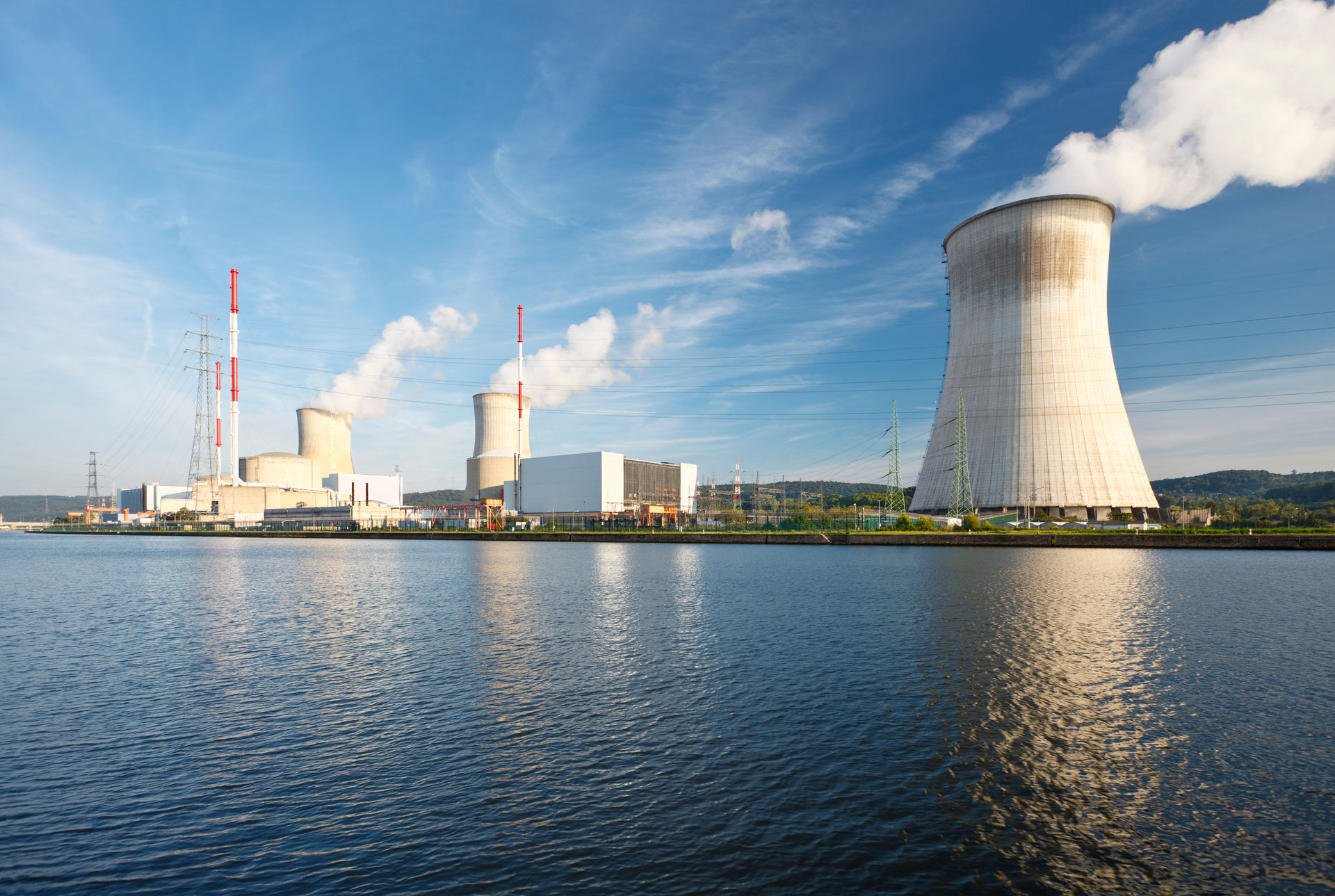

Nuclear power plant
The nuclear fission of uranium-236 can be initiated by adding a neutron to a uranium-235 atom to temporarily form uranium-236. The initial reaction is conducted according to the following equation.
||^{235}_{92}\text{U}+\ ^{1}_{0}\text{n}\rightarrow\ ^{236}_{92}\text{U}||
When the nucleus of uranium-236 disintegrates for the first time, 3 neutrons are released. The 3 neutrons can combine with other uranium-235 nuclei to form 3 new uranium-236 nuclei.
It triggers the nuclear fission of the 3 nuclei of uranium-236, then 9 nuclei, 27 nuclei, 81 nuclei, 243 nuclei and so on. It is called a chain reaction.
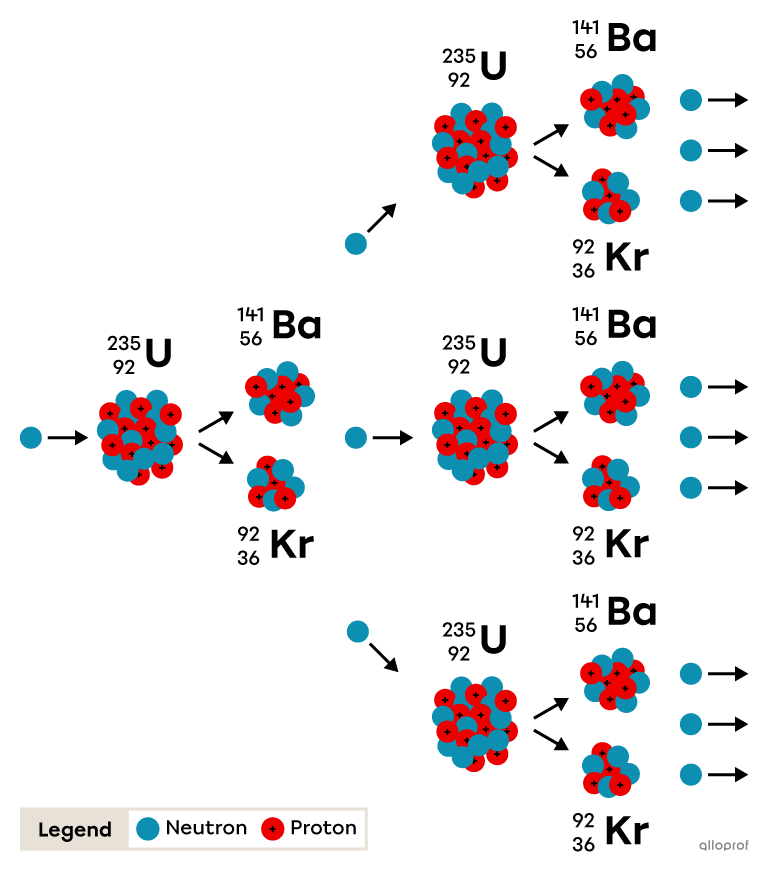
Illustration of the nuclear fission of uranium-236 from uranium-235
Nuclear fusion is the combination of smaller atomic nuclei to form a larger nucleus. The transformation can also generate subatomic particles.
The Sun's energy is generated by the nuclear fusion of hydrogen atoms to form helium.
||4\,^{1}_{1}\text{H}\rightarrow\ ^{4}_{2}\text{He}+2\,^{0}_{1}\beta||
During the reaction, 4 protons from 4 distinct hydrogen atoms are converted into 2 protons and 2 neutrons within the same helium nucleus.
The transformation releases beta particles |(\beta)| as well as phenomenal amounts of energy in the form of electromagnetic radiation (heat, visible light, etc.).

The Sun
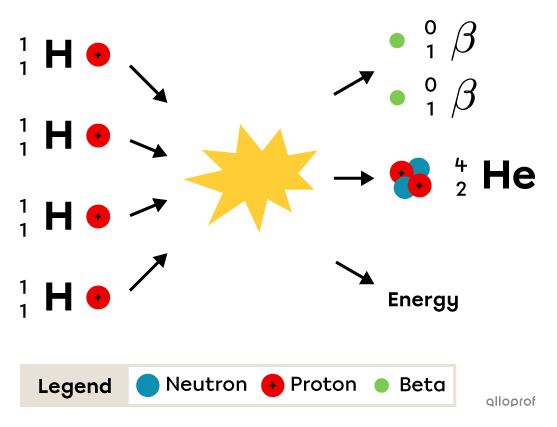
Illustration of nuclear fusion in the sun
The reaction emits beta particles |(\beta)| energy, as well as neutrinos.
The hydrogen bomb (H-bomb) uses nuclear fusion. Several complex transformations take place, such as the fusion of deuterium and tritium, both hydrogen isotopes.
||^{2}_{1}\text{D}+\ ^{3}_{1}\text{T}\rightarrow\ ^{4}_{4}\text{He}+\ ^{1}_{0}\text{n}||
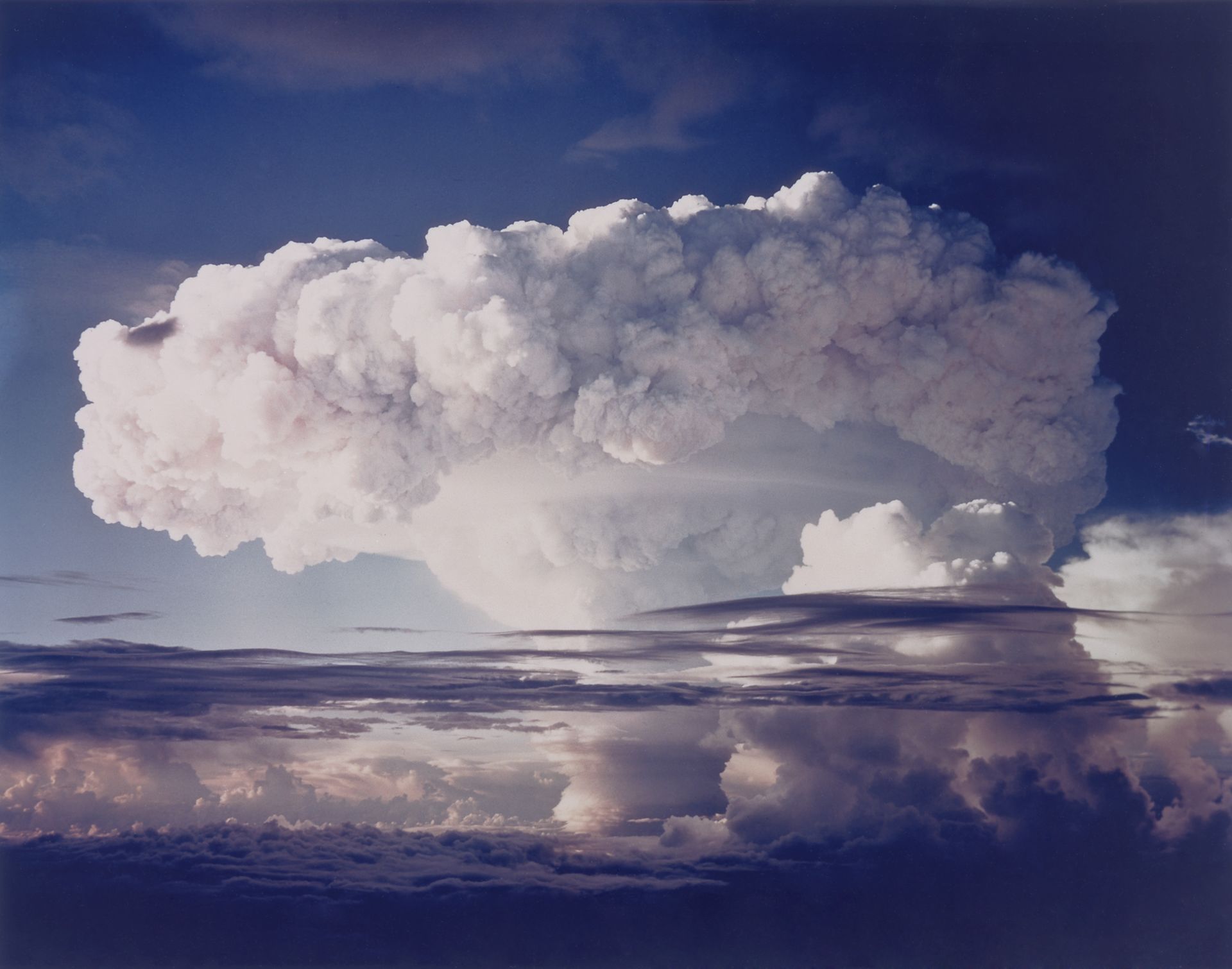
The Ivy Mike H-bomb on November 1, 1952
The principles of nuclear fusion have been on scientists’ radar for several years with the objective of harnessing the energy released following the nuclear fusion of atomic nuclei in order to generate electricity. Less environmentally damaging than nuclear fission, fusion could be a sustainable option for generating electricity for future generations.
The stars are a good example of the amount of energy that can be continuously generated by nuclear fusion reactions occurring within these celestial bodies. To reproduce the reaction in the lab, many technological challenges need to be overcome. Scientists must:
Ensure the fusion reaction occurs continuously.
Enable the fusion reaction to produce more energy than it takes to trigger the reaction.
Research laboratories around the world are studying this possibility. The National Ignition Facility is one such lab. At present, nuclear fusion reproduced in the laboratory is not an efficient process. However, the good news is that researchers are getting closer every day to making the process more efficient.